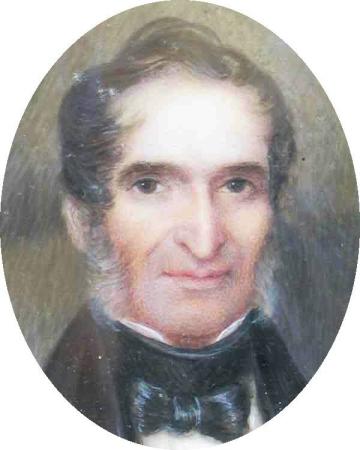
Who he was
Christian Gobrecht did not set out to make coins. He set out to make clocks.
Born in Hanover, Pennsylvania, in December 1785, he was apprenticed young to the clockmaking trade in nearby Manheim. That schooling — cutting tiny, precise figures into brass and steel — turned out to be the perfect training for a man who would one day cut faces into coin dies. (A die is the hardened steel stamp that strikes a coin's image; engraving one is unforgiving work, because every flaw multiplies across every coin it makes.)
By his twenties he was engraving ornamental clockwork in Baltimore, then moved to Philadelphia, and by 1816 he had joined Murray, Draper, Fairman & Company — one of the great American bank-note engraving houses of the day. Bank notes were where the finest engravers earned their living, and Gobrecht's hand was good enough to belong there.
He was also a restless inventor. He built a medal-ruling machine — a device that could trace the relief of a medal and reproduce it as a flat engraving — around 1810 and refined it for years. He tinkered with the camera lucida, a drawing aid; he is even credited with a talking doll and a reed organ. This was a craftsman who liked to make machines that made art.
The U.S. Mint pulled him in slowly. He sold lettering and numeral punches to the Mint in the 1820s, and when Chief Engraver Robert Scot died in 1823 Gobrecht applied for the post — and lost it to William Kneass. He stayed in Kneass's orbit. Then, in August 1835, Kneass suffered a stroke that left him unable to work. The Mint needed a steady hand, fast. In September 1835 Gobrecht was hired as "Second Engraver," and from that moment most of the Mint's design work flowed through him. Five years later, on December 21, 1840, he was finally named the third Chief Engraver of the United States. He held the office until he died, in Philadelphia, in July 1844.