Era
Postwar America: The Silver Years
The boom, the Cold War, and a president's death — all in the change in your pocket, 1946 to 1964.
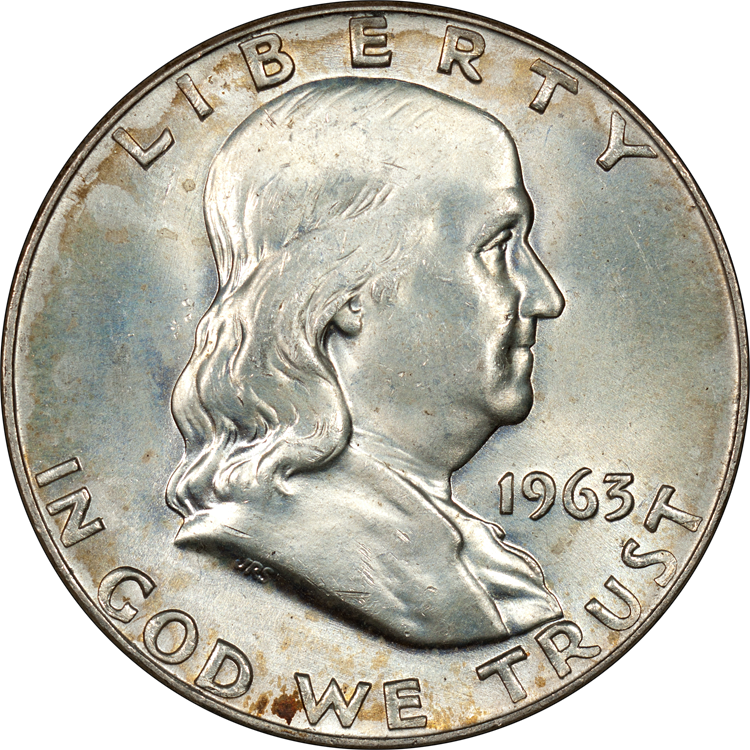
For one generation, ordinary American pocket change was real silver. A dime, a quarter, a half dollar — each carried 90% silver and a small piece of the era's story. Then, almost overnight, the silver disappeared. This is how that happened.
The world then
Picture a country that had just won a war and didn't quite know what to do with the energy. Between 1946 and 1964, America boomed. Gross national product climbed from roughly $200 billion in 1940 to over $500 billion by 1960. Returning soldiers bought houses with cheap mortgages. The number of cars built each year quadrupled between 1946 and 1955. Suburbs spread, televisions arrived, and a baby boom filled them.
It was also the Cold War. The same years brought the bomb, the Red Scare, the space race, and a low hum of dread under the prosperity. That tension shows up in odd corners — including, as you'll see, a conspiracy theory about a dime and an anti-communist slogan very nearly stamped onto a coin.
And under all of it ran something quieter and older: silver. The coins that paid for the groceries, the movies, and the parking meters were 90% silver and 10% copper — the same recipe the U.S. Mint had used for generations. Nobody thought twice about it. A quarter was a quarter. That assumption was about to break.
The money
The coins of these years read like a memorial wall. The Mint kept using them to honor the dead and to mark the moment.
The story opens with grief. Franklin Roosevelt died in April 1945, and within months the Mint replaced the old "Mercury" dime with his portrait. The dime — not the quarter, not the half — was a deliberate choice. Roosevelt had helped found the March of Dimes, the campaign against polio, the disease that had paralyzed his legs since 1921. Chief Engraver John R. Sinnock designed it; the reverse — the "tails" side — carries a torch for liberty, an olive branch for peace, and an oak branch for strength, a quiet salute to a war just won. The first dimes were struck on January 19, 1946, and released on January 30 — what would have been Roosevelt's birthday.
Sinnock's initials, "JS," sat on the obverse — the "heads" side. In the paranoia of the early Cold War, some Americans decided the letters stood for Joseph Stalin, smuggled onto U.S. coinage by communist sympathizers. The Mint actually sent out press releases to debunk it; the rumor lingered into the 1950s anyway. It was, of course, nonsense — the engraver's initials, nothing more.
Two years later came an oddity: a coin honoring a man who was never president. In 1948 the half dollar took on the face of Benjamin Franklin, championed by Mint Director Nellie Tayloe Ross, who admired him. On the reverse sat the Liberty Bell — crack and all. The Commission of Fine Arts, the federal panel that advises on public art, hated it: the crack, they warned, would invite jokes and "statements derogatory to United States coinage," and the small eagle squeezed in beside the bell (required by law on coins above a dime) looked "insignificant." The Mint overruled them and struck it anyway. Sinnock had died in May 1947 before finishing the design; his successor, Gilroy Roberts, completed it — a handoff that would echo a decade later.
Because in November 1963, the Mint had to do it all again, and fast. President John F. Kennedy was assassinated on November 22. Within weeks, Congress moved to put him on a coin, and the bill passed on December 30, 1963. There was no time to start from scratch. Gilroy Roberts — the same engraver who finished Franklin's half — adapted the portrait he'd already made for Kennedy's inaugural medal. His assistant Frank Gasparro built the reverse from the Presidential Seal. Kennedy's widow, Jacqueline, reviewed the designs and asked only that the hair be softened slightly. The choice of denomination was hers too: she did not want to displace George Washington on the quarter, so the half dollar — Franklin's half — gave way to Kennedy. The Treasury released the coin on March 24, 1964. Almost 430 million were struck that year. And here the era's ending begins.
The coins of this era
If you had emptied your pockets onto a kitchen table in 1955, you'd have held the everyday story in your hand. Five faces, five chapters of American history, jingling together.
Three of them were the silver. The Roosevelt dime, designed by John R. Sinnock, arrived in 1946. The Washington quarter, by sculptor John Flanagan, had run in 90% silver since 1932 and kept right on going. And the half dollar carried whichever portrait the decade demanded: Adolph A. Weinman's lovely Walking Liberty, struck through 1947; then Sinnock's Franklin half from 1948; then, after Dallas, the Kennedy half of 1964. Same denomination, different hands, one unbroken seam of silver running through all of it.
Two coins in that handful were not silver, and that's part of the story too. The Jefferson nickel — Felix Schlag's 1938 design — was copper-nickel, the everyday metal it had always been. (Its brief turn as a silver "war nickel" had ended in 1945, just before this era opened.) And the humble cent stayed copper throughout: Victor David Brenner's Lincoln looked out from the obverse the whole time, while the reverse turned a page mid-era. The wheat ears Brenner drew in 1909 — the Lincoln Wheat cent — gave way in 1959, Lincoln's 150th birthday, to Frank Gasparro's Lincoln Memorial cent. The same young engraver who built Kennedy's eagle had quietly reworked the most common coin in the country.
But the table didn't hold the whole story, because two of this era's coins almost never reached a pocket at all. Alongside the workaday change, the Mint struck two silver commemorative half dollars — collector coins, sold by mail at a premium, never meant to circulate — and they carry the era's conscience.
The first was the Booker T. Washington half dollar, struck from 1946 to 1951. Its obverse shows the educator who rose, as the reverse legend puts it, "From slave cabin to Hall of Fame" — the small log cabin where he was born set against the Hall of Fame for Great Americans. It was designed by Isaac Scott Hathaway, an African American artist and educator; sculptor Charles Keck had been commissioned first, but his models went unused (he was paid anyway). Money from the coin went to buy and preserve Washington's Virginia birthplace. Hathaway returned for the sequel: the Washington-Carver half dollar of 1951 to 1954, which pairs Booker T. Washington with the agricultural scientist George Washington Carver in profile, over a plain outline map of the United States and the words "Freedom and Opportunity for All / Americanism." Here the Cold War crept right onto the coinage — one stated aim of the program was "to oppose the spread of Communism among" African Americans, and early concepts even floated the inscription "United Against the Spread of Communism." Both coins were 90% silver, so they belong to the same metallic seam as the dime and the half. And the Washington-Carver coin earned a quiet distinction: when its run ended in 1954, it was the last U.S. commemorative coin for twenty-eight years — none more until 1982. The era's silver and the country's first long chapter of commemoratives went dark together.
That is the thread. A boom that minted hundreds of millions of coins. A run of national grief — a dead president, an assassinated one — and a reckoning with race, all written onto the money. And underneath, the slow squeeze of a rising silver price that would, by 1965, strip the silver out of the dime and quarter and gut the half. These coins fit together because they shared a metal, a moment, and a Mint working under pressure. They are the last American change that was worth melting.
One honest note for the curious: the quarter, the half dollar, and the cent are old denominations with long lives. The faces above belong to the silver years, but the same series carry work by engravers from far earlier and from later decades. Follow the links below to meet the designers whose hands shaped this era's coins; here, we've stayed on the coins themselves — the ones that rode in a 1950s pocket, and the two that rode out to collectors by mail.
A timeline of the silver years
- 1946Roosevelt dime debuts, released on FDR's birthday — the March of Dimes coin. The Booker T. Washington commemorative half dollar also begins its run.
- 1947Last Walking Liberty half dollars are struck, closing a design begun in 1916.
- 1948Franklin half dollar arrives — first non-president on a regular U.S. coin, Liberty Bell and all.
- 1951The Washington-Carver half dollar begins, pairing Booker T. Washington and George Washington Carver — a commemorative shaped by Cold War politics.
- 1954Washington-Carver half ends — the last U.S. commemorative coin for the next 28 years.
- 1959Lincoln cent's wheat reverse retires for Frank Gasparro's Lincoln Memorial on Lincoln's 150th birthday.
- 1963JFK assassinated Nov 22; Congress authorizes the Kennedy half dollar on Dec 30.
- 1964Kennedy half released March 24 — the last circulating 90% silver half. Nearly 430 million struck, and almost none seen in pockets.
- 1965Coinage Act of 1965 signed July 23 — silver removed from dimes and quarters, halved in the half dollar.
- 1968Treasury stops propping up the silver price; the old 90% coins are gone from circulation for good.
Key facts
- Region
- United States
- Span
- 1946–1964 (90% silver circulating coinage)
- Standard composition
- 90% silver, 10% copper
- Signature coins
- Roosevelt dime, Franklin half dollar, 1964 Kennedy half dollar
- Silver commemoratives
- Booker T. Washington half (1946–1951); Washington-Carver half (1951–1954)
- Designers
- Sinnock, Roberts, Gasparro, Flanagan, Schlag, Brenner, Hathaway
- The turning point
- Coinage Act of 1965 — signed July 23, 1965
Why it fascinates collectors
The silver years are where most American collectors start, and many never leave. The reason is simple: this is the last coinage that was worth something as metal. Pull a pre-1965 dime, quarter, or half from a jar today and you're holding bullion as well as history. Dealers call common-date examples "junk silver" — an affectionate insult, because there's nothing junky about it.
But it's the disappearance that gives the era its drama. Silver prices were rising. Once the metal in a coin was worth more than its face value, people stopped spending those coins and started saving — or melting — them. Economists have a name for this, Gresham's law: bad money drives out good. People hand over the cheap money and keep the valuable kind. So the gleaming new 1964 Kennedy halves — nearly 430 million of them — barely circulated at all. They went straight into drawers and coffee cans, where many still sit.
That set up the end. The Coinage Act of 1965, signed by President Lyndon Johnson on July 23, stripped the silver out of dimes and quarters entirely and cut the half dollar from 90% to 40%. Johnson argued in his message to Congress that "the metal necessary for industry must not be wasted as a means of exchange." The new coins were copper-nickel "clad" — a copper core sandwiched between nickel-alloy faces. They worked fine. But the romance was over.
For the collector, that hard stop is the gift. The series are finite. The Franklin half ran only from 1948 to 1963 — short and complete. The chase isn't usually about rare dates; it's about condition. The prize term is Full Bell Lines (FBL): a Franklin half struck so crisply that the parallel lines across the bottom of the Liberty Bell survive unbroken. A worn die or a soft strike blurs them. A 1953-S in Full Bell Lines is genuinely scarce, with only a few dozen ever certified — proof that even a "common" coin can become a quiet trophy when the strike is perfect. The two silver commemoratives play a different game: they were sold in three-coin Philadelphia-Denver-San Francisco sets, so collectors hunt the low-mintage years and mint marks rather than the strike — and, as Isaac Scott Hathaway's work, they carry a history far larger than their face value.
Questions collectors ask
Are dimes, quarters, and half dollars from before 1965 really silver?
Yes. From 1946 to 1964, U.S. dimes, quarters, and half dollars were struck in 90% silver and 10% copper. The Coinage Act of 1965 removed the silver from dimes and quarters and cut the half dollar to 40% silver. So 1964 and earlier is the line collectors watch for.
Why was the 1964 Kennedy half so hard to find in change?
Silver prices were climbing, so a coin's metal was becoming worth more than its 50-cent face value. People saved and hoarded the new memorial halves rather than spending them. Nearly 430 million were struck for 1964, yet they were rarely seen in circulation — a textbook case of Gresham's law, where people keep the valuable money and pass along the cheaper kind.
Which coins of this era were not silver?
The cent and the nickel. Lincoln's bronze cent stayed copper throughout, with the wheat reverse giving way to the Lincoln Memorial in 1959. The Jefferson nickel was copper-nickel — its short-lived silver 'war nickel' alloy had ended in 1945, just before this era began. Only the dime, quarter, and half dollar carried 90% silver — along with two silver commemorative half dollars sold to collectors.
Why does a non-president like Benjamin Franklin appear on the half dollar?
Mint Director Nellie Tayloe Ross admired Franklin and pushed to honor him. The 1948 Franklin half made him the first non-president on a regular-issue U.S. coin. The reverse shows the Liberty Bell — crack included — over the objections of the Commission of Fine Arts, which feared it would invite ridicule.
Did the Roosevelt dime designer really hide Joseph Stalin's initials on the coin?
No. The 'JS' on the obverse is the designer's monogram — John R. Sinnock. In the Cold War climate, a rumor spread that the letters stood for Joseph Stalin, and the Mint issued press releases to knock it down. It is a Cold War legend, not a fact.
What does 'Full Bell Lines' mean on a Franklin half dollar?
It describes a sharp strike in which the horizontal lines across the bottom of the Liberty Bell are complete and unbroken. A weak strike or worn die blurs them. Full Bell Lines examples are scarcer and can command large premiums, especially for dates like the 1953-S.
What are the Booker T. Washington and Washington-Carver half dollars?
Two 90% silver commemorative half dollars of this era, both designed by African American artist Isaac Scott Hathaway. The Booker T. Washington half (1946–1951) honors the educator with his birth cabin and the legend 'From slave cabin to Hall of Fame.' The Washington-Carver half (1951–1954) pairs Washington with scientist George Washington Carver; its program was framed partly as opposing the spread of communism. When the Carver-Washington run ended in 1954, it was the last U.S. commemorative coin until 1982.
Sources
- Wikipedia — Roosevelt dime
- Wikipedia — Franklin half dollar
- Wikipedia — Kennedy half dollar
- Wikipedia — Washington quarter
- Wikipedia — Jefferson nickel
- Wikipedia — Booker T. Washington Memorial half dollar
- Wikipedia — Carver-Washington half dollar
- U.S. Mint — Booker T. Washington Memorial Half Dollar
- U.S. Mint — Carver-Washington Half Dollar
- Wikipedia — Coinage Act of 1965
- CoinWeek — 1959 Lincoln Memorial Cent Collector Guide
- CoinWeek — Franklin Half Dollar Collector Guide
- CoinWeek — 1964 Kennedy Half Dollar: A Collector's Guide
- National Park Service — Minting a Legacy: The History of the Kennedy Half Dollar
- PCGS — 1964: A Pivotal Year
- University of Groningen — The Postwar Economy: 1945–1960