US coin · series

The Franklin Half Dollar

A Founding Father, a cracked bell, and an eagle nobody asked for — silver from 1948 to 1963.

The Franklin Half Dollar
John Baumgart (Variety Slabbing Service) for the image; John R. Sinnock for the coin design · public domain · source

For sixteen years, Americans carried Benjamin Franklin and a cracked Liberty Bell in their pockets. It is the only regular U.S. coin to honor a Founding Father who was never president — and the art board nearly killed it over that crack.

The story behind the coin

A Mint director wanted Benjamin Franklin on a coin, and she got her way.

Nellie Tayloe Ross ran the U.S. Mint for two decades — the first woman to do so — and she had long admired Franklin. In the mid-1940s she told the Mint's chief engraver, John R. Sinnock, to design a half dollar around him. There was no act of Congress behind it. The half dollar's design had been in circulation long enough that the Mint could change it on its own authority, and Ross simply chose to.

That choice was quietly radical. Franklin was a printer, a scientist, a diplomat — and never president. Putting him on circulating coinage broke the unwritten habit of reserving that honor for presidents and allegorical figures of Liberty. It made him the first real historical American, rather than a symbol, to ride a coin into everyday pockets — and to this day he is the only Founding Father so honored on a coin meant to spend.

The timing fit the moment. America had come out of the war as the world's creditor, its silver dollars and halves backed by a Treasury flush with metal. A confident postwar country was happy to mint its own history in silver — and a thinker on a coin, rather than a general, suited a nation that had just won and now wanted to build.

The design and who made it

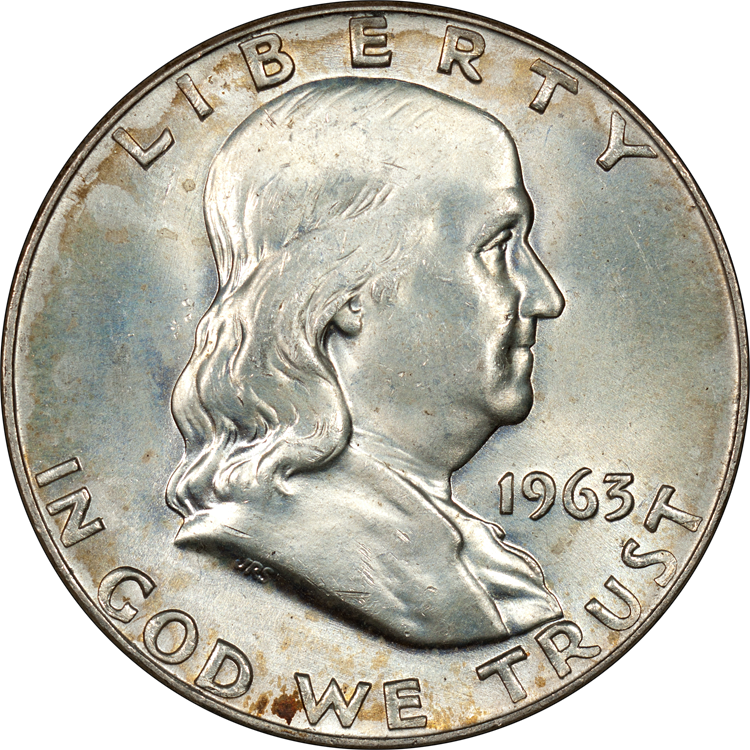
The obverse — the heads side — carries Franklin's bust in profile, drawn from a classic Houdon sculpture, with "LIBERTY" above and "IN GOD WE TRUST" below. The reverse — the tails side — shows the Liberty Bell, crack and all, the very bell that the Mint sits a short walk from in Philadelphia.

That crack caused trouble. The Commission of Fine Arts, the board that reviews federal coin and medal art, objected: showing the famous flaw, they warned, would invite puns and jokes at the coinage's expense. The Mint overruled them and struck the bell as it really looks.

Then a small eagle appeared, almost as an afterthought. Mint officials realized the Coinage Act of 1873 required an eagle on every coin larger than a dime — so a tiny one was squeezed in beside the bell to satisfy the law. It looks crowded because it is; it was added late to keep the design legal.

John R. Sinnock, the Mint's chief engraver, designed the coin but did not live to finish it — he died in May 1947, before completing the reverse. His successor, Gilroy Roberts, finished the work, and the coin reached circulation in April 1948. Sinnock's initials, "JRS," sit at the cutoff of Franklin's shoulder, and they drew a strange accusation: letter-writers insisted the "JS" was a secret tribute to Joseph Stalin. (It was not — the same conspiracy had chased Sinnock's Roosevelt dime a year earlier. The initials are simply the designer's.)

Key facts

Years struck
1948–1963
Obverse designer
John R. Sinnock (Franklin bust)
Reverse designer
John R. Sinnock, completed by Gilroy Roberts (Liberty Bell)
Championed by
Mint Director Nellie Tayloe Ross
Composition
90% silver, 10% copper
Weight / diameter
12.5 g / 30.61 mm
Silver content
0.36169 troy oz
Mints
Philadelphia (no mark), Denver (D), San Francisco (S)
Proofs
Philadelphia, 1950–1963
Classic key date
1949-S — 3,744,000 struck
Lowest mintage
1955 — 2,498,181 struck
Total struck (incl. proofs)
Just under 498 million
Replaced by
Kennedy half dollar (authorized Dec 30, 1963)

Collecting it: key dates, varieties, and the bell lines

For a coin you can complete in just 35 date-and-mintmark combinations, the Franklin half punches far above its size — and the reason is two horizontal lines on a bell.

Full Bell Lines (FBL). Look at the bottom of the Liberty Bell. A set of parallel lines runs across it, and on a sharply struck coin they are complete and unbroken. On a weak strike they smear together. A coin with those lines fully separated earns the "Full Bell Lines" designation — and because the difference is purely about strike quality, it turns an ordinary coin into a rare one. Denver-struck coins tend to come fully struck; San Francisco coins are notoriously soft, which sets up the series' great prize.

The 1953-S. The 1953-S is the series' conditional rarity. Its mintage of 4,148,000 is unremarkable — but San Francisco struck them so softly that fully-struck Full Bell Lines examples almost don't exist. Across the major grading services the combined population is only about 69 coins. The gap in value is staggering: a 1953-S that might bring around $150 in a high grade without the lines can sell for $30,000 to $42,000 with them. Same date, same mint — the strike alone is the difference.

The 1949-S. With 3,744,000 struck, the 1949-S is the classic key date — the lowest regular mintage of the early years — and it is genuinely hard to find well struck on top of being scarce.

The 1955 "Bugs Bunny." In 1955 (the series' lowest mintage at 2,498,181), some coins show what collectors nicknamed "Bugs Bunny." The obverse and reverse dies clashed — struck each other with no coin between them — and the eagle's wings left a mark across Franklin's mouth that looks like a pair of buck teeth. It is a die clash, catalogued as FS-401, and the same flaw shows up on some 1956 coins too. It is hard to spot if you aren't looking, which is exactly why people enjoy hunting for it.

Why high grades are scarce. As a group, circulation-strike Franklins were struck softly, so a coin can be technically uncirculated and still look mushy. A truly sharp, fully-struck example — bell lines crisp, Franklin's hair detailed — is the exception, not the rule. That is why the series rewards the eye over the wallet: condition and strike, more than rarity of date, drive what a Franklin is worth.

Questions collectors ask

Why does the Franklin half dollar have an eagle?

Because the law demanded it. The Coinage Act of 1873 required an eagle on every U.S. coin larger than a dime. The design didn't originally include one, so the Mint squeezed a small eagle in beside the Liberty Bell to keep the coin legal — which is why it looks like an afterthought.

What does 'Full Bell Lines' mean on a Franklin half?

It refers to the parallel lines across the bottom of the Liberty Bell. On a sharply struck coin they're complete and separated; on a weak strike they blur together. A coin with fully separated lines earns the 'Full Bell Lines' (FBL) designation and is worth far more — because it proves the coin was struck with full detail.

Why is the 1953-S Franklin half dollar so valuable?

Not because it's a low-mintage coin — 4,148,000 were struck. The San Francisco Mint struck them so softly that almost none came out with Full Bell Lines. Only about 69 FBL examples are known across the grading services, so an FBL 1953-S can sell for $30,000 to $42,000, while the same coin without the lines might bring around $150.

What is the 'Bugs Bunny' Franklin half dollar?

It's a die-clash variety, mostly on 1955 (and some 1956) coins. The dies struck each other without a coin between them, and the eagle's wings left marks across Franklin's mouth that resemble buck teeth — hence 'Bugs Bunny.' It's catalogued as FS-401 and is a fun, affordable variety to cherry-pick.

Are Franklin's initials really a tribute to Stalin?

No. The 'JRS' on Franklin's shoulder are the initials of the designer, chief engraver John R. Sinnock. During the Cold War some people convinced themselves the letters honored Joseph Stalin — the same myth had chased Sinnock's Roosevelt dime a year before. It's a legend, not a fact.

Why did the Franklin half dollar end in 1963?

After President Kennedy was assassinated in November 1963, Congress and the Mint moved quickly to honor him on a coin. The Kennedy half dollar was authorized on December 30, 1963, ending the Franklin series after just 16 years.

Sources