Era
The Modern Dollar Experiments
Three decades. Two coins. America's stubborn, losing fight to put a dollar in your pocket.
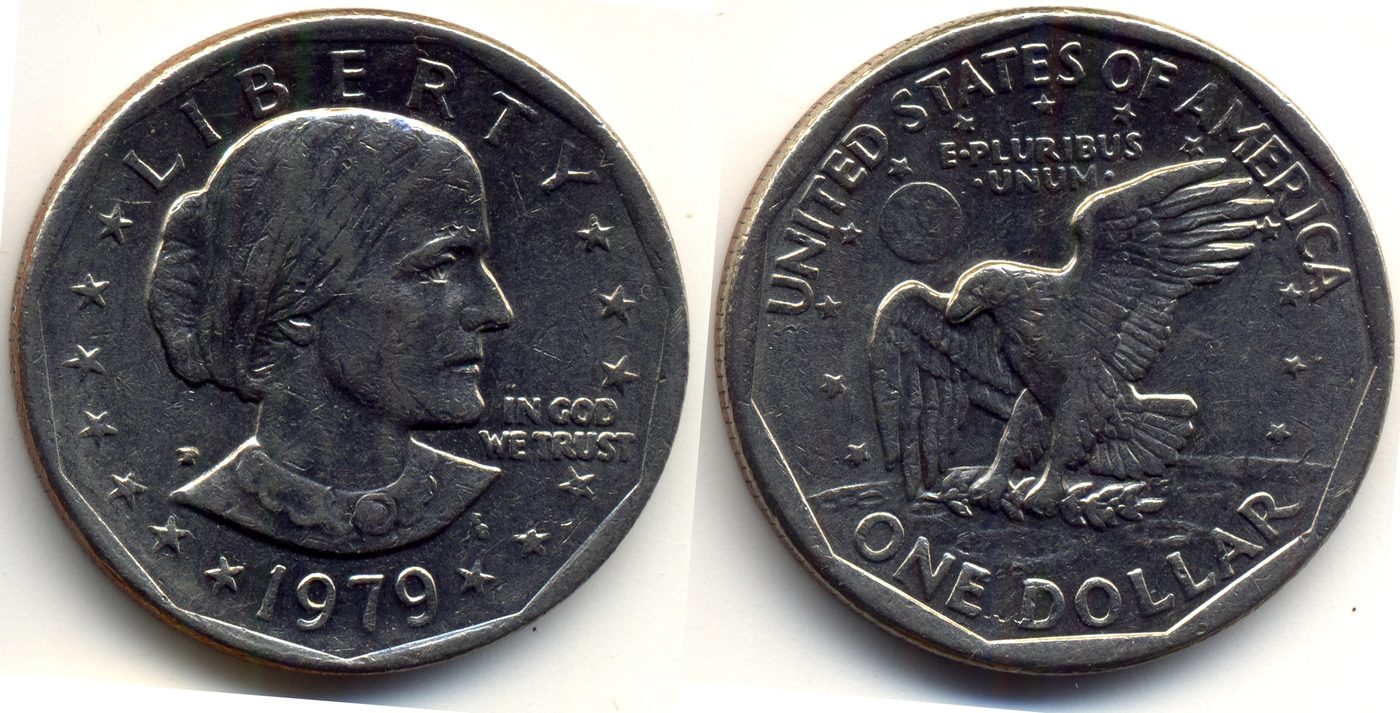
Between 1979 and 2008, the United States minted hundreds of millions of dollar coins almost nobody wanted. The Mint kept making them. The public kept refusing. The story of why is stranger — and more human — than any single coin.
A coin nobody asked for, made anyway
In 1979, the U.S. government released a brand-new dollar coin. Within months, Congress was holding hearings about why it had flopped.
That coin was the Susan B. Anthony dollar — the first American circulating coin to honor a real woman. It should have been a triumph. Instead it became a national punchline, jammed into the wrong slot in a thousand cash drawers because it was almost exactly the size of a quarter.
To understand why, you have to understand what the government was actually chasing. A dollar bill wears out fast — federal estimates put its life at under five years. A coin can last decades. And there is real money in the gap: it costs the Mint far less to strike a dollar coin than the dollar it's worth, a profit the Treasury calls seigniorage. Every accountant in Washington could see the savings. Canada and Britain had already pulled it off, simply by yanking their paper notes out of circulation.
But Americans love the foldable dollar. It tucks into a wallet; a fistful of coins does not. So began a thirty-year standoff: a government convinced the dollar coin made sense, and a public that flatly would not carry one.
The two coins that tried — and the wall they hit
The first attempt replaced a coin that had its own problem. The Eisenhower dollar, struck since 1971, was a hefty slab of metal too big and heavy to carry. So the Mint shrank it. Chief Engraver Frank Gasparro — the man whose initials sit on the Lincoln Memorial cent — designed a smaller dollar, and with the backing of the vending-machine industry, Congress authorized it in 1978.
There was a fight over whose face went on it. Gasparro had sketched an allegorical Liberty in a Phrygian cap — the soft pointed hat that's symbolized freedom since Roman times. Congress overruled him and chose Susan B. Anthony, the suffragist. The reverse kept the Eisenhower dollar's eagle landing on the moon, lifted from the Apollo 11 mission patch.
Then came the flaw that doomed it. At 26.5 millimeters across, the Anthony dollar was barely two millimeters wider than a quarter, with the same copper-nickel color and a reeded — grooved — edge just like a quarter's. People mixed them up constantly. The Mint added an eleven-sided inner border to help, but it wasn't enough. After a flood of 757 million coins in 1979, demand collapsed; by 1981 the Mint struck them only for collectors and stopped.
Two decades later it tried again — and this time it fixed the color. The Sacagawea dollar of 2000 was the same size as the Anthony, but its outer layer of manganese brass gave it a warm golden glow no one could mistake for a quarter. The obverse — the heads side — showed Sacagawea, the Shoshone interpreter of the Lewis and Clark expedition, carrying her infant son on her back; sculptor Glenna Goodacre modeled her on a young Shoshone woman, Randy'L He-dow Teton, since no portrait of Sacagawea survives. Thomas D. Rogers Sr. designed the soaring eagle on the reverse.
The Mint launched it like a product. It teamed up with Walmart and Sam's Club to push the coins into circulation, and partnered with General Mills to drop a golden dollar into roughly one in every 2,000 boxes of Cheerios in early 2000. For one season the "golden dollar" was everywhere. Then the novelty wore off, demand cratered after 2001, and circulation production all but stopped. The coin had beaten the color problem and still lost — because the real obstacle was never the design. It was the paper dollar in everyone's pocket.
How the experiments unfolded
- 1971Gasparro's secret prototype Ike
- 1978Congress authorizes the Anthony dollar
- 1979The Anthony dollar arrives — and stumbles
- 1980–1981Demand collapses
- 1992–1993Commemorative silver dollars keep the form alive
- 1997Congress greenlights a new dollar
- 1999The Anthony dollar returns as a stopgap
- 2000The golden Sacagawea dollar launches
- 2002–2008Sacagawea goes collector-only
- 2007The Presidential dollar program begins
- 2009The Sacagawea becomes the Native American dollar
- 2018The American Innovation dollar arrives
Key facts
- Span
- 1979–today
- Country
- United States
- Denomination
- One dollar (circulating coin)
- Signature coins
- Susan B. Anthony dollar (1979–1981, 1999); Sacagawea dollar (2000–)
- Anthony dollar designer
- Frank Gasparro, U.S. Mint Chief Engraver
- Sacagawea designers
- Glenna Goodacre (obverse), Thomas D. Rogers Sr. (reverse)
- Anthony composition
- Copper-nickel clad, 26.5 mm — nearly quarter-sized
- Sacagawea composition
- Manganese-brass clad copper, golden color, 26.49 mm
- Why it matters
- First circulating U.S. coin to honor a real woman (Anthony)
The coins of this era
The dollar coin gets the headlines, but it was never alone on the workbench. The same Mint, the same engravers, and the same restless decades produced a whole family of coins — and once you see them together, the thread is hard to miss.
The dollar-coin saga itself. It even has a prequel. Before the Anthony dollar shrank the Ike, Gasparro quietly struck a handful of 1971 Eisenhower dollar trial prototypes in higher relief — coins so close to the real thing that no one noticed them for 37 years, until a specialist spotted one and it sold for $264,000. Then came Gasparro's Susan B. Anthony dollar, the quarter look-alike that flopped; and two decades on, Glenna Goodacre's Sacagawea dollar, which fixed the color and still lost the wallet war. When circulation gave up, the design simply changed jobs: since 2009 it has run as the Native American dollar, keeping Goodacre's portrait while the reverse rotates each year — the 2021 Military Service coin, with eagle feathers and a star for each branch of the armed forces (reverse by Donna Weaver, sculpted by Chief Engraver Joseph Menna), is a fine example. And since 2018 the golden dollar has lived on as the American Innovation dollar, a state-by-state tribute series with Justin Kunz's Statue of Liberty on the front, sculpted by Phebe Hemphill.
The coins that refused to change. Against all that churn, two long-running designs prove the opposite lesson — that a coin Americans already love, left alone, just keeps working. Victor David Brenner's 1909 Lincoln carried the Lincoln Memorial cent (1959–2008), with Gasparro's marble memorial on the back. And Felix Schlag's 1938 Monticello rode the Jefferson nickel straight through this whole era, before a 2006 refresh paired it with a new forward-facing Jefferson by Jamie Franki.
Coins as keepsakes, not change. This era also ran on a booming appetite for collector coins — money struck to be saved, not spent. The First Spouse gold series (2007–2020) gave the nation's first ladies their own half-ounce, 24-karat portraits, drawn by sculptors including Phebe Hemphill, Don Everhart, Susan Gamble, and Donna Weaver. Two commemorative silver dollars catch the moment perfectly: the 1992 Columbus Quincentenary dollar (John Mercanti's Columbus on the obverse, Thomas D. Rogers Sr.'s Santa María-meets-Space-Shuttle reverse), and the 1993 Jefferson 250th-anniversary dollar, designed front and back by T. James Ferrell. And the American Silver Eagle, launched in 1986, reached back to Adolph A. Weinman's gorgeous 1916 Walking Liberty, paired it with John Mercanti's heraldic eagle, and became the most collected silver coin on earth.
Held together, these coins tell one honest story. A Mint that did the arithmetic on a coin that lasts decades, a public that kept folding paper into its wallet, and a generation of engravers who answered the failed-money problem the only way artists can — by making the coins beautiful enough to keep anyway.
Why this era fascinates collectors
A coin that failed in commerce can thrive in a collection — and these two are proof. They're affordable, recent, and findable, which makes them a perfect first hunt. Yet they hide some genuinely scarce prizes.
On the Anthony dollar, look to the dies. The 1979-P comes in a common Narrow Rim and a scarcer Wide Rim — on the Wide Rim, the date sits so close to the edge it nearly touches the rim. Among proofs — special coins struck from polished dies for collectors — the 1979-S and 1981-S each exist with two different mint-mark punches; the clearer Type 2 mark is the one that commands a premium.
The Sacagawea dollar's treasures come from its launch. The eagles in those 2000 Cheerios boxes turned out to carry a sharper, more detailed reverse than the regular coins — the so-called "Cheerios dollar," with only dozens confirmed and high-grade examples selling for tens of thousands. There's also the "Wounded Eagle" (or "Speared Eagle"), where a flaw on the die left raised gouges slicing across the bird's breast.
And then there are the trophies. Gasparro's secret 1971 Eisenhower prototype — the coin that started the whole shrink-the-dollar idea — is one of the great modern discoveries, hidden in plain sight for almost four decades before fetching a quarter of a million dollars at auction. The deeper draw, though, is the story. Hold one of these and you're holding a clean, honest record of ambition meeting human habit — a government that did the math, and a public that just kept reaching for the paper.
Questions collectors ask
Why did the Susan B. Anthony dollar fail?
Mostly because it looked and felt like a quarter. At 26.5 mm it was only about two millimeters wider, with the same color and a reeded edge, so people confused the two constantly. The vending and banking systems weren't ready for it either, and the public never warmed to carrying a dollar coin instead of a bill. Demand collapsed within two years.
Why is the Sacagawea dollar gold-colored if it isn't gold?
It's not gold at all. The coin has a pure copper core clad in manganese brass, an alloy that gives it a warm golden tone. The color was deliberate — it solved the Anthony dollar's biggest flaw, being mistaken for a quarter.
What is a Cheerios dollar and how do I know if I have one?
In early 2000 the Mint dropped a Sacagawea dollar into roughly one in every 2,000 boxes of Cheerios. A small number of those coins were struck with a more detailed eagle reverse — sharper tail feathers. Only dozens have been confirmed, and they can be worth thousands, so any 2000-dated Sacagawea worth checking should be examined by a professional grader.
What happened to the Sacagawea dollar after 2008?
It never really ended — it changed costume. Since 2009 the same coin has been issued as the Native American dollar: Glenna Goodacre's Sacagawea stays on the front, while the reverse changes every year to honor a different Native American story, such as the 2021 Military Service design. They're still struck mainly for collectors, not circulation.
Did the government give up on the dollar coin?
Not exactly — it kept trying. The Presidential dollar program launched in 2007, and the Native American series began in 2009, followed by the American Innovation dollar in 2018. But Americans still didn't use them, and over a billion unused dollar coins piled up in Federal Reserve vaults, prompting the Mint to suspend striking them for general circulation in 2012.
Are these dollar coins worth anything?
Most circulated Anthony and Sacagawea dollars are worth their face value of one dollar. The exceptions are specific scarce varieties — the 1979-P Wide Rim, certain Type 2 proofs, and the Sacagawea Cheerios and Wounded Eagle varieties — which can be worth far more in high grades. The rarest piece of all is a 1971 Eisenhower trial prototype, which sold for $264,000.
Sources
- Susan B. Anthony dollar — Wikipedia
- Sacagawea dollar — Wikipedia
- Susan B. Anthony Dollar (1979–1999): History & Value — CoinWeek
- Susan B. Anthony Dollar — PCGS CoinFacts
- 2000-P SAC$1 Wounded Eagle — PCGS CoinFacts
- 2000-P SAC$1 Cheerios Prototype Reverse — PCGS CoinFacts
- A Dollar Coin Could Save Millions — U.S. GAO
- Fed Presidential $1 inventory tops 1.2 billion — Coin World
- 1971-S Eisenhower dollar prototype sells for first time at auction — Coin World
- Christopher Columbus Quincentenary coins — Wikipedia
- Thomas Jefferson 250th Anniversary silver dollar — Wikipedia
- 2021 Native American $1 Coin — U.S. Mint
- Native American $1 Coin Program — U.S. Mint
- Lincoln cent — Wikipedia
- Jefferson nickel — Wikipedia
- American Innovation dollars — Wikipedia
- American Innovation $1 Coin Program — U.S. Mint
- American Silver Eagle — Wikipedia
- United States Mint Offers First Spouse Coins (2007) — U.S. Mint
- T. James Ferrell — Wikipedia