US coin · series

The Seated Liberty Half Dime

A silver coin smaller than a dime — and home to one of the rarest U.S. coins ever struck.

The Seated Liberty Half Dime
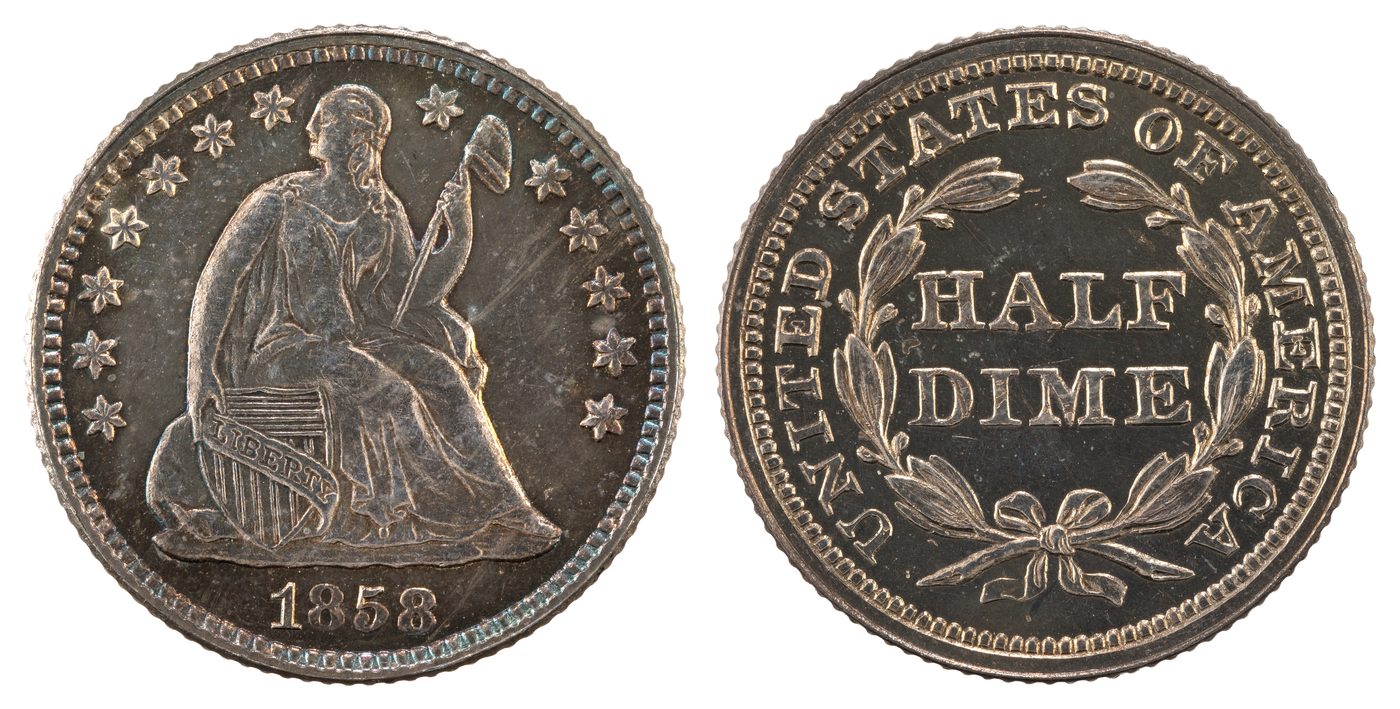
US Mint (coin, designed by Christian Gobrecht); photograph by Jaclyn Nash, National Numismatic Collection, National Museum of American History (Smi… · public domain · source

It is smaller than a modern dime, almost too small to read with the naked eye, and it carried the same buying power as five cents for most of the 19th century. Yet one Seated Liberty half dime — a single coin nobody knew existed for over a century — sold for $3.12 million.

The story behind the coin

In 1837 the United States gave its smallest silver coin a complete makeover — and quietly began a 36-year run that would end with one of the most famous rarities in American numismatics.

The half dime was already old by 1837. The Mint had struck silver "half dismes" since 1792, worth five cents, in a country where small silver still did the daily work of trade. But the old designs — a draped bust of Liberty — were tired. The Mint wanted a single, unified look across the silver coinage, from this tiny piece up to the dollar.

The answer came from a sculptural, almost classical image: Liberty seated on a rock, holding a shield in one hand and a liberty cap on a pole in the other. It first appeared on a pattern dollar in 1836, and in 1837 it landed on the half dime and the dime. The "Seated Liberty" era of American coinage had begun, and the half dime was one of its first two carriers.

The coin lived through the country's most turbulent decades — the California Gold Rush, the silver-price swings of the 1850s, and the Civil War, which drove silver coins out of circulation into hiding. By the time it ended in 1873, the half dime had been made obsolete by a new, cheaper coin made of copper and nickel: the five-cent piece we still call the nickel.

The design and who made it

The seated figure of Liberty was the work of Christian Gobrecht, the U.S. Mint's third Chief Engraver. He cut the dies from a drawing by the painter Thomas Sully, a leading American portraitist of the day. The obverse — the "heads" side — shows Liberty seated, her right hand steadying a shield inscribed LIBERTY, her left holding a pole topped by a liberty cap, the ancient symbol of freedom. Gobrecht designed the reverse (the "tails" side) too: an open wreath tied with a ribbon, wrapped around the words HALF DIME, with UNITED STATES OF AMERICA around the rim.

Over 36 years the design changed enough to create distinct, collectible types. The earliest 1837 coins — and the 1838 New Orleans issue — carry no stars around Liberty, leaving the field open and stark. In 1838 the Mint added a semicircle of thirteen stars, one for each original state. Around 1840, the sculptor Robert Ball Hughes reworked the figure, adding extra drapery at Liberty's elbow and tidying the composition.

Two later changes are easy to spot. In 1853, the Mint added small arrowheads beside the date — a public signal that the coin's silver weight had been cut as silver prices climbed. The arrows stayed through 1855. Then in 1860, Chief Engraver James B. Longacre gave the coin its final look: he replaced the stars with the legend UNITED STATES OF AMERICA on the obverse, and swapped the plain wreath for a lush cereal wreath of corn, wheat, oak, and maple. (Some scholars credit the wreath's actual cutting to Longacre's assistant, Anthony C. Paquet.) That "Legend Obverse" type ran to the end in 1873.

Key facts

Years struck
1837–1873
Denomination
Half dime (5 cents)
Obverse designer
Christian Gobrecht, from a Thomas Sully drawing
Reverse designer
Christian Gobrecht (1837); cereal wreath from 1860 under James B. Longacre
Composition
90% silver, 10% copper
Weight (1837–1853)
1.34 g (20.625 grains)
Weight (1853–1873)
1.24 g (19.2 grains)
Diameter
About 15.5 mm — smaller than a modern dime
Edge
Reeded
Mints
Philadelphia (no mark), New Orleans (O), San Francisco (S)
Major types
No Stars; Stars (No Drapery / With Drapery); Arrows 1853–1855; Legend Obverse 1860–1873
Series rarity
1870-S — one example known; sold for $3,120,000 (2023)

Collecting it: key dates and varieties

The half dime is a favorite of type collectors because the whole story of Seated Liberty silver — the stars, the drapery, the arrows, the legend — plays out on one tiny canvas. You can build a "type set" of the major design changes without chasing the rarest dates at all.

But the date-by-date set is where the legends live. The undisputed king is the 1870-S. For more than a century no one knew it existed; it appears on no official Mint report for 1870. Today exactly one example is known in private hands. Researchers Nancy Oliver and Richard Kelly later found archival records showing that in May 1870 the San Francisco Mint coined examples of eleven denominations for the new mint building's cornerstone — the 1870-S half dime among them, alongside coins never otherwise struck that year. A second example may still rest, sealed, inside that cornerstone. The known coin surfaced in 1978: by the widely told account, it was bought as an ordinary 1870 half dime in a small-shop lot in Illinois, then authenticated under a microscope. In January 2023 it sold for $3,120,000 at Heritage Auctions.

You don't need a seven-figure budget to find scarcity, though. The 1846 Philadelphia half dime had an original mintage of just 27,000 — the lowest circulating figure of the series — and it is genuinely hard to find, especially in higher grade. Among the New Orleans coins, the 1853-O without arrows is the toughest, struck briefly before the 1853 weight change with a reported mintage near 130,000. Early dates like the 1849-O and the first No Stars pieces of 1837–1838 are perennial targets.

A word on grade. Grade is the condition score a coin earns, from worn to flawless. These coins circulated hard in the 19th century, and small silver shows wear fast on Liberty's head and the high points of the gown. A coin in a high "Mint State" grade — meaning it never circulated — is far scarcer than a worn one of the same date, which is why two coins sharing a date can be worth a few dollars or a few thousand depending entirely on how they survived. Proofs — specially struck presentation coins with mirror-like fields — exist for many dates but only in tiny numbers, often a few hundred or fewer.

Questions collectors ask

What is a half dime, and how is it different from a nickel?

A half dime is a five-cent coin made of silver, struck from 1792 to 1873. It is not the same as the nickel. When silver grew costly and a cheaper copper-nickel five-cent piece appeared in 1866, the silver half dime became redundant and was abolished in 1873. The nickel replaced it.

Why is the 1870-S half dime worth millions?

Because only one is known to exist in private hands, and it appears on no official Mint report for 1870 — for over a century, collectors did not know it existed. Records suggest San Francisco struck it for the new mint's cornerstone in 1870. The single known coin sold for $3,120,000 in January 2023.

What do the arrows next to the date mean?

The arrowheads beside the date in 1853–1855 were a public signal that the coin's silver weight had been reduced — from 20.625 grains to 19.2 grains — as silver prices rose. The reduced weight stayed even after the arrows were removed.

Who designed the Seated Liberty half dime?

Christian Gobrecht, the Mint's third Chief Engraver, cut the seated-Liberty design from a drawing by the painter Thomas Sully. Robert Ball Hughes reworked the figure around 1840, and James B. Longacre redesigned the coin in 1860 with the UNITED STATES OF AMERICA legend and the cereal wreath.

Why was the half dime smaller than a dime?

Silver coins of the era were sized by their silver content, not by their face value's logic. A half dime held half the silver of a dime, so it was physically smaller — about 15.5 mm across, smaller than the dime you carry today.

What is the easiest Seated Liberty half dime to collect?

A type set — one example of each major design (No Stars, Stars, Arrows, Legend Obverse) — is very achievable, since most Philadelphia dates from the 1850s and 1860s are common and affordable in circulated grades. The famous rarities are specific dates and mints, not the design itself.

Sources