US coin · series

The Seated Liberty Dime: a goddess on a rock, 1837–1891

Fifty-four years of one design — through bank panics, a civil war, and a coinage law that doomed an entire mintage.

The Seated Liberty Dime: a goddess on a rock, 1837–1891
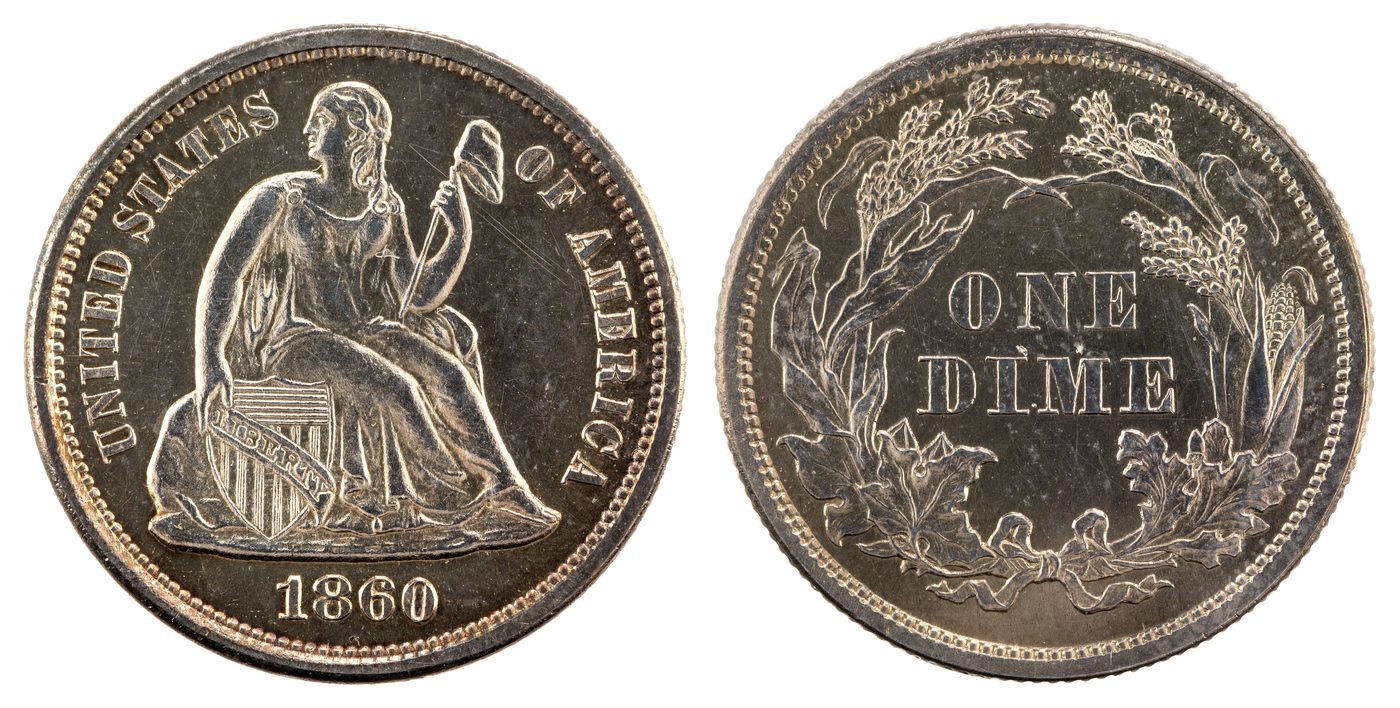
US Mint (coin); National Numismatic Collection, National Museum of American History — photograph by Jaclyn Nash · public domain · source

In 1873, the Carson City Mint struck 12,400 little silver dimes — and a new law made every one of them obsolete almost overnight. Today, exactly one is known to survive. That single coin sold in 2012 for $1.84 million. It is a Seated Liberty Dime, the workhorse ten-cent piece that outlasted nearly every other American coin design of the 1800s.

The story behind the coin

In the 1830s the U.S. Mint wanted its silver to look serious. The old "bust" coins — a chunky portrait of Liberty in a cap — felt dated. Mint Director Robert M. Patterson wanted something grander, closer to the seated figures the British put on their copper. So he commissioned a goddess: Liberty, seated on a rock, the very picture of a young republic at rest but ready.

The design first reached the public on the half dimes and dimes of 1837, and it stuck. For the next fifty-four years the same seated figure rode in American pockets through some of the country's most turbulent decades — the Panic of 1837, the California gold rush, the Civil War, the silver and gold fights of the Gilded Age. Few U.S. coin designs have ever lasted that long. The dime's longevity is exactly why it's so collectable: one design, dozens of years, four different mints, and a string of varieties that turn a simple ten-cent piece into a 54-year puzzle.

It was a true workhorse — a dime was real money in the 1800s, enough for a meal or a drink — and the Mint quietly tinkered with it the whole way. Stars came and went. Arrows appeared beside the date. The whole front was redrawn. Each change is a fingerprint of what was happening to American money at that moment.

The design — and who made it

The seated figure was a team effort. Artists Thomas Sully and Titian Peale drew the concept; the Mint's third Chief Engraver, Christian Gobrecht, cut it into steel and engraved both sides of the coin. Gobrecht's reverse — the "tails" side — adapted an older wreath-and-denomination layout. So when collectors say "Gobrecht designed the Seated Liberty Dime," that's the honest shorthand: he engraved the obverse (the heads side) from Sully and Peale's drawings, and he engraved the reverse too.

The obverse shows Liberty seated on a rock. Her right hand steadies a shield marked LIBERTY — defense. Her left holds a pole topped by a soft Phrygian cap — the ancient symbol of a freed person, and so of liberty itself. It's a quiet, classical scene, and it changed in small, datable steps:

  • No Stars (1837–1838): the earliest dimes, with a plain field around Liberty — clean and almost cameo-like.
  • Stars (1838–1860): thirteen six-pointed stars added around the rim, one for each original colony. In 1840 the figure was re-engraved by sculptor Robert Ball Hughes, who added a fold of drapery at Liberty's elbow.
  • Legend Obverse (1860–1891): Chief Engraver James B. Longacre swept the stars away and moved UNITED STATES OF AMERICA from the back to the front. The reverse got a fuller "cereal" wreath — corn, wheat, maple, and oak — that would survive on the dime, essentially unchanged, until 1916.

Then there are the arrows — two of the most informative little marks in U.S. coinage. When you see arrowheads flanking the date (1853–1855, and again 1873–1874), the Mint is telling you the coin's weight just changed. In 1853, with silver suddenly worth more than the coin's face value, Congress cut the dime's weight to keep it from being melted; the arrows flagged the lighter new standard. In 1873 a sweeping coinage law nudged the weight up to a tidy metric 2.5 grams, and the arrows returned to mark that. Same goddess, different gram on the scale.

Key facts

Years struck
1837–1891
Designers
Christian Gobrecht (engraver, both sides), after drawings by Thomas Sully & Titian Peale; obverse re-engraved by Robert Ball Hughes (1840); Legend obverse by James B. Longacre (1860)
Composition
90% silver, 10% copper
Diameter
17.9 mm; reeded edge
Weight standards
2.67 g (1837–1853) → 2.49 g (1853–1873, arrows) → 2.50 g (1873–1891)
Mints & mintmarks
Philadelphia (none), New Orleans (O), San Francisco (S), Carson City (CC)
Major types
No Stars · Stars (with/without arrows) · Legend (with/without arrows)
Replaced by
Barber Dime (1892)
Rarest issue
1873-CC No Arrows — unique; one known of 12,400 struck

Collecting it: key dates, varieties, and high-grade scarcity

The Seated Liberty Dime rewards patience, because the rarities are spread across the whole 54-year run rather than bunched in a few famous years.

The legendary one: 1873-CC No Arrows. Carson City struck 12,400 dimes early in 1873 under the old weight standard. Then the Coinage Act of 1873 changed the weight, and the arrows-at-date dies arrived. The no-arrows pieces were obsolete before they ever circulated, and were almost certainly melted for recoining. Exactly one is known to have escaped. It became the final coin needed to complete the legendary Louis Eliasberg collection — the most complete set of U.S. coins ever assembled — and in 2012, as part of the Battle Born Collection, it sold for $1.84 million.

The famous "sleeper" pair: 1844 and 1846. The Philadelphia 1844 (mintage 72,500) earned the nickname "Little Orphan Annie." The most-repeated story credits a 1930s collector, Frank Ross, who hoarded and promoted the date — but the exact origin of the nickname is collector lore, not documented fact, so treat it as a good story rather than gospel. Quietly, the 1846 is arguably the tougher coin: just 31,300 struck, less than half the 1844, and genuinely scarce in any grade.

The Carson City run (1871–1874). Beyond the unique 1873-CC No Arrows, the early Carson City dimes — 1871-CC, 1872-CC, 1873-CC With Arrows, 1874-CC — are all serious rarities from the new frontier mint near the Comstock silver mines. Tiny mintages and heavy circulation make any of them a prize.

Why high grades are scarce. A dime was working money. Most Seated dimes spent years in commerce, so they survive worn smooth. Mint-state survivors — coins that never circulated — are scarce for almost every date, and for the genuinely low-mintage years they barely exist. That gap between a worn example and a sharp, lustrous one is where most of the value lives. Collectors also chase documented varieties: the 1837 Large Date / Small Date, repunched dates, and overdates that turn a common year into a specialist's hunt.

Questions collectors ask

Who designed the Seated Liberty Dime?

Christian Gobrecht, the Mint's third Chief Engraver, engraved both sides, working from drawings by Thomas Sully and Titian Peale. The figure was later re-engraved by Robert Ball Hughes in 1840, and James B. Longacre redesigned the obverse with a legend in 1860.

Why is the 1873-CC No Arrows dime worth over a million dollars?

Only one is known to exist. Carson City struck 12,400 in early 1873, but a new coinage law changed the dime's weight days later, making the no-arrows pieces obsolete before they circulated — almost all were melted. The single survivor sold for $1.84 million in 2012.

What do the arrows next to the date mean?

They mark a weight change. Arrows appear in 1853–1855 (when the dime's weight was reduced) and again in 1873–1874 (when it was nudged up to a metric 2.5 grams). Same design, different official weight.

What is the 'Orphan Annie' dime?

It's the nickname for the 1844 Philadelphia dime, which had a low mintage of 72,500. The name is usually traced to a 1930s collector who promoted the date, but the exact origin is collector lore rather than documented fact.

Are Seated Liberty Dimes silver?

Yes — every Seated Liberty Dime is 90% silver and 10% copper, 17.9 mm across, with a weight that shifted slightly over the series (2.67 g, then 2.49 g, then 2.50 g).

Why did the Seated Liberty Dime end in 1891?

After 54 years, tastes had changed and the Mint wanted a fresh look. The Barber Dime replaced it in 1892.

Sources