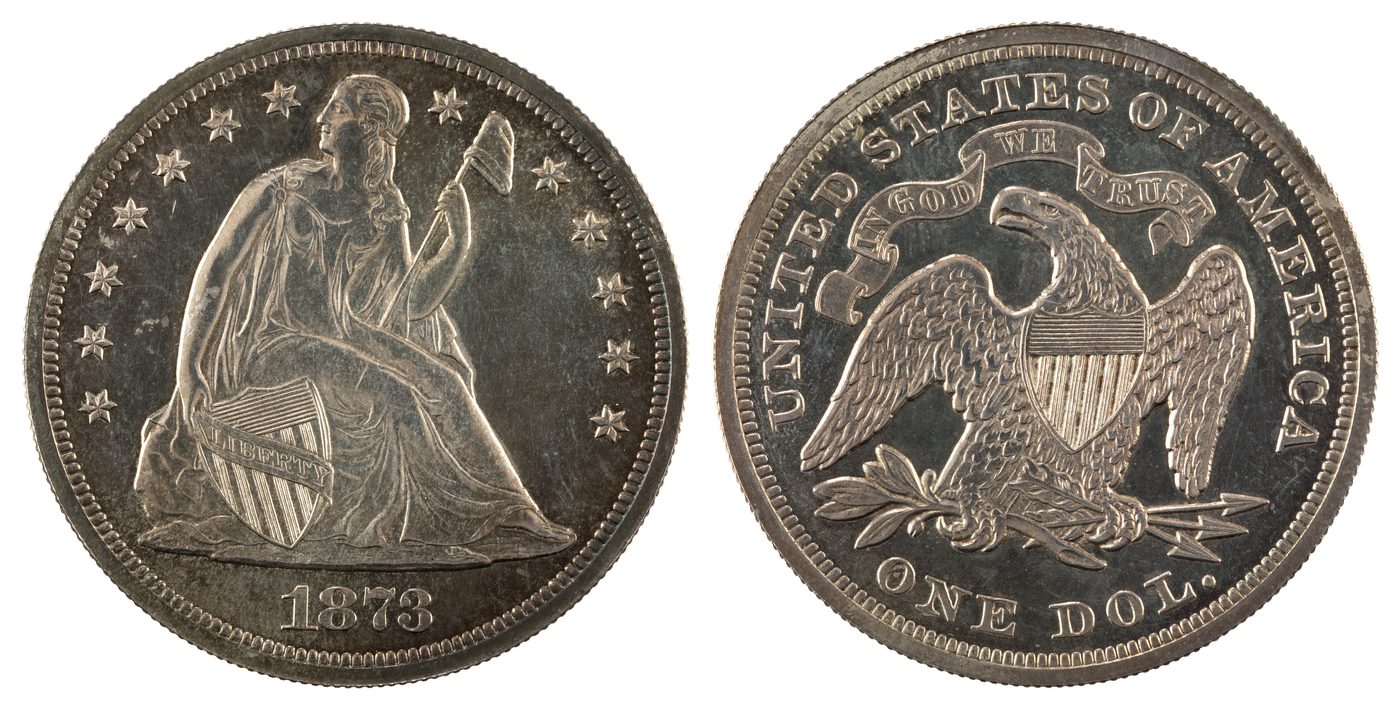
The Seated Liberty series is a favorite precisely because the coins are little history lessons. The design barely changed for fifty years — so when it did change, something big was happening in the country.
The arrows and rays of 1853. The California Gold Rush flooded the country with gold, which made silver, by comparison, more valuable. Suddenly the silver in a handful of coins was worth more melted than spent, and small change vanished — hoarded, exported, melted. Congress responded with the Act of February 21, 1853, slightly reducing the weight of the subsidiary silver coins so they'd stay in circulation. To mark the new lighter coins, the Mint added arrowheads beside the date and, for one year only, rays around the eagle. Those 1853 "arrows and rays" coins are the most recognizable type in the whole series. (The silver dollar was exempt and kept its full weight — which is exactly why so many were exported or melted.)
The motto of 1866. The Civil War sent a wave of religious feeling through public life, and in 1866 the Mint added IN GOD WE TRUST to a ribbon above the eagle. That creates two clean collectible halves of the dollar, quarter, and half dollar: "No Motto" before 1866, "With Motto" after.
The arrows of 1873. The Coinage Act of February 12, 1873 nudged the subsidiary coins slightly heavier to align with the metric system — so the arrows returned for 1873 and 1874. The same law quietly ended the standard silver dollar, a decision Western silver interests would later furiously brand "the Crime of '73."
Why high grades are scarce. These were working coins. They circulated hard for decades, so most survivors are worn smooth. Branch-mint issues — especially New Orleans (O) and Carson City (CC) — were struck in smaller numbers, often shipped straight into commerce, and rarely saved by collectors. A common date in pristine, lightly handled condition can be worth many times a worn example, and certain branch-mint dates are genuinely rare in any grade.
The trophies. Two coins tower over the series. The 1873-CC "No Arrows" dime — struck just before the 1873 weight change, with 12,400 reported made and almost all melted — survives in a single known example, which sold for $3,600,000 in January 2023. And the 1870-S half dime, a coin unrecorded in Mint ledgers and unknown to collectors until 1978, is tied to the cornerstone ceremony of the new San Francisco Mint; its one collectible specimen brought $3,120,000, also in January 2023. (How either coin escaped the Mint is, honestly, still a mystery — collectors have theories, not proof.)