US coin · series

The Quintuple Stella: a $20 gold coin for a money that never came

Five were struck in 1879. One sold for $1.88 million. None ever bought a thing.

The Quintuple Stella: a $20 gold coin for a money that never came
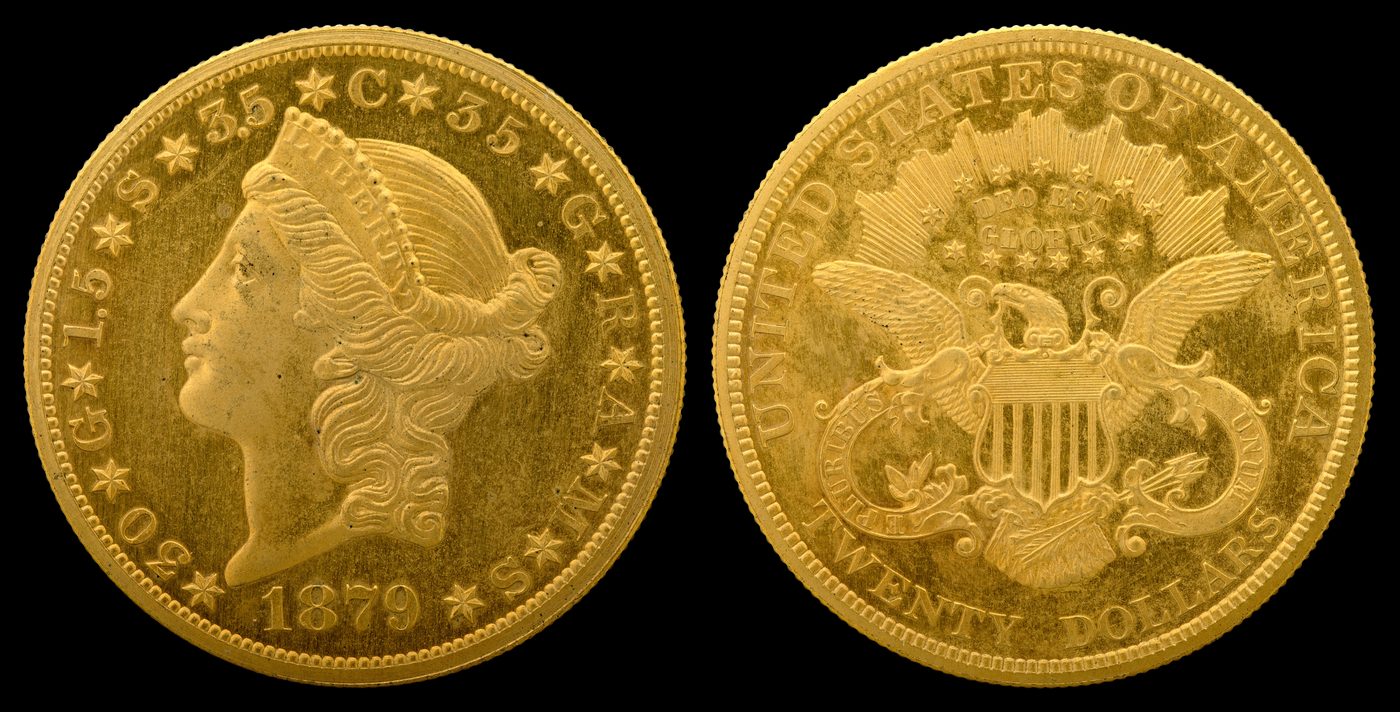
US Mint (coin), National Numismatic Collection (photograph by Jaclyn Nash); Credit: National Numismatic Collection, National Museum of American His… · public domain · source

In 1879 the U.S. Mint stamped a gold coin with grams instead of stars — a $20 piece built for an international money that Congress would never approve. Only five survive, and collectors call them Quintuple Stellas.

The story behind the coin

In the 1870s, money did not cross borders cleanly. A traveler leaving the United States carried gold that the next country had to weigh, test, and convert — different standards, different alloys, constant friction. Reformers across Europe and America chased a fix: a single coin that any nation could spend at face value. The dream had a name, the Latin Monetary Union, and for a few years Washington wanted in.

The U.S. Mint's answer began small. In 1879 it struck the $4 "Stella" — a quarter-sized gold pattern (a trial coin, never released for spending) named for the large star, stella in Latin, on its back. Around its edge ran a strange legend: not a portrait of stars, but a recipe in grams. The Stella was meant to slot neatly against the gold coins of France, Austria, and the Netherlands.

Then the Mint asked a bigger question. If a $4 coin could be built on the metric system, why not the workhorse of American gold, the $20 double eagle? So it struck five examples of a $20 metric pattern — the same idea, five times the value. Collectors named it the Quintuple Stella: five Stellas in one coin.

Congress said no. The bill to put metric gold into circulation died, the international-currency dream faded, and the Quintuple Stella never spent a cent. What was left was five coins — and a question that still hangs over them: what would American money have looked like if the answer had been yes?

The design and who made it

Pick up a Quintuple Stella and the front looks familiar at first. It carries Liberty in profile, her hair bound and crowned — the classic Liberty Head, or Coronet, portrait that James Barton Longacre designed for the regular $20 double eagle decades earlier. (The obverse is the "heads" side; Longacre, the Mint's chief engraver, had died in 1869, so his portrait was reused.)

Look closer and the coin turns strange. Where a normal double eagle rings Liberty with stars, this one rings her with numbers: ★30★G★1.5★S★3.5★C★35★G★R★A★M★S★. Read it out and it's a formula — 30 grams gold, 1.5 grams silver, 3.5 grams copper, 35 grams total. The coin wears its own composition on its face. That metric "goloid" recipe came from Dr. William Wheeler Hubbell, a Philadelphia inventor who had patented a gold-silver-copper alloy he believed could anchor a new kind of money.

The reverse — the "tails" side — borrows the Stella's back, with its Latin motto DEO EST GLORIA ("To God is the Glory") in place of the usual "In God We Trust," alongside E PLURIBUS UNUM and TWENTY DOLLARS. That Stella reverse is generally credited to Charles E. Barber, the rising engraver who would soon become chief. Here the histories disagree, and honestly: some catalogs credit the design to George T. Morgan (of Morgan dollar fame), and note that both men worked on the dies. The fairest thing to say is that Longacre's portrait met a reverse from the Mint's engraving room — Barber and Morgan both had hands on the Stella work — wrapped around Hubbell's metric formula.

The result is a genuine $20 gold coin, 34 millimeters across and 35 grams in weight, struck as a polished proof (a special, mirror-finish strike made for presentation, not for pockets).

Key facts

Denomination
$20 (twenty dollars)
Year struck
1879
Mint
Philadelphia
Obverse design
Liberty Head (Coronet) — after James Barton Longacre
Reverse design
Stella reverse, "DEO EST GLORIA" — Charles E. Barber (George T. Morgan also credited)
Metric composition concept
Dr. William Wheeler Hubbell (goloid metric alloy)
Composition
Gold, with silver and copper — ~30 g gold / 1.5 g silver / 3.5 g copper
Weight
35 grams
Diameter
34 mm
Catalog number
Judd-1643 / Pollock-1843
Number known
Five (one in the Smithsonian)
Auction record
$1,880,000 — Legend Rare Coin Auctions, New Orleans, May 19, 2016 (PCGS PR64 Deep Cameo)

Collecting it: why five coins matter

You will almost certainly never own a Quintuple Stella. That is the point of it.

Only five examples are known to exist, and one of them is impounded forever in the National Numismatic Collection at the Smithsonian — meaning four can ever change hands. Pattern coins are rated on a rarity scale, and the Quintuple Stella sits near the top, at Rarity-7. There is no "common date" and no affordable grade; the whole population would fit in one hand.

Because so few exist, each coin is known by its pedigree — the chain of famous owners it has passed through. One specimen traces from the Mint to dealer J.W. Haseltine, then to Dr. Edward Maris and the Garrett family, names that read like a roll call of American collecting. Another — the Virgil Brand–Amon Carter–Ed Trompeter–Bob Simpson coin — is the one that set the record. In May 2016, at Legend Rare Coin Auctions in New Orleans, it sold for $1,880,000, graded PR64 Deep Cameo by PCGS. ("Deep Cameo" describes the contrast on a proof: frosted, sculptural devices floating on a black-mirror field.)

What drives that price is not metal. Thirty-five grams of gold is worth a few thousand dollars. The value is in the story: a coin that was almost the future of American money, frozen at the moment Congress turned away. For the handful of collectors who can reach it, the Quintuple Stella is less a coin than a piece of a road not taken.

One caution worth knowing: the Quintuple Stella has been restruck and reproduced over the years, including modern commemorative tributes and gilt-copper pattern restrikes. The original 1879 gold strikings — the five — are the only ones that carry this history. Genuine examples are slabbed and pedigreed by the major grading services; anything offered cheaply is, by definition, not one of the five.

Questions collectors ask

Is the Quintuple Stella a $50 coin?

No — it's a $20 piece. The name 'Quintuple Stella' means five times the $4 Stella, and 4 × 5 = $20. The famous $50 gold pattern from this era is a different coin entirely, the 'Half Union.' The two are sometimes confused, but the Quintuple Stella is a twenty-dollar pattern.

Why is it called a 'Stella'?

Stella is Latin for 'star.' The original $4 pattern was named for the large star on its reverse. The $20 metric pattern shares that Stella reverse and its metric idea, so collectors call it the Quintuple — five-times — Stella.

How many Quintuple Stellas exist?

Five are known. One is permanently held in the Smithsonian's National Numismatic Collection, so only four can ever be privately owned. It is far rarer than the better-known $4 Stella.

What does the strange legend of letters and numbers mean?

The obverse legend — ★30★G★1.5★S★3.5★C★35★G★R★A★M★S★ — is the coin's own recipe in grams: 30 grams gold, 1.5 grams silver, 3.5 grams copper, 35 grams total. It reflects the metric 'goloid' alloy that inventor William Wheeler Hubbell proposed for a new international money.

Who designed the Quintuple Stella?

The Liberty Head on the front comes from James Barton Longacre's double eagle design. The reverse is the Stella reverse with the motto DEO EST GLORIA, generally credited to Charles E. Barber, though some catalogs credit George T. Morgan — both engravers worked on the Stella dies. The metric composition concept was Dr. William Wheeler Hubbell's.

Why was it never made for circulation?

It was part of a push for a single international currency and a metric coinage system in the late 1870s. Congress rejected the bill, the U.S. abandoned the international-currency idea, and neither the Stella nor the metric alloy ever went into production.

Sources