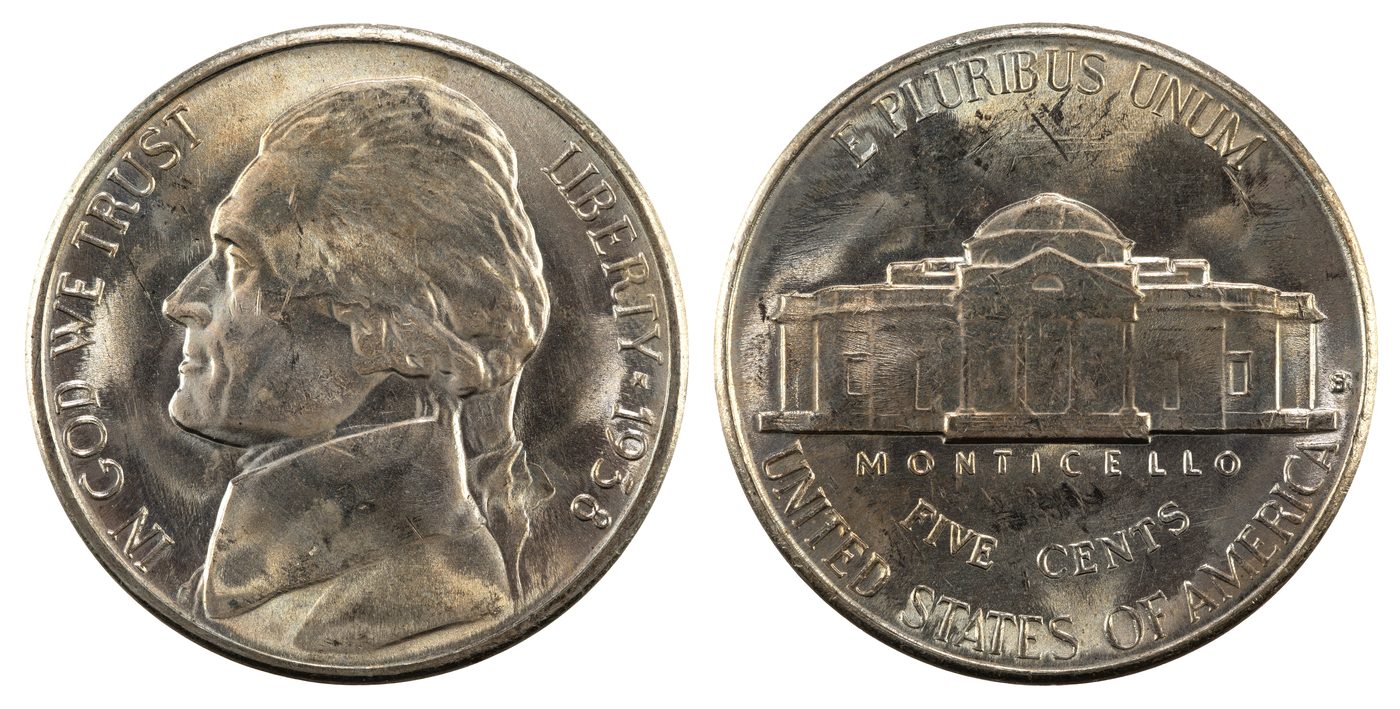
US coin · series

The Jefferson Nickel: A Public Contest, a War, and a Coin Still in Your Pocket

An immigrant sculptor won the right to design it. World War II turned it to silver. It has run, with two faces and six reverses, for over eighty years.

The Jefferson Nickel: A Public Contest, a War, and a Coin Still in Your Pocket
US Mint (coin); National Numismatic Collection, National Museum of American History (photograph by Jaclyn Nash) · public domain · source

In 1938 the U.S. Mint did something unusual — it threw the design of a circulating coin open to the public, took 390 entries, and let a German-born sculptor win. The coin he made is probably in your car's cupholder right now.

The story behind the coin

For thirty years, Americans had spent the Buffalo nickel — a coin everyone loved and the Mint quietly hated, because its high relief wore out dies fast and its dates rubbed flat. By 1938 it had served the legal minimum of 25 years, and the Mint was free to replace it.

What happened next was rare. Instead of handing the job to its own engravers, the Mint held an open competition. The brief was specific: put Thomas Jefferson — the third president, whose 200th birthday was coming in 1943 — on the obverse (the "heads" side), and put Monticello, the Virginia home Jefferson designed himself, on the reverse (the "tails" side).

Roughly 390 artists entered. The winner, announced in April 1938, was Felix Schlag, a sculptor who had emigrated from Germany only a decade earlier. His prize was $1,000 — and the strange distinction of designing one of the most-produced objects in human history while remaining, for years, almost anonymous on it.

The first Jefferson nickels reached circulation on November 15, 1938. They have never stopped.

The design and who made it

Schlag's obverse is a left-facing portrait of Jefferson. The art historian Cornelius Vermeule noted it leans closely on the 1789 marble bust of Jefferson by the French sculptor Jean-Antoine Houdon — a likeness taken from life. The reverse shows Monticello head-on, calm and symmetrical, with the mansion's name spelled out beneath it.

That head-on view was not Schlag's first idea. His original reverse showed Monticello at a three-quarter angle, with real architectural depth — and the Treasury rejected it, asking for a flatter, more straightforward front view and new lettering. Schlag complied. The coin we know is the compromise, not the artist's first vision.

Stranger still: Schlag's initials are nowhere on the early coins. The Mint left them off. Only in 1966 were the tiny letters "FS" finally added below Jefferson's shoulder — 28 years late, while the designer was still alive to see it.

The portrait Schlag drew rode unchanged into the 21st century before the Mint reopened the design. In 2004–2005, for the bicentennial of the Louisiana Purchase and the Lewis and Clark expedition, the Mint ran the Westward Journey series — a short run of new reverses (and, in 2005, a new Jefferson profile) by several artists. Then in 2006 a forward-facing portrait of Jefferson by Jamie Franki, sculpted by Donna Weaver, became the permanent obverse — and Schlag's original Monticello returned to the reverse, where it remains. Schlag's "FS" moved with it, to the right of the building.

Key facts

Years struck
1938–present
Obverse designer (1938–2004)
Felix Schlag — Jefferson profile, after Houdon's 1789 bust
Reverse designer
Felix Schlag — Monticello (restored 2006, runs today)
Obverse designer (2006–)
Jamie Franki, sculpted by Donna Weaver — forward-facing Jefferson
Standard composition
75% copper, 25% nickel
War nickels (mid-1942–1945)
56% copper, 35% silver, 9% manganese
Weight / diameter
5.000 g / 21.21 mm
Lowest mintage
1950-D — 2,630,030 struck
"FS" initials added
1966 (obverse); moved to reverse in 2006

How the war rewrote the coin

Nickel is a strategic war metal — it hardens armor plating. So in October 1942, with the country fully in World War II, Congress ordered the metal stripped out of the five-cent coin. The Mint replaced it with an alloy of 56% copper, 35% silver, and 9% manganese. For three years the "nickel" contained no nickel at all — but it did contain silver, which is why these "war nickels" are still pulled from circulation and pocket change today.

The Mint had a second problem: how would future Americans recover this odd silver alloy from the billions of ordinary nickels already out there? Its answer is the most visible clue on any U.S. coin of the era. War nickels carry a large mint mark floating above the dome of Monticello — and for the first time ever, coins struck in Philadelphia got a mint mark at all, a bold "P." Both marks were oversized on purpose, so the silver coins could be spotted and pulled fast once the war ended. It is the only time the Philadelphia "P" and that high mint mark appear; the mark dropped back below Monticello in 1946 and the nickel went back to copper-nickel.

Collecting it: key dates, varieties, and Full Steps

The Jefferson series is famous for being finishable. A patient collector can assemble nearly the whole run from circulation and modest purchases — which is exactly why it has introduced generations of children to the hobby. The challenge isn't rarity; it's condition.

The key dates are the low-mintage early branch-mint coins. The 1950-D is the standout — just 2,630,030 struck, the lowest business-strike mintage in the series — though because collectors hoarded rolls of it at the time, plenty survive in high grade. The 1939-D (3,514,000) is the genuinely scarce one in worn condition. The 1939-S and 1942-D round out the dates that command real premiums.

The famous variety is the 1939 Doubled Monticello (also called the "Reverse of 1940"): a reverse die struck twice, slightly offset, so "MONTICELLO" and "FIVE CENTS" show clear doubling visible to the naked eye. The Mint reworked the reverse hub that year — sharpening Monticello's steps — and the doubled die is a relic of that transition.

Why high grades are scarce — and what "Full Steps" means. Look at the base of Monticello and you'll see a row of steps. On most Jefferson nickels those steps are mushy, because the deepest part of the design fills last and is the first to suffer from worn dies. A coin that shows five or six sharp, unbroken steps earns the Full Steps (FS) designation — and for many dates a true Full Steps coin is dramatically harder to find than a high grade alone. For some dates, none are known above a certain grade. That single detail — six clean steps — is where the real money and the real hunt live in this series.

Questions collectors ask

Why is the 1950-D nickel the famous one?

It has the lowest business-strike mintage in the whole series — 2,630,030. But it's not truly rare: collectors hoarded rolls of it when it was issued, so many survive in mint condition. It's the date everyone knows, and it usually anchors a Jefferson set.

What is a 'war nickel' and how do I spot one?

From mid-1942 through 1945 the Mint removed nickel for the war effort and used an alloy of 56% copper, 35% silver, and 9% manganese. You spot them instantly by a large mint mark sitting above Monticello's dome — including a 'P' for Philadelphia, the first time that mark was ever used. Because they contain silver, people still pull them from change.

What does 'Full Steps' (FS) mean on a Jefferson nickel?

It's a strike-quality designation. The steps at the base of Monticello are the hardest part of the design to strike fully, so most coins show them mushy or broken. A coin with five or six sharp, complete steps is graded 'Full Steps' — and a true FS example can be far scarcer than the grade alone suggests.

Who designed the Jefferson nickel?

Felix Schlag, a German-born sculptor, won a public design competition in 1938 and created both the original Jefferson profile and the Monticello reverse. In 2006 a new forward-facing Jefferson portrait by Jamie Franki (sculpted by Donna Weaver) became the obverse, while Schlag's Monticello returned to the reverse.

What was the Westward Journey nickel series?

A short run in 2004–2005 marking the bicentennial of the Louisiana Purchase and the Lewis and Clark expedition. It introduced new reverses (an Indian Peace Medal, a keelboat, an American bison, a Pacific coastline) and, in 2005, a new Jefferson profile — before the permanent 2006 redesign brought Monticello back.

Sources