US coin · series

The Two-Cent Piece — the coin that gave America 'In God We Trust'

A Civil War stopgap that lasted nine years and left four words on every coin since.

The Two-Cent Piece — the coin that gave America 'In God We Trust'
Heritage Auctions (image); U.S. Mint (coin) · public domain · source

In the middle of the Civil War, with silver and gold vanishing from pockets, the U.S. Mint struck an odd new coin worth two cents. It was the first American coin ever to read "In God We Trust" — a motto that outlived the coin by 150 years and counting.

The story behind the coin

By 1862 the small change had simply disappeared. The Civil War had people hoarding anything made of silver or gold, and even the humble copper-nickel cent was being squirreled away faster than the Mint could replace it. Shopkeepers improvised — postage stamps stuffed in little brass frames, privately made tokens, paper "shinplasters" for a few cents. The country was running on IOUs and stamps.

The Mint's answer was a brand-new denomination: a fat bronze coin worth two cents. Mint Director James Pollock pushed for it in December 1863, partly to ease the shortage and partly to get away from nickel, whose hard alloy chewed up the Mint's dies. Congress agreed in the Coinage Act of 1864, which President Abraham Lincoln signed on April 22, 1864 — the same law that made base-metal coins legal tender for the first time, in small amounts.

But the coin's real fame came from four words. Back in late 1861, a Pennsylvania minister named Reverend Mark R. Watkinson had written to Treasury Secretary Salmon P. Chase, urging that the nation put God on its coins so that future generations would know it was a religious people, not a godless one. Chase liked the idea. The pattern coins read "God Our Trust"; Chase preferred a phrasing borrowed from the final verse of "The Star-Spangled Banner." When the two-cent piece rolled out, it became the first U.S. coin ever to carry In God We Trust — the motto now on every American coin and bill.

The design and who made it

The man behind it was James Barton Longacre, the Mint's Chief Engraver, who cut both sides — the obverse (the "heads" side) and the reverse alike.

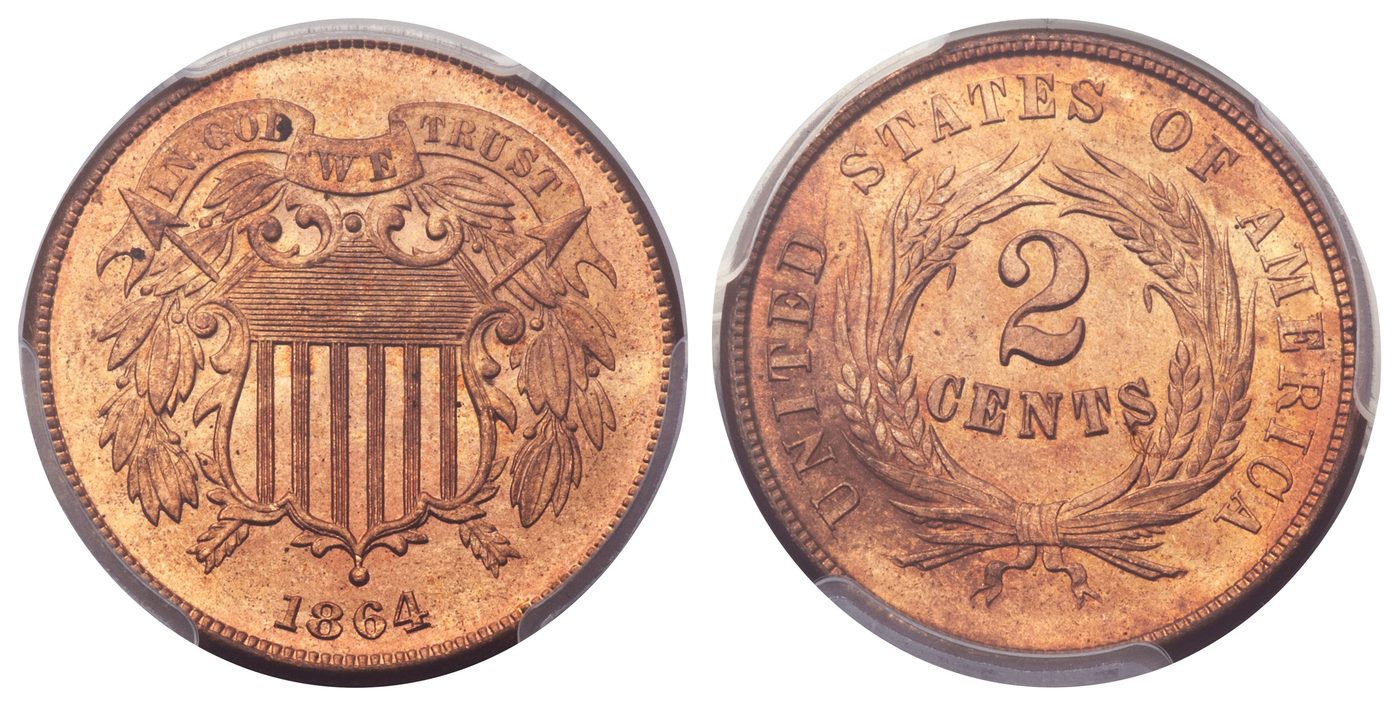
The obverse is dominated by a heraldic shield — the "Union Shield" the series is named for — propped against a pair of crossed arrows and ringed by a laurel wreath. Above it, a furled ribbon carries IN GOD WE TRUST. It's defiant, defensive imagery for a country at war with itself: the shield is the Union, the arrows its readiness. The art historian Cornelius Vermeule later called Longacre's two-cent piece among the most expressive coins of the Civil War era.

The reverse keeps it plain and practical: the words 2 CENTS inside an open wheat wreath, with UNITED STATES OF AMERICA arched around the rim. The edge is smooth (plain) — no reeding. The coin is heavy for its value because it was made of real metal worth something: 95% copper with the remaining 5% tin and zinc — bronze, in other words — at 6.22 grams and 23 millimeters across, a bit wider than today's quarter.

Key facts

Years struck
1864–1873
Designer
James B. Longacre (obverse and reverse)
Composition
95% copper, 5% tin and zinc (bronze)
Weight / diameter
6.22 g / 23.00 mm, plain edge
Historic first
First U.S. coin to bear 'In God We Trust'
Authorizing law
Coinage Act of 1864, signed by Lincoln on April 22, 1864
Mint
Philadelphia only (no mint mark)
Key dates
1864 Small Motto; 1872; 1873 (proof-only)

Collecting it

Here's the rhythm of the series in one number: the Mint struck nearly 20 million two-cent pieces in 1864, and just 65,000 of them in 1872. The denomination peaked instantly and then died slowly. Once the public got the small, convenient nickel three-cent piece in 1865 and the Shield five-cent nickel in 1866, the awkward two-cent coin had no job left to do.

That collapse is what makes the series collectible. The early dates (1864–1865) are everywhere and cheap. The scarcity lives at the end: the 1872 business strike, with a mintage around 65,000, and the 1873, struck only as proofs — collector coins made with polished dies, never released for spending — in two flavors, the "Closed 3" and "Open 3," totaling roughly 1,100 pieces. Those two dates routinely sell for four figures.

The other prize is the 1864 Small Motto. The first 1864 coins used a small version of the motto lettering before the Mint switched to the Large Motto used for the rest of the run. You spot it by the lettering: the "D" in GOD is noticeably smaller, and on the Small Motto the wreath stem under GOD is visible (on the Large Motto it's hidden). PCGS estimates only about 10,000 Small Mottos survive in all grades, with a tiny handful in top mint state.

One more thing collectors chase: color. Bronze coins start out bright red and slowly turn chocolate brown as the copper tones. Graders label a coin Red, Red-Brown, or Brown, and a fully original "Red" coin from the 1860s is genuinely rare — most of these spent decades in circulation or open trays and went brown long ago. A gem two-cent piece with full red surfaces is the real trophy of the series; the record price for the type was set by exactly such a coin.

Questions collectors ask

Was the two-cent piece really the first coin with 'In God We Trust'?

Yes. The 1864 two-cent piece was the first U.S. coin to carry the motto 'In God We Trust.' The idea came from a wartime letter by Reverend Mark R. Watkinson and was championed by Treasury Secretary Salmon P. Chase. The motto has appeared on American coinage ever since and is now required on all U.S. coins and currency.

Why was a two-cent coin made at all?

The Civil War caused a severe shortage of small change as people hoarded silver, gold, and even cents. A heavy bronze two-cent piece was meant to fill the gap. It worked briefly, then lost its purpose once the nickel three-cent piece (1865) and the five-cent nickel (1866) arrived.

What's the difference between the 1864 Small Motto and Large Motto?

They're two varieties of the same year. On the Small Motto, the 'D' in GOD is smaller and the wreath stem beneath GOD is visible; on the Large Motto that stem is hidden. The Small Motto was struck first and is far scarcer — only about 10,000 are thought to survive in all grades.

Which two-cent pieces are actually rare?

The early dates (1864 Large Motto, 1865) are common. The genuinely scarce issues are the 1864 Small Motto, the 1872 business strike (mintage around 65,000), and the 1873, which was struck only as a proof — never for circulation — in Closed 3 and Open 3 varieties totaling roughly 1,100 coins.

Why are high-grade two-cent pieces so expensive?

Bronze tones from bright red to brown over time, and a coin that has kept full original red color for over 150 years is rare. Gem-grade coins with full red surfaces command large premiums; brown circulated examples of common dates remain affordable.

Sources