US coin · series

The Seated Liberty Half Dollar

A silver coin that outlived the man who designed it by nearly fifty years.

The Seated Liberty Half Dollar
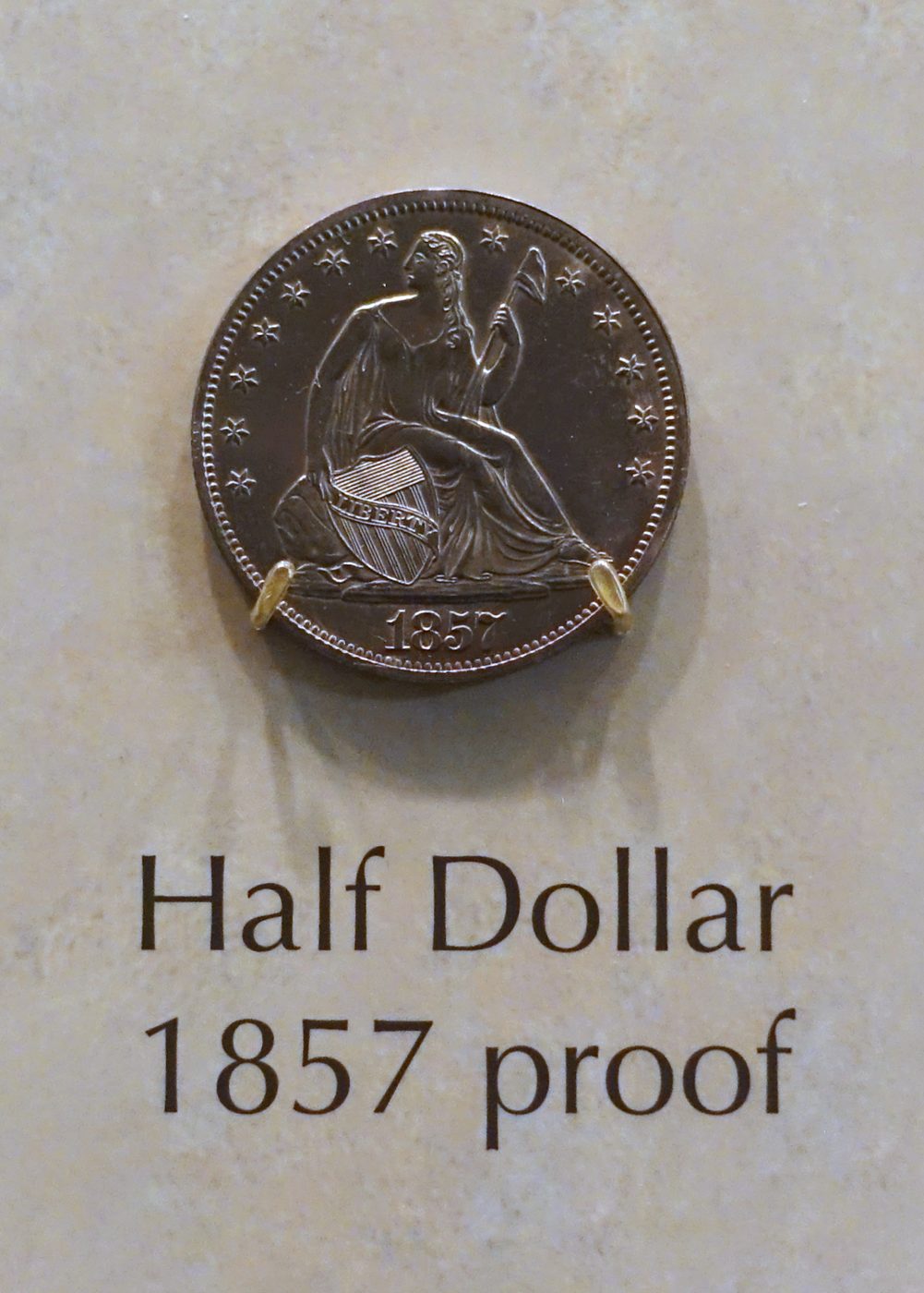
Photograph by Daderot (own work), National Museum of American History / National Numismatic Collection. Coin design by Christian Gobrecht · CC0 · source

For more than half a century, the same calm figure of Liberty sat on the same rock on America's fifty-cent piece — through a gold rush, a civil war, and the silver towns of the Wild West. Christian Gobrecht died in 1844; his half dollar kept rolling out of the Mint until 1891.

The story behind the coin

In the 1830s, the Mint's director, Robert Maskell Patterson, wanted American silver to look less like a parade of stern profile busts and more like the dignified seated figures on British and ancient coins. He commissioned the painter Thomas Sully to sketch a goddess of Liberty seated on a rock — and the Mint's engravers turned that drawing into steel.

The design first appeared on the silver dollar in 1836. One by one, the smaller silver coins adopted it. The half dollar was the last to convert, in 1839 — and once it did, it settled in for the long haul.

What followed was an extraordinary run of 53 years. The same Liberty sat through the California Gold Rush, the Civil War, the opening of the silver mines out West, and the Gilded Age boom. The coin barely changed its face — but the country around it changed completely, and the half dollar quietly recorded every upheaval in small marks: arrows by the date, rays behind the eagle, a new motto over its head. Learn to read those marks and you can date a chapter of American history at a glance.

The design & who made it

The obverse — the heads side — shows Liberty seated on a rock. In one hand she holds a pole topped with a liberty cap, the ancient symbol of a freed person; the other hand steadies a shield marked LIBERTY, the nation on guard. Thirteen stars ring her for the original colonies, with the date below.

The figure was drawn by the portrait painter Thomas Sully and engraved by Christian Gobrecht, the Mint's third Chief Engraver. Gobrecht is the name that sticks to the whole "Seated Liberty" family of coins. He was a Pennsylvania-born craftsman who had engraved clockwork and book plates before the Mint hired him, and he gave America one of its most enduring coin designs — even though he died in 1844, just five years into the half dollar's run.

The reverse — the tails side — carries a naturalistic eagle, wings partly spread, gripping an olive branch (peace) and a bundle of arrows (war), descended from the heraldic-eagle tradition Mint engraver John Reich had established decades earlier. One quiet detail sets the half dollar apart from its smaller cousins: in 1840 the sculptor Robert Ball Hughes was hired to refine the seated figure across the silver series, but the half dollar never received his reworking — it kept Gobrecht's original treatment to the end.

The coin was struck in 90% silver at four mints. A mint mark — a tiny letter saying which mint made it — sits under the eagle: O for New Orleans, S for San Francisco, CC for Carson City, and no letter for Philadelphia.

Key facts

Years struck
1839–1891
Denomination
Half dollar (50 cents)
Obverse design
Thomas Sully (drawing), engraved by Christian Gobrecht
Composition
90% silver, 10% copper
Weight
13.36 g (1839–1853) → 12.44 g (1853–1873) → 12.50 g (1873–1891)
Diameter
30.6 mm
Edge
Reeded
Mints
Philadelphia (none), New Orleans (O), San Francisco (S), Carson City (CC)
Motto added
IN GOD WE TRUST on the reverse, from 1866
Famous rarity
1878-S — only 12,000 struck

Collecting it: key dates, varieties, and why high grades are scarce

The Seated Liberty half dollar is, on its surface, one design. Underneath, it's a puzzle of small variations — and that's exactly what collectors love about it. The marks on the coin track real money crises.

1839 No Drapery. In its very first year, the original obverse left a gap of bare arm under Liberty's elbow. Partway through 1839 the Mint added a fold of drapery there (and reshaped the rock). The early "No Drapery" coins are a one-year sub-type and genuinely scarce, especially in high grade.

1853 Arrows and Rays. This is the headline variety. The California Gold Rush flooded the country with gold and made silver relatively more valuable — so valuable that a half dollar was worth more melted than spent, and coins were vanishing into the melting pot. Congress's Coinage Act of 1853 cut the coin's weight (from 13.36 to 12.44 grams) to kill the profit in melting. To flag the lighter coins, the Mint added small arrowheads beside the date and a burst of rays behind the eagle. The rays were a striking nightmare — they wore out dies fast — and were dropped after a single year, making the 1853 Arrows-and-Rays type a distinct, much-wanted one-year design. Arrows alone stayed through 1855.

1866 With Motto. After the Civil War, a wave of public religious feeling put IN GOD WE TRUST onto American silver. From 1866 the motto appears on a ribbon above the eagle, splitting the series cleanly into "No Motto" (1839–1866) and "With Motto" (1866–1891) halves.

1873–1874 Arrows again. A tiny weight tweak (to 12.50 grams, a round metric figure) brought the arrows back for two years, then they vanished for good.

The great rarities. The single most famous date is the 1878-S, with a reported mintage of just 12,000 — the whole run was swallowed by West Coast commerce, and survivors number in the dozens. The Carson City coins are the other prize: the first-year 1870-CC (around 54,000 struck) is one of the toughest in the series, and the 1874-CC is nearly as elusive. Among legendary issues, the 1853-O without arrows stands apart — struck before the new weight standard took hold, only a tiny handful are known to exist today.

Why are high grades so scarce across the board? These were working coins. A half dollar was real spending money — a day's wage for many — so the vast majority circulated hard for decades and came back worn smooth. A crisp, original Seated half with full detail survived by luck, not design, which is why a sharp example of even a common date commands real attention.
Questions collectors ask

Who designed the Seated Liberty half dollar?

The seated figure of Liberty was drawn by the painter Thomas Sully and engraved by Christian Gobrecht, the U.S. Mint's third Chief Engraver. Gobrecht's name is attached to the whole Seated Liberty family of silver coins, even though he died in 1844, early in the half dollar's run.

What do the arrows and rays on the 1853 half dollar mean?

They flag a weight change. The Coinage Act of 1853 reduced the coin's silver weight so people would stop melting half dollars for profit during the Gold Rush silver squeeze. Arrowheads beside the date and rays behind the eagle marked the new, lighter coins. The rays wore out dies quickly and were used for 1853 only, making that one-year type especially collectible.

Why does the half dollar say IN GOD WE TRUST only after 1866?

The motto was added to U.S. silver and gold coinage after the Civil War, following the Act of March 3, 1865. On the Seated Liberty half dollar it appears on a ribbon above the eagle starting in 1866, which is why collectors split the series into 'No Motto' (1839–1866) and 'With Motto' (1866–1891) halves.

What is the rarest Seated Liberty half dollar?

The 1878-S is the famous key date, with a reported mintage of only 12,000 and just a few dozen believed to survive. The 1870-CC and 1874-CC from Carson City are also major rarities, and the 1853-O struck without arrows is one of the legendary coins of American numismatics, known from only a handful of examples.

Is the Seated Liberty half dollar made of real silver?

Yes. Every year of the series was struck in 90% silver and 10% copper. The amount of silver dropped slightly in 1853 when the coin's weight was reduced, but the alloy stayed 90% silver throughout.

Sources