US coin · series

The Quintuple Stella: America's $20 Bid for a World Currency

In 1879 the Mint struck a gold coin that spelled its own recipe in grams — and made only five of them.

The Quintuple Stella: America's $20 Bid for a World Currency
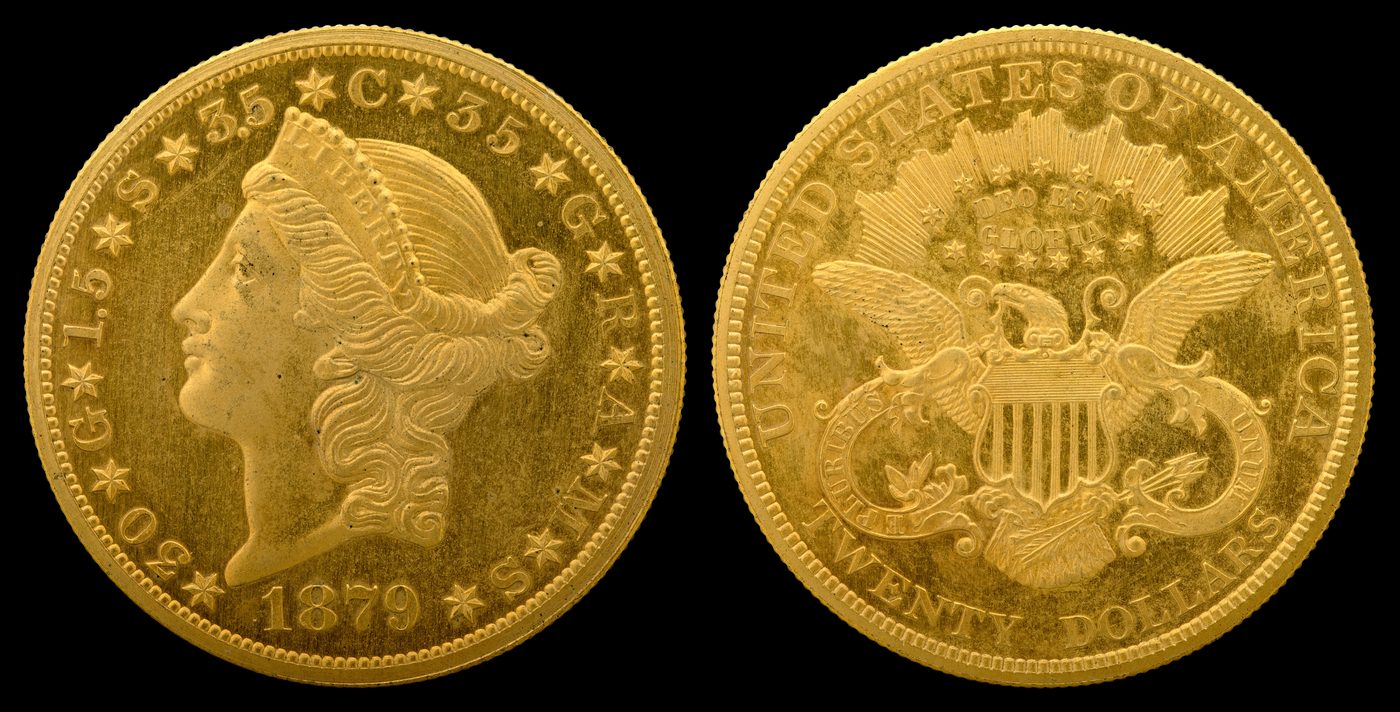
US Mint (coin); National Numismatic Collection, National Museum of American History (photograph by Jaclyn Nash) · public domain · source

In 1879 the United States Mint pressed a $20 gold coin that printed its own recipe on its face — 30 grams gold, 1.5 silver, 3.5 copper, 35 grams in all. It was an experiment in a world currency. Five were struck in gold. Today one of them sold for nearly two million dollars.

The story behind the coin

In the 1870s, paying across borders was a headache. A traveler from New York to Paris to Vienna had to swap dollars for francs for florins, losing a little at each counter. So reformers asked a radical question: what if one coin could spend everywhere?

That dream produced the Quintuple Stella. The push came from John A. Kasson, the U.S. minister to Austria-Hungary and a former chairman of Congress's Committee on Coinage, Weights, and Measures. Kasson proposed a small American gold piece — the $4 "Stella," named for the five-pointed star on its back — sized to slot neatly beside Europe's existing coins. A U.S. $4 would land near the Austrian 8 florins, the French 20 francs, the Italian 20 lire, the Spanish 20 pesetas. It was the same instinct that would build the euro more than a century later.

The Quintuple Stella was the big brother of that idea. As the Numista and Heritage records put it, a metric $20 double eagle was floated as "a further consequence of the Kasson proposal." Quintuple means five-fold: this coin was worth five $4 Stellas. And instead of leaning on the metal standards of the day, it was built and labeled in the metric system, so a clerk in Lyon or Lisbon could read its gold content at a glance.

It never circulated. The Mint's quest for an international coin ended in failure, and Congress let the idea die. But the few pieces that were struck became some of the most coveted objects in American numismatics.

The design and who made it

Look at the Quintuple Stella and you'll think you're looking at a regular $20 Liberty Head double eagle — and you nearly are. The obverse (the heads side) carries the same coroneted head of Liberty, and the reverse shows the same heraldic eagle. Those designs are the work of James Barton Longacre, the Mint's chief engraver who created the Liberty Head double eagle back in 1849.

But two changes give the coin away. Around Liberty's head, where you'd expect stars, runs a string of cryptic marks: ★30★G★1.5★S★3.5★C★35★G★R★A★M★S★. That's the recipe — 30 grams of gold, 1.5 of silver, 3.5 of copper, 35 grams total — stamped right onto the coin so its value could be read anywhere on Earth. And on the reverse, the familiar motto IN GOD WE TRUST is gone, replaced by the Latin DEO EST GLORIA — "to God is the glory." Why the swap? A Latin motto, like the metric weights, was meant to travel.

Here's a wrinkle worth being honest about. Longacre drew the base portrait and eagle, but he had died in 1869 — a decade before this coin existed. The pattern dies, with their metric lettering and Latin motto, were prepared by the Mint's engraving department in 1879 under Chief Engraver William Barber, who himself died that August; his son Charles E. Barber would take the post the next year. So the design is Longacre's; the 1879 dies are Barber-era Mint work. (Catalogs such as Numista credit Longacre as engraver because the portrait and eagle hubs are his.)

The recipe was no accident. It came from Dr. William Wheeler Hubbell of Pennsylvania, who had patented a gold-silver alloy he called "goloid" and championed the metric cause. Congress's Coinage Committee — chaired by Alexander Stephens of Georgia — endorsed both the coin and its composition. The reviews were glowing. The vote never came.

A small charming detail survives in the record: on the first copper trial piece struck, the period in "3.5" was left off by mistake — a tiny human slip frozen into one of the rarest coins America ever made.

Key facts

Year struck
1879 (pattern — never circulated)
Denomination
$20 (a "quintuple Stella" — five times the $4 Stella)
Base design
Liberty Head double eagle by James Barton Longacre
1879 pattern dies
Mint engraving dept. under Chief Engraver William Barber
Composition
30 g gold, 1.5 g silver, 3.5 g copper — 35 g total (~.857 fine gold)
Weight
35 grams
Diameter
34 mm
Edge
Reeded
Reverse motto
DEO EST GLORIA (replacing IN GOD WE TRUST)
Reference
Judd-1643 / Pollock-1843 (gold); Judd-1644 / Pollock-1844 (copper)
Known in gold
Five (one in the Smithsonian's National Numismatic Collection)
Known in copper
About a dozen gilt/plain copper trial pieces
Auction record
$1,880,000 — PCGS PR64 Deep Cameo, Legend Regency, New Orleans, 2016

Collecting it: why so few, and why they cost a fortune

This is not a coin you complete a date set with. It is a coin you might see once. Only five examples are known in gold — and one of those is permanently impounded in the Smithsonian Institution's National Numismatic Collection, which leaves just four that can ever change hands. (Counts of the gold survivors are cited as four to five across sources; the figure most often quoted today, including by PCGS, is five.)

Because they were never made for the public, every gold Quintuple Stella is a proof — a specially prepared presentation strike with mirror fields, made from polished dies. Collectors describe the surviving pieces with terms like Cameo and Deep Cameo, meaning the frosted devices stand out sharply against those mirror backgrounds. The pattern carries a rarity rating in the R-7 range — a few pieces known — which on the standard scale is about as rare as a coin gets without being unique.

There are companions, too. Roughly a dozen trial pieces exist struck in copper, catalogued as Judd-1644 / Pollock-1844, some of them gilt (thinly gold-plated) to mimic the look of the gold strikes. They are far more affordable than the gold — though "affordable" is relative for a coin this storied.

What drives the price isn't just the tiny survivor count. It's the story stamped into the metal: a moment when the United States seriously imagined its money spending in Paris and Vienna, written out in grams and Latin. The gold record stands at $1,880,000, set in 2016 for a PCGS PR64 Deep Cameo example at a Legend Regency auction in New Orleans. These coins also attract the kind of attention that follows great rarities — one gold specimen was stolen in 2008, a reminder that objects this scarce live in a different world from ordinary collecting.

Questions collectors ask

Why is it called a 'Quintuple Stella'?

The $4 gold coin of 1879–1880 was nicknamed the 'Stella' for the five-pointed star on its reverse. This $20 pattern was worth five times as much — five Stellas — so collectors call it the Quintuple Stella. Officially it is the Metric Double Eagle.

What do the numbers around Liberty's head mean?

They are the coin's recipe in metric weights: 30 grams gold, 1.5 grams silver, 3.5 grams copper, 35 grams total. The idea was that anyone in any country could read the coin's exact gold content without converting units.

Why does it say DEO EST GLORIA instead of IN GOD WE TRUST?

DEO EST GLORIA is Latin for 'to God is the glory.' Like the metric weights, a Latin motto was meant to travel — this coin was designed to be understood and spent across Europe, not just at home.

Who actually designed it?

The Liberty Head portrait and the eagle are James Barton Longacre's double-eagle designs. But Longacre died in 1869, so the 1879 pattern dies — with the metric lettering and Latin motto — were prepared by the Mint's engraving department under Chief Engraver William Barber. The metric recipe came from Dr. William Wheeler Hubbell.

How many exist, and what are they worth?

Five are known in gold (one in the Smithsonian), plus about a dozen copper trial pieces. The gold auction record is $1,880,000, set in 2016 for a PCGS PR64 Deep Cameo example.

Did it ever circulate?

No. It was a pattern — a proposal struck to show Congress. The international-coinage plan failed, the idea was never adopted, and the coin was never made for the public.

Sources