US coin · series

The Mercury Dime: a coin that was never Mercury at all

Adolph Weinman put Liberty in a winged cap. A generation looked at it and saw the wrong god.

The Mercury Dime: a coin that was never Mercury at all
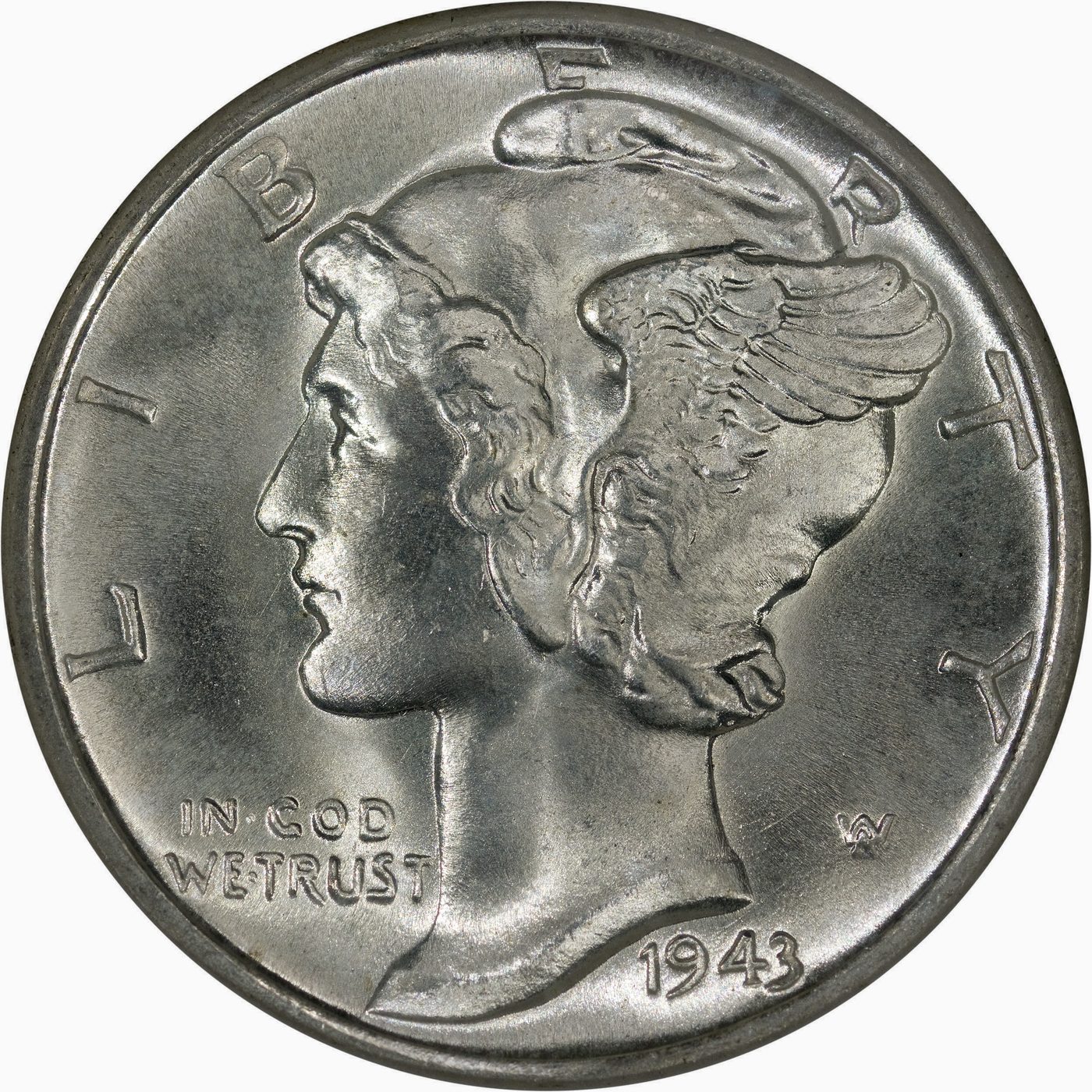
Photograph by Wikimedia Commons user BrandonBigheart; coin design by Adolph A. Weinman · public domain · source

In 1916 the U.S. Mint set out to make its coinage beautiful, and a sculptor named Adolph Weinman gave the ten-cent piece a face so fine that people mistook the goddess Liberty for the messenger god Mercury. The name stuck. The mistake stuck. And for thirty years it rode in pockets across two world wars and the Great Depression.

The story behind the coin

By 1915 the dime in your pocket was old news. The Barber dime — flat, sensible, named for the Mint engraver who drew it — had been struck since 1892. A quirk of U.S. law let the Mint redesign a coin without asking Congress once a design had run twenty-five years. The clock had nearly run out, and the country wanted something better.

This was the height of what collectors now call the Renaissance of American Coinage — a roughly fifteen-year stretch when the Mint, pushed by President Theodore Roosevelt's earlier crusade for art on money, replaced its plain Victorian designs with the work of America's finest sculptors. In 1915 Mint Director Robert W. Woolley ran a quiet competition among three of them — Adolph Weinman, Hermon MacNeil, and Albin Polašek — to redesign the dime, quarter, and half dollar all at once.

Weinman won twice. His designs were chosen for the dime and the half dollar (the Walking Liberty half). The new dime was released on October 30, 1916. It would outlast the war that was already raging in Europe, the boom that followed, and the Depression that followed that.

The design — and the name everybody got wrong

The obverse — the heads side — shows a young Liberty wearing a winged cap. To Weinman the wings meant "liberty of thought." But to most Americans, a winged head meant only one thing: Mercury, the fleet-footed Roman messenger with wings on his sandals and hat. The coin's real name is the Winged Liberty Head dime. Almost nobody calls it that. "Mercury dime" won, and it won completely.

The reverse — the tails side — is where Weinman said the most. He placed a fasces there: a bundle of wooden rods bound around an axe, an ancient Roman emblem of authority and strength through unity. Wrapped around it is an olive branch. The pairing is deliberate — strength and the axe of war on one side, the olive branch of peace on the other. The numismatic author Walter Breen read the message as a modern "Don't tread on me." (The fasces was a common patriotic symbol in 1916, years before Mussolini's movement made the word uncomfortable.)

Weinman never named his model. The long-told story — likely true, never confirmed by him — is that the face belongs to Elsie Stevens, wife of the poet Wallace Stevens, who once rented an apartment from the sculptor. His monogram, the joined letters AW, sits on the obverse near the date.

Key facts

Official name
Winged Liberty Head dime
Years struck
1916–1945 (no dimes 1922, 1932, 1933)
Designer
Adolph A. Weinman (obverse and reverse)
Composition
90% silver, 10% copper
Weight / diameter
2.50 g · 17.91 mm
Silver content
0.07234 troy oz
Mints
Philadelphia, Denver (D), San Francisco (S)
Key date
1916-D — 264,000 struck, lowest of the series
Famous error
1942/1 overdate (Philadelphia and Denver)

Collecting it — the dates that make collectors chase

For most of its run the Mercury dime is common and affordable, which is exactly why a handful of dates command the spotlight.

The 1916-D is the crown jewel. Denver struck just 264,000 of them — the lowest circulation mintage in the whole series. The reason is mundane and wonderful: late in 1916 the Treasury ordered four million quarters to meet an urgent demand, and the Denver Mint dropped everything else to make them. Dimes were the casualty. A genuine 1916-D in high grade can sell for tens of thousands of dollars, and counterfeits — usually a Denver mintmark added to a Philadelphia coin — are common enough that authentication matters more here than almost anywhere in U.S. coins.

The 1942/1 overdate is the great error. It's a doubled-die mistake: a working die took one impression from a 1942 hub and one from a 1941 hub, leaving the ghost of a "1" beneath the "2" in the date. It happened at both Philadelphia (1942/1) and Denver (1942/1-D), and both are prized.

Other scarce dates cluster in the lean year of 1921, when an economic downturn cut coin production sharply (1921 and 1921-D), and again in the Depression, when no dimes at all were struck in 1932 and 1933.

Then there's the detail that separates a good coin from a great one: Full Bands, abbreviated FB. Look at the fasces on the reverse. The horizontal bands binding the rods should show two clean, fully separated lines across the center. On a soft or worn strike they blur together. A coin where those bands are crisp and split is scarcer, harder, and worth a premium — proof that the die was fresh and the strike was sharp. Collectors hunt FB examples the way photographers chase sharp focus.

Questions collectors ask

Is the Mercury dime really Mercury?

No. It depicts Liberty wearing a winged cap, which Weinman said stood for 'liberty of thought.' Because a winged head looked like the Roman god Mercury, the public nicknamed it the Mercury dime, and the name stuck. Its official name is the Winged Liberty Head dime.

Why is the 1916-D Mercury dime so valuable?

The Denver Mint struck only 264,000 in 1916 — the lowest circulation mintage of the series — because it was reassigned to meet an urgent order for quarters. That scarcity makes it the series' key date, especially in high grade. Beware added mintmarks; authentication is essential.

What does 'Full Bands' mean on a Mercury dime?

Full Bands (FB) describes the two horizontal bands across the center of the fasces on the reverse showing complete, separated detail. It signals a sharp strike from a fresh die, is scarcer than a typical strike, and commands a premium.

What is the 1942/1 Mercury dime?

It's a famous overdate error. A die received one impression from a 1942 hub and one from a 1941 hub, leaving traces of a '1' under the '2' in the date. It exists from both Philadelphia and Denver and is highly collectible.

Why did the Mercury dime end in 1945?

President Franklin D. Roosevelt died in April 1945. Because the law let the Mint change a dime without Congress, officials moved quickly to honor him — and the dime was fitting because of his ties to the polio-fighting March of Dimes. The Roosevelt dime debuted on January 30, 1946, his birthday.

How much silver is in a Mercury dime?

Each coin is 90% silver and 10% copper and contains about 0.07234 troy ounces of pure silver. That silver content sets a floor value for common, worn examples regardless of date.

Sources