US coin · series

The Lincoln Wheat Cent

The first circulating U.S. coin to wear a real person's face — and the small change that became a national obsession.

The Lincoln Wheat Cent
U.S. Mint coin (designer Victor David Brenner); image via Wikimedia Commons, no specific photographer credited (PD-USGov) · public domain · source

For more than a century, American coins showed Liberty — never a real person. Putting a once-living face on the nation's money felt too close to a king's portrait. Then, in 1909, a Lithuanian immigrant sculptor put Abraham Lincoln on the penny, and the rule was broken forever.

The story behind the coin

For its first 117 years, the United States kept a quiet rule about its money: no real faces. Coins showed Liberty, eagles, an idealized Native American — symbols, never people. Putting a once-living person on a coin smacked of monarchy, of the kings and emperors the young republic had defined itself against.

The hundredth anniversary of Abraham Lincoln's birth broke that rule. February 12, 1909 marked Lincoln's centennial, and the country wanted to honor the man who had held the Union together. President Theodore Roosevelt — already deep into a campaign to make American coins beautiful again — pushed for a Lincoln portrait on the most ordinary coin of all, the one-cent piece. Every American handled pennies. A Lincoln cent would put the savior of the Union into millions of pockets at once.

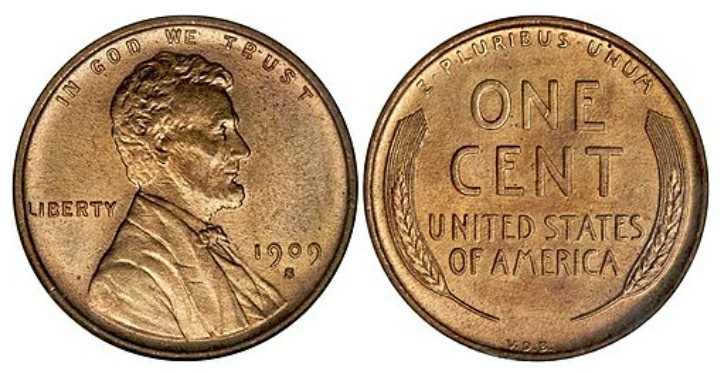
The result, released in August 1909, was the first regular U.S. circulating coin to carry the likeness of an actual historical person. It replaced the Indian Head cent and started a run that lasted half a century. The "wheat cent" nickname comes from its reverse — the reverse is the tails side — where two stalks of wheat frame the words ONE CENT. That design held until 1958.

The design and who made it

The man behind both sides was Victor David Brenner, a sculptor and medalist who had emigrated from Lithuania. Roosevelt had sat for a Brenner plaque of Lincoln and admired it; that portrait became the basis for the coin. Brenner designed the obverse — the heads side — with Lincoln in profile, and the reverse with its two simple wheat ears. He did both.

Then came the row that made the coin famous before anyone had a chance to admire it. Brenner placed his initials — V.D.B. — prominently at the bottom of the reverse, at the 6 o'clock position. To Brenner this was ordinary practice; sculptors sign their work. To critics it looked like a billboard. Newspapers complained that a designer was getting free advertising on the nation's coinage. The outcry was loud enough that the Mint pulled the design within days of its August 2, 1909 debut and ground the initials off the dies by August 6.

That tiny edit is the engine behind the whole series' romance. A handful of coins — struck in those first days, in both Philadelphia and San Francisco — carry the V.D.B. The rest don't. Brenner's credit didn't return until 1918, when his initials reappeared in miniature on the truncation of Lincoln's shoulder, where you'll still find them on the cent today. The lesson the Mint took from 1909: a designer can sign the work, just quietly.

Key facts

Years struck
1909–1958 (wheat reverse)
Designer
Victor David Brenner (obverse and reverse)
Composition
95% copper bronze, 1909–1942 & 1944–1958
Wartime composition
Zinc-coated steel in 1943; shell-case brass (95% Cu) 1944–1946
Diameter
19.05 mm
Weight
3.11 g (bronze); 2.70 g (1943 steel)
Lowest mintage
1909-S VDB — 484,000 struck
Replaced by
Lincoln Memorial reverse (Frank Gasparro), 1959

Collecting it: key dates and famous varieties

The wheat cent is the gateway series for American collectors — common enough that almost anyone can start a folder, deep enough that the best dates command real money. Three issues form the spine of any serious set.

The 1909-S VDB is the king. The San Francisco Mint got the dies late and struck only 484,000 before the initials were removed — the lowest mintage of any regular-issue Lincoln cent. First year, lowest mintage, and the V.D.B. backstory all at once: no wonder it's the coin every wheat-cent collector wants.

The 1914-D (Denver) is the quiet trap. Its mintage of 1,193,000 isn't tiny, but almost none were saved in fresh condition — they circulated until worn smooth. In high, unworn grades it is the rarest regular issue in the series, and it's the date most often counterfeited (often by altering a 1944-D). The 1931-S (San Francisco), at 866,000 struck during the Great Depression, is the second-lowest mintage — but collectors knew it was scarce at the time and hoarded it, so many survive in nice condition. Two low-mintage coins, two opposite survival stories.

Then there are the errors that became legends:

  • The 1922 "Plain" (No-D): in 1922, only Denver struck cents — so every 1922 cent should wear a D. On some, worn and grease-clogged dies left the mintmark missing entirely. The most prized variety comes from a single die pair (Die Pair 2) where the D was polished away during a die repair, producing a genuine "No-D" coin that looks like it was minted nowhere.
  • The 1943 steel cent: with copper needed for shell casings and wiring in World War II, the Mint struck 1943 cents in zinc-coated steel. They came out silvery and magnetic — the only regular U.S. cent you can pick up with a magnet. In 1944 the Mint went back to copper, reclaimed from spent military shell casings, the so-called "shell-case" cents.
  • The 1955 Doubled Die: a working die at the Philadelphia Mint took its second blow from the hub slightly out of register, doubling the date and lettering — LIBERTY and IN GOD WE TRUST appear visibly twice. Roughly 40,000 were struck on a single night shift, and an estimated 20,000–24,000 reached the public mixed in with normal cents. The Mint chose not to chase them down. It remains one of the most dramatic, naked-eye errors in U.S. coinage.

A word on why high grades are scarce. Cents were spending money — they were meant to be spent, not saved. Copper also tones and spots over time, so a wheat cent that kept its full original mint-red color across a hundred years is genuinely uncommon. That's why grade and color matter so much here: a worn 1909-S VDB is a treasure, but a blazing red one in top grade is a different animal entirely.
Questions collectors ask

Why is the 1909-S VDB penny so valuable?

It combines three things collectors prize: it's a first-year coin, it carries the designer's V.D.B. initials that were removed within days, and at 484,000 pieces it has the lowest mintage of any regular-issue Lincoln cent. Demand far outstrips the supply that survived.

What does VDB stand for on a Lincoln penny?

They are the initials of Victor David Brenner, the sculptor who designed both sides of the coin. He placed them prominently at the bottom of the reverse in 1909. After public complaints the Mint removed them, then restored them in tiny form on Lincoln's shoulder in 1918, where they still appear.

Why is the 1943 penny silver-colored?

It isn't silver — it's zinc-coated steel. During World War II copper was needed for the war effort, so the Mint struck 1943 cents in steel. They look silvery and are the only regular U.S. cent that sticks to a magnet. The Mint returned to copper in 1944.

What makes the 1914-D a key date if over a million were made?

Mintage isn't the whole story — survival is. Almost no 1914-D cents were set aside in fresh condition; nearly all circulated until heavily worn. In high, unworn grades it's the rarest regular issue in the series. It's also frequently counterfeited, so certification matters.

When did the wheat penny stop being made?

The wheat reverse was struck through 1958. In 1959, for the 150th anniversary of Lincoln's birth, it was replaced by the Lincoln Memorial reverse designed by Frank Gasparro. Lincoln's portrait stayed on the obverse.

Sources