US coin · series

The Liberty Head Double Eagle: America's $20 Gold Giant

Born in the California Gold Rush, the biggest coin the U.S. had ever made — and the one Theodore Roosevelt couldn't wait to replace.

The Liberty Head Double Eagle: America's $20 Gold Giant
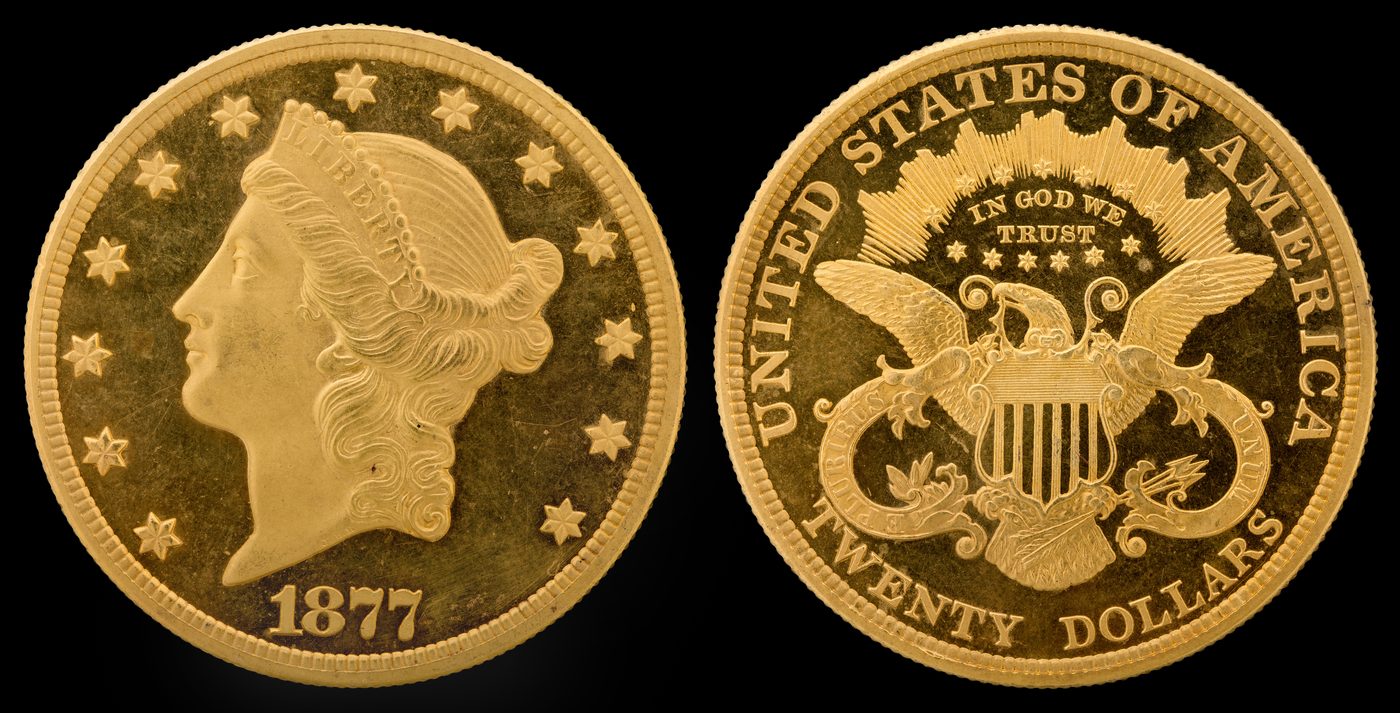
US Mint (coin), National Numismatic Collection, National Museum of American History (photograph by Jaclyn Nash) · public domain · source

In 1849 the United States struck the largest gold coin it had ever attempted — a $20 piece, an ounce of gold, made to soak up the flood pouring out of California. For nearly sixty years it was the workhorse of American wealth. Then it almost vanished entirely.

The story behind the coin

In 1848 a carpenter found gold in a California riverbed, and within a year the United States had a problem most countries would envy: too much gold. Bullion was pouring east faster than the Mint could turn it into coins. The denominations on hand were too small to keep up.

So Congress acted. A bill introduced by Representative James I. McKay became law on March 3, 1849, authorizing two new gold coins — a tiny gold dollar and a giant $20 piece. The big one got a name borrowed from ancient Rome. An "eagle" was the $10 gold coin; twice that was a double eagle.

It was the largest-denomination coin the country had ever circulated — a full ounce of gold in your palm, worth about three weeks' wages for a working man. Not everyone wanted it. Mint Director Robert M. Patterson reportedly grumbled that "there can be no other objection to the Double eagle except that it is not needed." He was outvoted by the gold itself. Once California's metal had a coin big enough to carry it, the double eagle became the way America moved serious money — in bank vaults, in international trade, in the holds of treasure ships.

The design and who made it

The man who designed it was James Barton Longacre, the Mint's Chief Engraver, and he cut both sides. On the obverse — the heads side — Liberty faces left in a coronet, her hair gathered up, ringed by stars. Tradition holds that Longacre modeled her on a Hellenistic sculpture, the Crouching Venus; that pedigree is often repeated but hard to pin down, so treat it as the story collectors tell rather than settled fact. On the reverse, a heraldic eagle spreads its wings behind a shield, clutching arrows and an olive branch.

Getting it made was a fight. Longacre owed his job to political patronage, and the Mint's old guard never forgave him for it. According to numismatist Walter Breen, the Chief Coiner Franklin Peale "with Patterson's tacit approval, began harassment" — Longacre's wax model was ruined during preparation, his first hardened die cracked, and Peale rejected his low-relief work. Longacre appealed over their heads to the Treasury Secretary and kept his post. The coin survived its own birth.

It changed twice over its life, giving collectors three distinct "types" to chase. Type 1 (1850–1866) carries no motto and reads "TWENTY D." Type 2 (1866–1876) adds "IN GOD WE TRUST" in a ring of stars above the eagle — a Civil War-era addition, when a nation bleeding through a war over its own soul reached for God on its money. Type 3 (1877–1907) finally spells the denomination out in full: "TWENTY DOLLARS."

Key facts

Years struck
1849 (pattern), 1850–1907 (circulation)
Denomination
$20 (the 'double eagle')
Designer
James Barton Longacre (obverse and reverse)
Composition
90% gold, 10% copper
Weight / gold content
33.431 g — .96750 troy oz of gold
Diameter
34.1 mm, reeded edge
Mints
Philadelphia (none), New Orleans (O), San Francisco (S), Carson City (CC), Denver (D)
Three types
Type 1 no motto (1850–66); Type 2 motto added (1866–76); Type 3 'TWENTY DOLLARS' (1877–1907)
Replaced by
Saint-Gaudens Double Eagle, 1907

Collecting it: the dates that matter

What makes a double eagle special is rarely the gold — it's the survival story. Millions were struck; the question is always how few of a given date are left, and in what shape.

The crown jewel is the 1849 double eagle. Only a single specimen is known to exist — a pattern, the trial coin that started it all — and it sits in the Smithsonian's National Numismatic Collection. It is one of the most coveted coins in all of American numismatics precisely because no collector can ever own it.

The 1854-S is the first double eagle struck in San Francisco, the city built by the very gold rush that created the coin. The 1856-O from New Orleans is the rarest Type 1: only 2,250 were struck, and perhaps 30 to 40 survive, many of them damaged or cleaned. Two are locked away in the Smithsonian.

The most romantic chapter belongs to the 1861 Paquet reverse. The Mint's assistant engraver, Anthony C. Paquet, tweaked the reverse — taller letters, a narrower rim — and officials quickly decided it wouldn't stack or strike well. Director James Ross Snowden ordered the Philadelphia run melted; only two of those Philadelphia coins are known today, putting it among the great regular-issue rarities. But there was no fast telegraph to San Francisco yet. By the time the order arrived, the San Francisco Mint had already struck 19,250 with the Paquet reverse and pushed them into circulation. That 1861-S Paquet is the rarest San Francisco double eagle of its kind.

Two more pieces of lore: the 1870-CC, first year of the frontier Carson City Mint, with just 3,789 struck — a key date in any cabinet — and the 1857-S, an otherwise common date made extraordinary by the wreck of the SS Central America. The "Ship of Gold" sank in 1857 carrying thousands of fresh double eagles; their recovery from the ocean floor over a century later put gleaming, mint-fresh 1857-S coins into collectors' hands. High grades are scarce across the series for a blunt reason: these were big coins that traveled and got banged up, and after 1933 the U.S. recalled circulating gold and melted enormous quantities — so many survivors today are coins that sat quietly in European bank vaults and came home decades later.

Questions collectors ask

Why is it called a 'double eagle'?

Because the $10 gold coin was the 'eagle,' so the new $20 piece — twice the value — became the 'double eagle.' The names came straight from the founding-era coinage law that set up American gold denominations.

Who designed the Liberty Head Double Eagle?

James Barton Longacre, the Chief Engraver of the U.S. Mint, designed both the obverse (Liberty in a coronet) and the reverse (a heraldic eagle with a shield). He fought Mint insiders to get it produced at all.

What are the three types, and why do they matter?

Type 1 (1850–1866) has no motto and reads 'TWENTY D.' Type 2 (1866–1876) adds 'IN GOD WE TRUST' after the Civil War. Type 3 (1877–1907) spells out 'TWENTY DOLLARS.' A complete type set needs all three, and Type 1 — especially New Orleans and early Carson City coins — is the hardest to find nice.

What is the rarest Liberty Head Double Eagle?

The 1849 is unique — a single pattern in the Smithsonian, never to be owned privately. Among coins a collector can actually buy, the 1861 Paquet reverse (only two Philadelphia examples known), the 1856-O, and the 1870-CC are the famous prizes.

How much gold is in one?

Each contains .96750 troy ounces of gold — just under a full ounce — in a 90% gold, 10% copper alloy. That bullion content is why so many were melted, and why survivors matter.

Why did it disappear in 1907?

President Theodore Roosevelt wanted American coinage to rival ancient art and commissioned the sculptor Augustus Saint-Gaudens. The Saint-Gaudens Double Eagle replaced Longacre's design in 1907, ending the Liberty Head series after nearly sixty years.

Sources