Designer

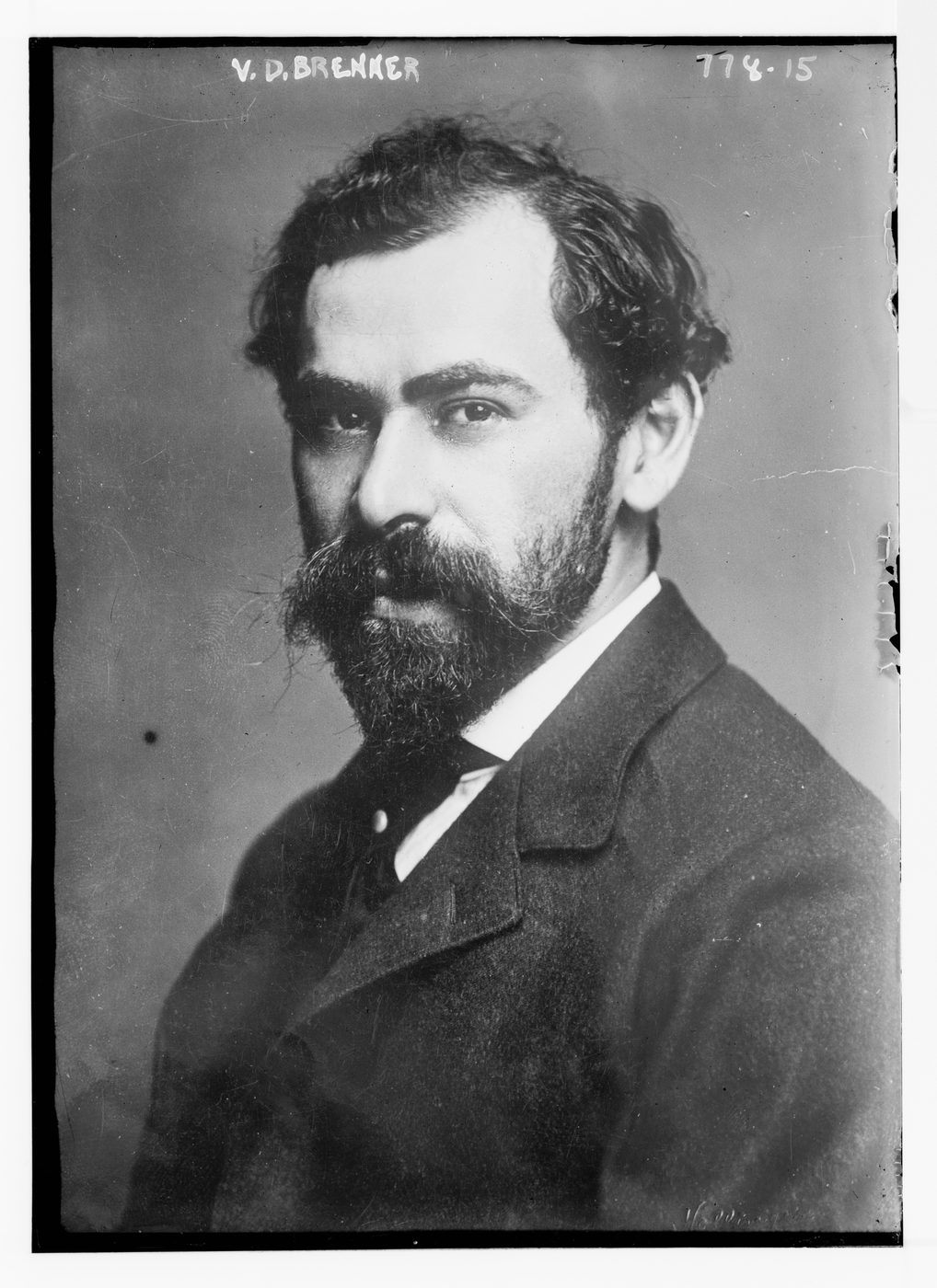
Victor David Brenner

The immigrant engraver who put Lincoln on a penny — and lost his name on it three days later.

Victor David Brenner
Bain News Service, publisher (Library of Congress, LCCN 2014683744) · public domain · source

In 1909 a Lithuanian-born sculptor put Abraham Lincoln's face on the U.S. cent. It became the most-reproduced piece of art in human history. Within days, the government scraped his initials off it.

Who he was

He was born Avigdor David Brenner in Šiauliai, in what was then the Russian Empire's Lithuania, on June 12, 1871. His father was a Jewish gem-and-seal engraver, and that trade — cutting tiny, precise images into hard stone — was the only inheritance Brenner carried when he emigrated to the United States in 1890.

He landed in New York with a skill and almost nothing else. He cut dies and engraved seals for a living and took night classes at Cooper Union to learn the rest. Within a few years he had enough English, enough French, and enough talent to do something most immigrant craftsmen never could: he sailed to Paris.

There, around 1898, he studied under Oscar Roty — the most celebrated medalist in France, the man whose sowing-figure La Semeuse defined French coinage for a generation. Roty taught Brenner how to make a portrait breathe inside a circle a few inches wide. Brenner exhibited his own medals at the Paris Exposition of 1900 and won recognition. He came home not a stonecutter anymore, but an artist.

By the early 1900s Brenner was one of America's finest medalists, turning out portrait plaques and medallions of the famous. One of them — a relief portrait of Abraham Lincoln — would change his life. President Theodore Roosevelt, who sat for Brenner in late 1908 for a Panama Canal service medal, saw the Lincoln plaque and admired it. That admiration became the most-handled commission in the history of money.

The craft — what made his work his

Brenner came up as a medalist, not a coin engraver, and the difference shows in everything he made. A medal is a small, private sculpture you hold in your hand and turn to the light. Brenner learned in Paris to make a face feel alive at that scale — soft modeling, real skin, a sense that the person might turn their head.

That instinct is exactly what he brought to the cent. Look at the obverse — the heads side. Lincoln is not a stiff emblem; he's a tired, thoughtful man caught mid-thought. Brenner is presumed to have based the profile on a photograph of Lincoln taken in February 1864 by Anthony Berger at Mathew Brady's Washington studio, and he sculpted it the way he sculpted his portrait plaques: as a living likeness, not a symbol.

It was a quiet revolution. Lincoln was the first real, identifiable person to appear on a regular U.S. circulating coin — before him, the cent and its cousins wore allegorical figures of Liberty, not Americans. Brenner's choice helped open the door to the portrait coinage Americans now take for granted.

For the reverse — the tails side — he kept it just as plain and just as deliberate: two ears of durum wheat framing the words, an old symbol of prosperity, the design that gave the coin its nickname, the "wheat penny." Brenner believed a coin's job was to carry one clear idea beautifully. He distrusted clutter. That restraint is why his Lincoln still works on a coin minted today.

Key facts

Born
June 12, 1871 — Šiauliai, Lithuania (Russian Empire)
Died
April 5, 1924 — New York
Nationality
Lithuanian-American (Jewish émigré, naturalized U.S.)
Trained
Cooper Union (New York); Académie Julian, Paris, under Oscar Roty (~1898)
Best known for
The obverse of the Lincoln cent (1909–present)
Signature mark
The initials VDB — removed in 1909, restored in 1918
Other works
Portrait medals & plaques; Panama Canal service medal (Theodore Roosevelt)

A career in relief

  1. 1871Born Avigdor David Brenner in Šiauliai, Lithuania, son of a gem-and-seal engraver.
  2. 1890Emigrates to the United States, settling in the New York area.
  3. ~1898Studies medal-making in Paris under Oscar Roty at the Académie Julian.
  4. 1900Exhibits his medals at the Paris Exposition and earns recognition.
  5. 1908Sculpts Theodore Roosevelt for a Panama Canal service medal; Roosevelt admires Brenner's Lincoln plaque.
  6. 1909His Lincoln cent is released August 2 for Lincoln's centennial — the first real person on a U.S. circulating coin. His VDB initials are removed days later.
  7. 1918Brenner's VDB initials are quietly restored to the coin, below Lincoln's shoulder, where they remain.
  8. 1924Dies in New York at 52.

The three letters that started a war

When Brenner sent in his finished model, he had signed it with his full name. The Mint director, Frank A. Leach, decided that was too much and had it cut down to three initials instead — V.D.B. — tucked along the bottom of the reverse between the wheat stalks. (Signing a coin with initials was ordinary practice in Europe, where Brenner had trained.)

The new cent was released on August 2, 1909, and it was an instant sensation — people lined up at banks to get one. Then the press noticed the initials. Critics called them too big, an artist advertising himself on the public's money. The Mint's own chief engraver, Charles E. Barber, had disliked the whole Lincoln cent from the start, and he pushed hard for the initials to go. Barber even objected to leaving a single "B," because he used a B on his own coins and didn't want Brenner's design mistaken for his.

The reaction from Washington was fast and absolute. On August 5 — three days after release — Treasury Secretary Franklin MacVeagh ordered coinage of the cent suspended, and by roughly August 12 the dies were being reworked with the initials ground off entirely. Millions of "VDB" cents had already left the Mint; the rest of 1909 and every year after came out bare.

Brenner objected — he believed an artist deserved credit on his own work — but he was overruled. (You'll often read that he threatened to sue; that detail circulates widely but is not firmly documented, so treat it as collector lore rather than fact.) His name stayed off the coin for nine years. Only in 1918 did the Mint quietly restore the initials, this time as three tiny letters tucked under the cut of Lincoln's shoulder — so small most people who've handled the coin all their lives have never noticed them.

The scrubbing is also why one date towers over the whole series. Only 484,000 cents carrying the VDB initials were struck at the San Francisco Mint in 1909 before the order came down. That coin — the 1909-S VDB — is the most famous and most chased penny in American collecting, the crown of any Lincoln set.

Questions collectors ask

What does VDB stand for?

Victor David Brenner, the artist who designed the Lincoln cent. He placed his three initials on the coin as his signature.

Why were the VDB initials removed in 1909?

Critics complained the initials were too prominent — an artist advertising himself on public money — and the Mint's own chief engraver pushed to remove them. Treasury suspended coinage on August 5, 1909, three days after release, and the dies were reworked without the initials. They returned in 1918 as tiny letters below Lincoln's shoulder.

Did Victor David Brenner design the whole Lincoln cent?

He designed the obverse — the Lincoln portrait — and the original wheat-stalk reverse used from 1909 to 1958. Later reverses (the Lincoln Memorial in 1959, the 2009 bicentennial designs, and the Union Shield from 2010) were by other artists, but Brenner's Lincoln portrait has stayed on the front the entire time.

Is Brenner's design still on the penny today?

Yes. His Lincoln portrait has appeared on the cent every year since 1909, making it the longest-running design on any U.S. circulating coin — and one of the most reproduced images in the world.

Was Brenner an American?

He became one. He was born in Lithuania in 1871 and emigrated to the United States in 1890, where he trained and built his career as a medalist before designing the cent.

Sources