US coin · series

The Twenty-Cent Piece: The Coin Nobody Wanted

For three years America minted a 20-cent coin — then quietly killed it for looking too much like the quarter.

The Twenty-Cent Piece: The Coin Nobody Wanted
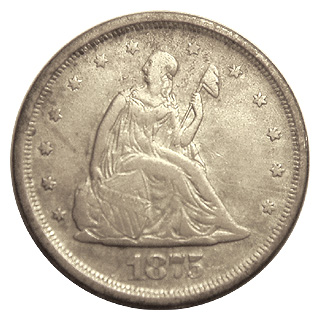
Splarka (English Wikipedia editor); coin by the U.S. Mint · public domain · source

In 1875 the United States introduced a brand-new silver coin worth twenty cents. It was almost the same size as the quarter, wore almost the same design, and confused almost everyone who touched it. Within three years Congress abolished it. Today it is one of the most collectible failures in American money.

The story behind the coin

The twenty-cent piece was born to solve a problem most people had stopped noticing — and ended up creating a bigger one.

Out West in the early 1870s, small change was genuinely scarce. The minor coins Americans needed for everyday purchases were struck only at the Philadelphia Mint, far from California and Nevada, and shipping them across the country was slow and costly. To fill the gap, Westerners still leaned on the old Spanish silver "bit" — one-eighth of a Spanish dollar, worth about 12.5 cents. There was no U.S. coin that matched it. A customer who handed over a quarter for a "short bit" purchase was often given a dime in change instead of the 12.5 cents owed — and quietly cheated of a couple of pennies on every transaction.

Nevada Senator John P. Jones — a silver-mine owner himself, with a stake in keeping silver flowing into coins — introduced a bill in 1874 to create a twenty-cent piece. The idea was that a 20-cent coin would let merchants make honest change on those small Western purchases. Congress went along, in part as a courtesy to Jones. President Grant signed it into law on March 3, 1875, and the Mint went to work.

The trouble showed up the moment the coins reached pockets. The twenty-cent piece was just a little smaller than the quarter and carried nearly the same design — so people kept mistaking one for the other and overpaying or undercharging by a nickel. A coin meant to end confusion had become its source. The public turned against it almost immediately.

The design

The twenty-cent piece looks like a quarter because, in essence, it was drawn from the same family of designs.

The obverse — the heads side — carries the seated figure of Liberty that Christian Gobrecht had created back in 1836: Liberty resting on a rock, one hand steadying a shield marked "LIBERTY," the other holding a pole topped with a soft cap. Thirteen stars ring her, with the date below. It was the same image already on the era's dimes, quarters, half dollars, and dollars — instantly familiar, and that was exactly the problem.

The reverse was the work of William Barber, the Mint's Chief Engraver. He adapted the bold, left-facing eagle he had designed for the Trade dollar, ringed by UNITED STATES OF AMERICA and the denomination TWENTY CENTS. The Mint's one real attempt to set the coin apart was its edge: the twenty-cent piece has a plain edge — smooth, with no ridges — while the quarter's edge is reeded, cut with fine vertical grooves. In theory you could tell them apart by feel. In practice the grooves on a worn quarter often flattened out, and the trick failed.

Key facts

Years struck
1875–1878 (proof-only after 1876)
Obverse design
Seated Liberty (after Christian Gobrecht, 1836)
Reverse design
Eagle by William Barber (Chief Engraver)
Composition
90% silver, 10% copper
Weight / diameter
5.0 g / 22.0 mm
Edge
Plain (the quarter's is reeded)
Authorized
Act of March 3, 1875
Abolished
Act of May 2, 1878
Highest mintage
1875-S — 1,155,000 struck
Famous rarity
1876-CC — 10,000 struck, nearly all melted; ~17–20 known

Collecting it

Because the denomination lived only three years, a complete date-and-mint set is short — and that is part of its appeal. The whole run can be laid out on a single tray, yet it includes one of the most famous rarities in U.S. coinage.

The common coin is the 1875-S, struck at San Francisco in the largest numbers — 1,155,000 pieces. It is the date most collectors own and the one most often seen. The 1875 Philadelphia and 1875-CC Carson City issues are scarcer; circulation figures for the 1875 Philadelphia coin vary across references (sources cite figures in the high 30,000s), so treat any exact number with care.

Then there is the 1876-CC, the coin that turns this short series into a legend. By 1876 the denomination was already dying, and Carson City's run of 10,000 pieces had nowhere to go. In May 1877 the Mint Director ordered Carson City's superintendent to melt the twenty-cent pieces on hand. Almost all of them went into the furnace. Researchers today account for only about 17 to 20 surviving examples — making the 1876-CC one of the great American rarities. Top specimens have sold at auction for sums in the hundreds of thousands of dollars; one example brought $870,000 in 2022.

The final two years tell the story plainly. After 1876, no twenty-cent pieces were made for circulation at all. The Mint struck only a few hundred proofs each in 1877 and 1878 — coins made with polished dies and mirror-like fields, produced for collectors rather than commerce — before Congress put the denomination out of its misery. (A proof is a specially prepared collector strike, not a grade.)

Questions collectors ask

Why did the twenty-cent piece fail?

It looked and felt too much like the quarter. At 22 mm it was only slightly smaller than the 24.3 mm quarter, and it wore the same Seated Liberty obverse. People constantly confused the two and made change wrong. The public rejected it almost at once, and Congress abolished the denomination in 1878 — barely three years after authorizing it.

How can I tell a twenty-cent piece from a quarter?

Look at the edge and the reverse. The twenty-cent piece has a plain, smooth edge and the words TWENTY CENTS on the back; the quarter has a reeded (grooved) edge and reads QUARTER DOLLAR. The twenty-cent coin is also a touch smaller and lighter. The edge test was the Mint's intended fix — but worn quarters lose their reeding, which is part of why it didn't work in everyday use.

Why is the 1876-CC twenty-cent piece so valuable?

Carson City struck 10,000 of them in 1876, but by then the denomination was dying. In 1877 the Mint ordered nearly all of them melted, so only about 17 to 20 are known to survive today. That extreme scarcity, plus the romance of the short-lived Carson City Mint, makes the 1876-CC one of the most coveted U.S. coins — top examples have sold for hundreds of thousands of dollars.

Were any twenty-cent pieces made just for collectors?

Yes. After the 1876 circulation issues, the only twenty-cent pieces struck in 1877 and 1878 were proofs — a few hundred each, made at Philadelphia for collectors. No business-strike coins were issued in those final two years.

Who designed the twenty-cent piece?

The obverse reuses Christian Gobrecht's 1836 Seated Liberty figure. The reverse eagle was designed by William Barber, the U.S. Mint's Chief Engraver, adapted from his Trade dollar eagle.

Sources