US coin · series

The Trade Dollar: a U.S. coin made to win Asia, then disowned at home

Silver that crossed the Pacific by the millions — and got stripped of its legal-tender status while it sat in American pockets.

The Trade Dollar: a U.S. coin made to win Asia, then disowned at home
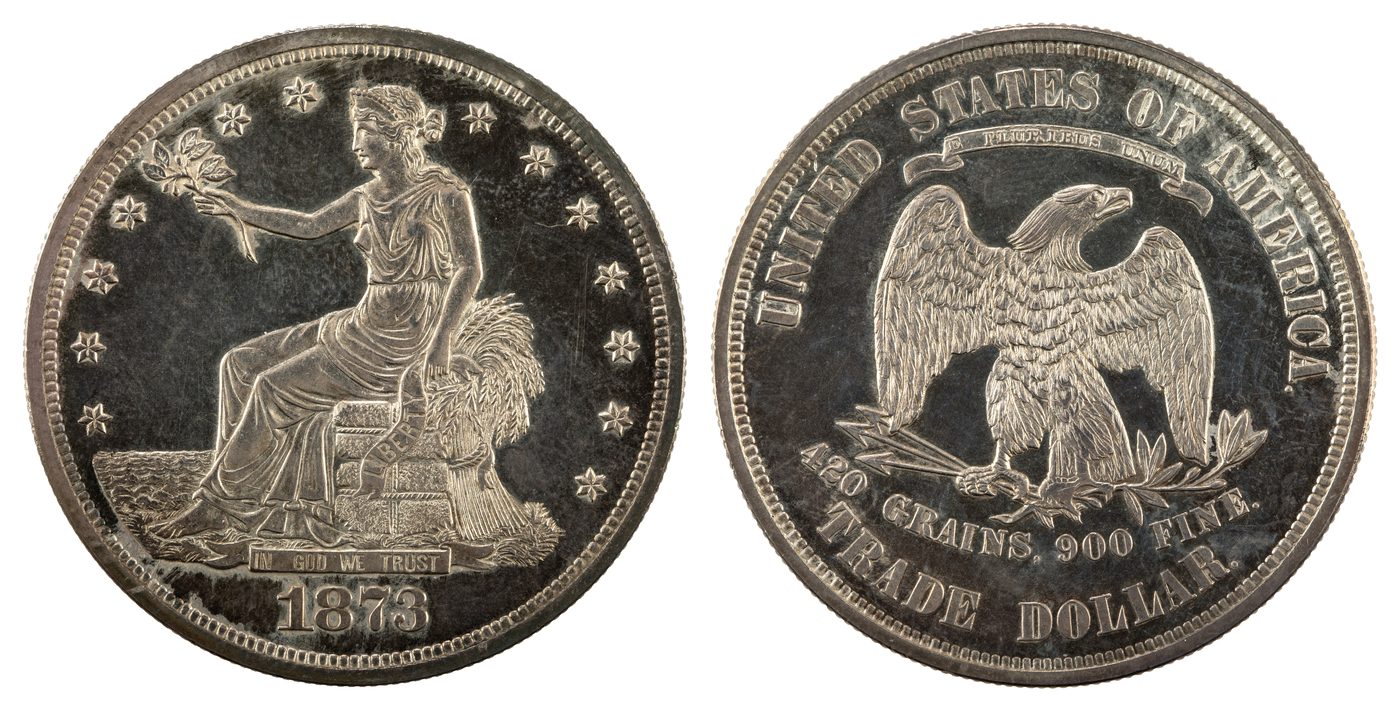
National Numismatic Collection, National Museum of American History (photograph by Jaclyn Nash) · public domain · source

In 1876 the United States did something it had never done before and has never done since: it told Americans that a coin still in their pockets was no longer money. That coin was the Trade Dollar — built to beat the Mexican peso in the markets of China, and then abandoned by the country that minted it.

The story behind the coin

By the early 1870s the United States had a glut of silver and a problem with where to spend it. New strikes in the American West — the Comstock Lode above all — were pulling silver out of the ground faster than the country could use it, and the price was sliding. Meanwhile, on the other side of the Pacific, a different silver coin ruled the wharves of Canton and Shanghai: the Mexican peso, descendant of the old Spanish dollar, the coin Chinese merchants trusted by weight and habit.

The idea was simple and a little audacious. If American silver could be struck into a coin Chinese merchants would accept instead of the peso, the West's silver would have a buyer and U.S. trade in the East would have a foothold. Congress agreed, and the Coinage Act of 1873 authorized the Trade Dollar — a coin designed not to circulate in America at all, but to be exported, sold to merchants, and shipped across the ocean as bullion you could count.

To make the pitch, the Mint did something telling: it made the Trade Dollar heavier than a regular silver dollar. It carried 420 grains of standard silver against the 412.5 of the ordinary dollar — and it said so, right on the coin. The reverse is stamped 420 GRAINS, 900 FINE. This was a coin that advertised its own silver content to a buyer half a world away who cared about exactly one thing: how much metal was really there.

Then the plan went sideways. Silver kept falling. By the late 1870s the bullion in a Trade Dollar was worth less than a dollar, and the coins began drifting back from the docks into American commerce — used at face value by people who had no idea they were holding what Washington now considered a leftover. Congress's response, in an act of July 22, 1876, was to demonetize the coin: strip it of legal-tender status entirely. (It had carried a five-dollar legal-tender ceiling to begin with, the result of a drafting quirk; 1876 removed even that.) The Mint kept making them for export through 1878, then stopped striking them for circulation altogether.

The design — and who made it

Both sides of the Trade Dollar came from William Barber, the Mint's Chief Engraver, and they read like a sales brochure for American silver.

The obverse — the heads side — shows Liberty seated, but not the familiar Seated Liberty of the era's other coins. She faces left, toward a stylized sea, perched on a bale of merchandise with a sheaf of wheat behind her. In one hand she holds an olive branch; the other extends a ribbon reading LIBERTY. The whole scene is an argument: here is American abundance, American commerce, facing west across the Pacific toward its new market.

The reverse carries a bald eagle clutching three arrows in one talon and an olive branch in the other — and, unusually, the arrangement is flipped from the other U.S. silver coins of the day. Around it run the inscriptions that mattered most to the coin's actual job: UNITED STATES OF AMERICA, TRADE DOLLAR, and the bullion guarantee, 420 GRAINS, 900 FINE. The edge is reeded; the coin is broad and substantial at 38.1 mm across and 27.2 grams in hand.

A small detail rewards a close look. Partway through the run the Mint quietly reworked both dies, and collectors split the coin into a Type I and Type II obverse and reverse. The easiest tell is on the reverse: the early (Type I) die has a tiny berry below the eagle's claw, and the later (Type II) die does not. Liberty's extended hand changed too — the later obverse adds a fourth visible finger. These look like trivia until you realize they let collectors date the exact moment, in 1875 and 1876, when the Mint was fine-tuning a coin it was still betting on.

William Barber himself was an Englishman — born in London in 1807 — who came to America and rose to Chief Engraver in 1869, succeeding James B. Longacre. The Trade Dollar and the short-lived Twenty-Cent Piece are his best-known regular issues. When he died in 1879, his son Charles E. Barber took the post and went on to design the coins that still carry the family name.

Key facts

Years struck
1873–1885 (circulation strikes through 1878; proof-only 1879–1885)
Designer
William Barber — obverse and reverse
Composition
90% silver, 10% copper
Weight
420 grains (27.2 g) — heavier than the standard silver dollar's 412.5 grains
Diameter
38.1 mm; reeded edge
Mints & mint marks
Philadelphia (none), San Francisco (S), Carson City (CC)
Purpose
Export to East Asia to compete with the Mexican peso
Demonetized
July 22, 1876 — legal-tender status removed; restored by the Coinage Act of 1965
Rarest business strike
1878-CC — roughly 97,000 struck, many later melted
Rarest proofs
1884 (about 10 known) and 1885 (about 5 known)

Collecting it — key dates, varieties, and why grade matters

The Trade Dollar is a series where the story and the scarcity line up, which is exactly what makes collectors chase it.

The famous proofs. The two most legendary dates aren't circulation coins at all. By 1879 the Mint had stopped striking Trade Dollars for export and was making them only as proofs — specially struck, mirror-finish coins for collectors — through 1883. Then come the 1884 and 1885 proofs, which appear in no Mint production records and only surfaced years later. About ten of the 1884 are known and only five of the 1885. They were almost certainly struck quietly inside the Philadelphia Mint and slipped out privately. Collectors tell a story — often repeated, never fully documented — tracing them to a well-connected Philadelphia coin dealer named William Idler. Treat that as the traditional account rather than settled fact; what is settled is that these are among the most coveted U.S. silver coins in existence, and a single 1885 has sold for a seven-figure sum.

The key business strike. Among coins actually meant to circulate, the prize is the 1878-CC from Carson City — roughly 97,000 struck, and a large share melted before they ever left the Mint, which is why survivors are genuinely scarce in any grade and very rare in high grade.

The varieties. The Type I and Type II obverse/reverse dies (the berry-below-the-claw tell on the reverse, the finger count on the obverse) create combinations collectors hunt date by date — including a scarce 1876 "transitional" pairing and well-known oddities like the 1875-S over CC and the 1876-CC doubled die reverse.

Chopmarks. Many surviving Trade Dollars carry chopmarks — small punches that Chinese and other Asian merchants stamped into the silver to vouch that they'd checked the metal and it was good. For a century collectors saw chopmarks as damage. Today the major grading services certify chopmarked coins as their own category, because each one is physical proof the coin did the job it was made for: it crossed the Pacific and passed through real hands in real markets.

Why high grades are scarce. This was working money in two senses. The coins that stayed home circulated, and the coins that went abroad were weighed, stacked, and chopped. On top of that, the redemption of 1887 — Congress gave holders six months to turn Trade Dollars in — pulled millions of coins out of circulation to be melted and recoined, much of it into Morgan Dollars. Of roughly $36 million face value struck, somewhere around $7.6 million came back to be destroyed. A coin that survived all of that and stayed sharp and lustrous is a small miracle, which is why condition drives Trade Dollar prices as sharply as date does.

Questions collectors ask

Why was the Trade Dollar made if it wasn't for use in America?

It was built for export. In the 1870s the U.S. had a flood of cheap Western silver and wanted a coin that East Asian merchants — especially in China — would take in place of the dominant Mexican peso. The Trade Dollar was struck to be shipped abroad and traded by its silver weight, which is why the reverse is stamped '420 GRAINS, 900 FINE.'

What does it mean that the Trade Dollar was 'demonetized'?

In an act of July 22, 1876, Congress removed the coin's legal-tender status — meaning it was no longer official money you could be required to accept, even though millions were already in circulation. It's the only regular U.S. coin ever demonetized while in active use. The Coinage Act of 1965 eventually restored legal-tender status to all U.S. coins, including this one.

What are chopmarks, and do they hurt the value?

Chopmarks are small punches Asian merchants stamped into the silver to confirm they had tested it. For decades they were treated as damage. Today the major grading services certify chopmarked Trade Dollars as a distinct, collectible category — many collectors prize them precisely because they prove the coin actually circulated in the Asian trade it was built for.

Why are the 1884 and 1885 Trade Dollars so famous?

They aren't in any Mint production record. Circulation striking had ended in 1878 and proof striking was supposed to have ended by 1883, yet a handful of 1884 and 1885 proofs exist — about ten and five known, respectively. They were almost certainly struck unofficially inside the Philadelphia Mint and only came to light years later, which makes them among the rarest and most valuable U.S. silver coins.

What is the rarest Trade Dollar you could realistically find?

Of the coins actually made for circulation, the 1878-CC from Carson City is the key date — only about 97,000 were struck and many were melted, so high-grade survivors are genuinely scarce. The 1884 and 1885 proofs are rarer still, but those are museum-and-auction-record coins, not pieces that turn up in an inherited box.

Sources