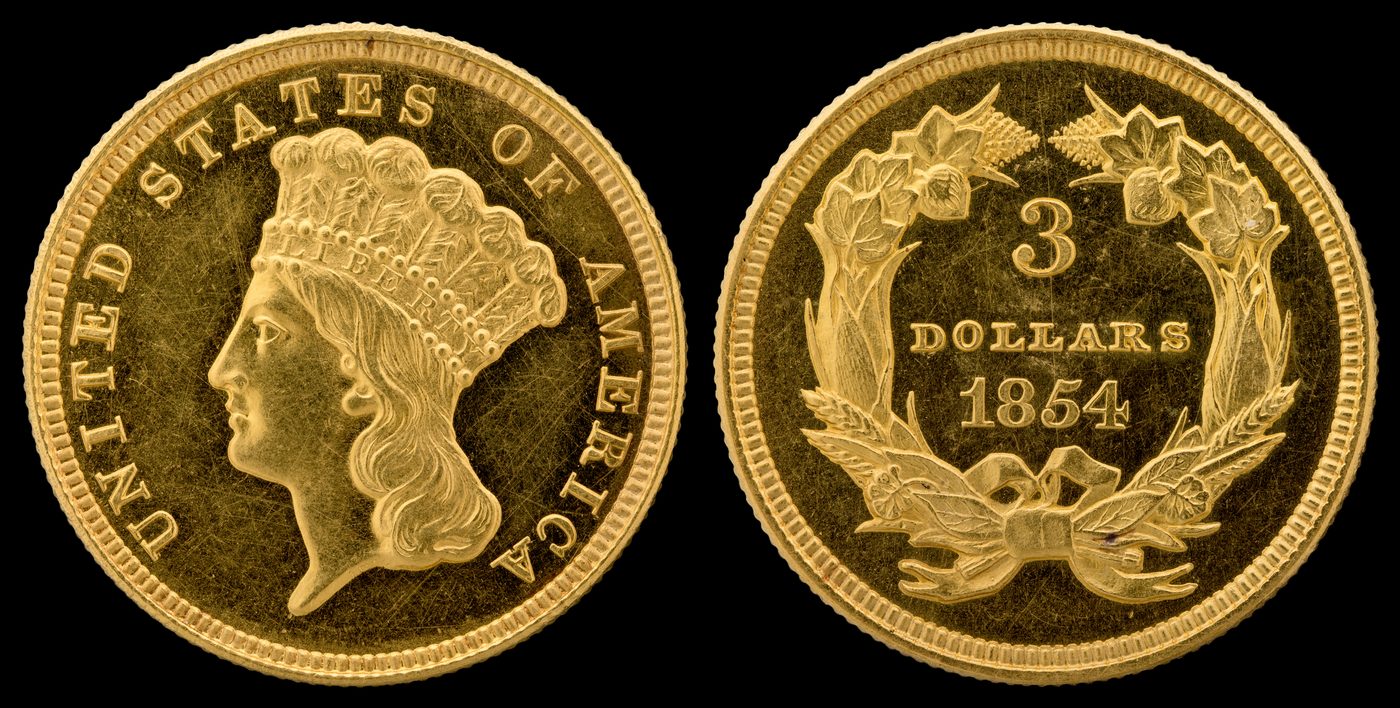
The story behind the coin
Three dollars. Of all the round numbers a coin could carry, the United States chose one of the oddest — and minted it in gold.
The three-dollar piece was authorized by the Act of February 21, 1853, and first struck on April 28, 1854. The official excuse was postal: a sheet of 100 of the new three-cent stamps cost exactly three dollars, and a single gold coin could buy one without fishing out a fistful of unloved copper cents. It is a tidy story, and historians have doubted it for over a century. The numismatist Walter Hagans pinned the real reason on something simpler — the flood of California gold after 1849, which gave the Mint more metal than it had denominations to absorb.
Whatever the cause, the coin landed in a country that didn't need it. The quarter eagle ($2.50) already sat right beside it. So the chief engraver, James Barton Longacre, deliberately made the $3 look different — a thinner, wider coin you couldn't mistake for its neighbor in the dark.
Then history finished it off. When the Civil War broke out in 1861, gold vanished from circulation in the East — banks stopped paying it out at face value, and Americans hoarded every yellow coin they could find. The three-dollar piece never came back to Eastern pockets. It limped on for decades anyway, struck in ever-smaller numbers, mostly so collectors could buy fresh examples straight from the Mint. In 1889 the Mint's own director, James P. Kimball, wrote that it "serves no useful purpose, its present coinage being in fact limited to its production for cabinet [collecting] purposes." Congress abolished it the next year.