US coin · series

The Shield Nickel: America's First Nickel

A wartime fix that became the coin so hard it shattered its own dies.

The Shield Nickel: America's First Nickel
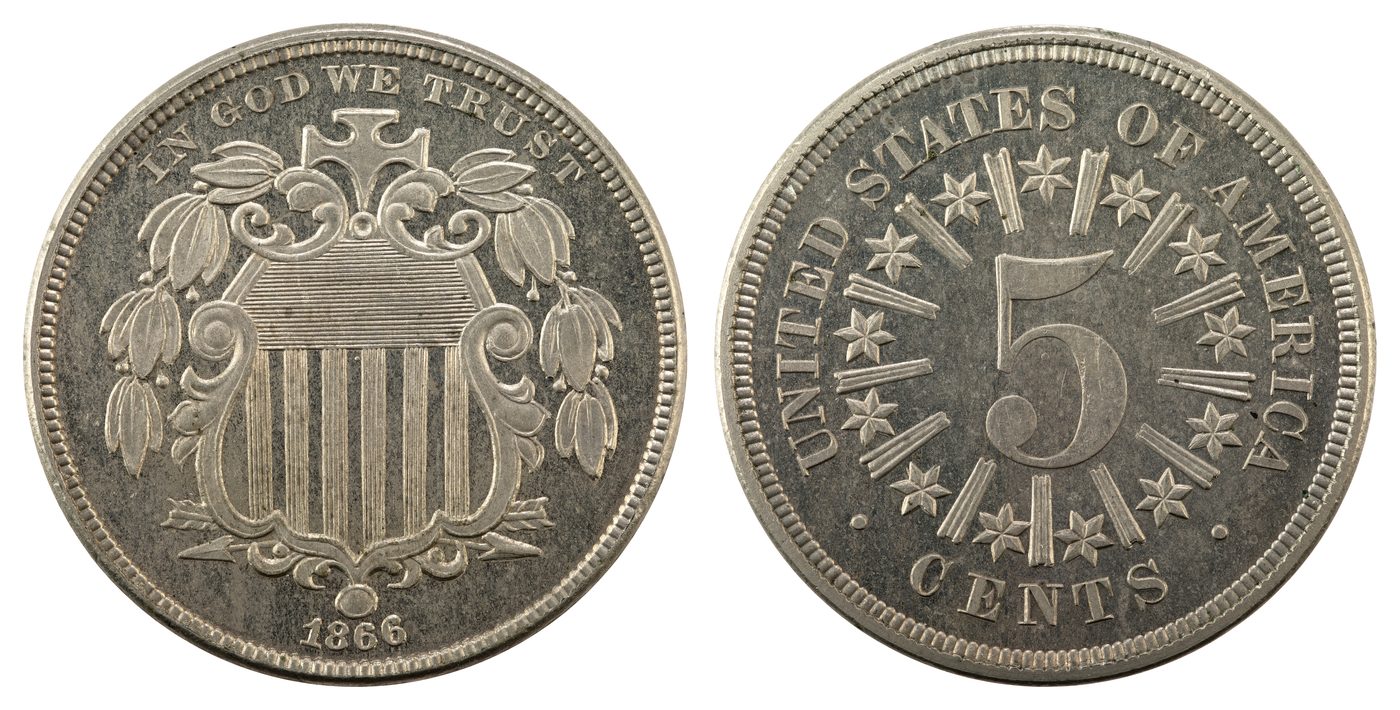
National Numismatic Collection, National Museum of American History (photograph by Jaclyn Nash); coin designed by James B. Longacre, US Mint · public domain · source

In 1866 the United States struck a five-cent coin out of a brand-new metal mix — and almost immediately regretted it. The alloy was so tough it cracked the Mint's steel dies faster than they could be made. The Shield Nickel is the coin that taught America how hard nickel really is.

The story behind the coin

By 1866, real money had vanished from American pockets. The Civil War had pulled gold and silver out of circulation — people hoarded anything with metal value, and the little silver half dime (a five-cent coin since 1792) disappeared into mattresses and melting pots. To make change at all, the country was using paper "fractional currency" and merchant tokens. It was a mess.

Into that gap stepped a powerful businessman. Joseph Wharton held a near-monopoly on nickel mining in the United States, and he wanted Washington to put his metal into coins. He got his wish. On May 16, 1866, Congress authorized a new five-cent piece made of copper and nickel — the first U.S. coin of that mix, and the direct ancestor of the nickel you carry today.

Here's the twist collectors love. The new nickel didn't replace the silver half dime — it joined it. For seven years, the country had two different five-cent coins in circulation at once: the tiny silver one and the fat new copper-nickel one. The half dime was finally killed off by the Coinage Act of 1873, leaving the Shield Nickel as the nation's only five-cent piece.

The design — and who made it

The Shield Nickel was the work of James B. Longacre, the Mint's Chief Engraver, who designed both sides. He was working under pressure — the law passed and the coin had to appear fast.

The obverse — the heads side — shows a shield, the same Union shield Longacre had already used on the two-cent piece, flanked by olive branches (peace) and arrows (war), with a cross at the top. The reverse — the tails side — carries a big numeral 5 ringed by stars. In the first version, sunburst rays shot out between those stars. That detail became the coin's most famous feature.

Almost nobody liked it. Wharton himself reportedly mocked the design as "a tombstone surmounted by a cross and overhung by weeping willows." Worse, in the raw years right after the war, the shield-and-cross looked to some eyes like Confederate symbolism. But the real problem wasn't taste — it was physics. Nickel is brutally hard. The alloy resisted the press so badly that the coins came out weakly struck and the dies (the engraved steel stamps that strike each coin) wore out almost as fast as the Mint could cut them. Early in 1867 the Mint gave up and removed the rays to simplify the design and ease the strain. That single change split the series into two instantly recognizable types: With Rays and Without Rays.

Key facts

Years struck
1866–1883
Designer
James B. Longacre (both sides)
Composition
75% copper, 25% nickel
Weight
5.00 grams
Diameter
20.5 mm
Edge
Plain
Mint
Philadelphia only (no mint mark)
Two major types
With Rays (1866–1867) · Without Rays (1867–1883)
Rarest circulation date
1880 — 16,000 struck
Proof-only years
1877 and 1878 (no coins made for circulation)
Replaced by
Liberty Head 'V' nickel, 1883

Collecting the Shield Nickel

This is a small series — under twenty dates — which makes a complete set a realistic goal. But a few dates turn it into a genuine challenge, and that's exactly the appeal.

The two types come first. Any collection wants both the 1866 With Rays and an early Without Rays coin. The rays type was made only in 1866 and part of 1867, so it's the scarcer of the two and the one most people reach for first.

The proof-only years. In 1877 and 1878 the Mint made no Shield Nickels for circulation at all — the country already had too many small coins, and an 1873 law let the Mint director simply stop. The only examples that exist are proofs: special collector coins struck from polished dies. They are the rarest dates in the series. The traditional figure for 1877 is around 510 pieces (newer research suggests the true number may be higher), and the two years together are usually put at fewer than 3,000 coins — so even a worn one is a trophy.

The 1880. With just 16,000 struck for circulation, the 1880 is the rarest Shield Nickel you can actually find in everyday grades — a date that's a favorite no matter the condition.

The famous varieties. The 1883/2 overdate shows a "2" hiding under the final "3," left over from reused 1882 dies; very few survive. The 1873 Closed 3 vs. Open 3 split happened when the Mint's chief coiner complained the "3" looked too much like an "8." And 1868 is a hunting ground for die-doubling — specialists have catalogued more than sixty different doubled dies for that single year.

Why high grades are scarce. Remember the hard alloy. Shield Nickels were often weakly struck and the worn dies left fuzzy, mushy detail — so a coin that is both well-struck and high grade is genuinely hard to find. That, more than rarity alone, is what drives prices for the finest pieces.

Questions collectors ask

What is the difference between a With Rays and Without Rays Shield Nickel?

It's the reverse design. The first version (1866 and early 1867) has sunburst rays between the stars around the numeral 5. The Mint removed those rays in 1867 because the hard alloy was wearing out dies and producing weak coins. So 'With Rays' coins were made for barely a year and a half, making them the scarcer of the two types.

Why are the 1877 and 1878 Shield Nickels so rare?

The Mint made none of them for circulation — the country had a glut of small coins, and an 1873 law let the Mint stop producing any denomination it didn't need. The only 1877 and 1878 Shield Nickels that exist are proofs struck for collectors, and there were very few. They are the rarest dates in the whole series.

Which Shield Nickel is the rarest one I could actually find in circulated grade?

The 1880, with only 16,000 struck for circulation. The 1877 and 1878 are rarer overall, but they exist only as proofs — the 1880 is the key date for anyone collecting normal business strikes.

Who designed the Shield Nickel?

James B. Longacre, Chief Engraver of the U.S. Mint, designed both sides. He reused the Union shield motif he had already created for the two-cent piece.

Why was the Shield Nickel replaced?

It was never a beloved design and it was hard to strike well. In 1883 the Mint introduced Charles E. Barber's Liberty Head 'V' nickel, which struck more cleanly and looked more refined. Proof Shield Nickels were still made into mid-1883 before the type was retired.

Was the Shield Nickel the first nickel?

Yes — it was the first United States five-cent piece made from copper-nickel alloy (75% copper, 25% nickel), the same family of metal used in the nickel today. The earlier five-cent coin, the half dime, was silver.

Sources