US coin · series

The Peace Dollar

A silver dollar designed to bury a war — and the broken sword the Mint erased before anyone could spend it.

The Peace Dollar
U.S. Mint (coin); National Numismatic Collection, National Museum of American History — photograph by Jaclyn Nash · public domain · source

In 1921, the United States struck a coin to mark the end of the deadliest war the world had ever seen. The sculptor put a broken sword on the back, swords-into-plowshares. Then a newspaper said it looked like surrender — and the Mint quietly carved it out before the first coin left the press.

The coin born from the end of a war

The First World War killed something like seventeen million people. When it ended, America wanted a way to say so in metal — and a small group of numismatists pushed Congress for a coin that would put peace on the country's money.

The timing worked in their favor. By 1921 the law that had governed the old Morgan dollar was satisfied, and the Mint was about to strike millions of new silver dollars anyway. The choice was simple: keep the thirty-five-year-old Morgan design, or seize the moment for something new. The peace advocates won. The Commission of Fine Arts ran a design competition, and in late 1921 the winner was chosen.

Then the Mint had to move. The design was approved on December 19, 1921. The first Peace Dollar was struck at the Philadelphia Mint on December 28 — barely a week later — under enormous pressure both political and literal. The coin's deep, sculptural relief demanded roughly 150 tons of force per strike, and the dies cracked and failed fast under the strain. A little over a million 1921 dollars made it out before the year ended. They are the only regular Peace Dollars ever struck in that towering "high relief."

The design — and the sword that vanished

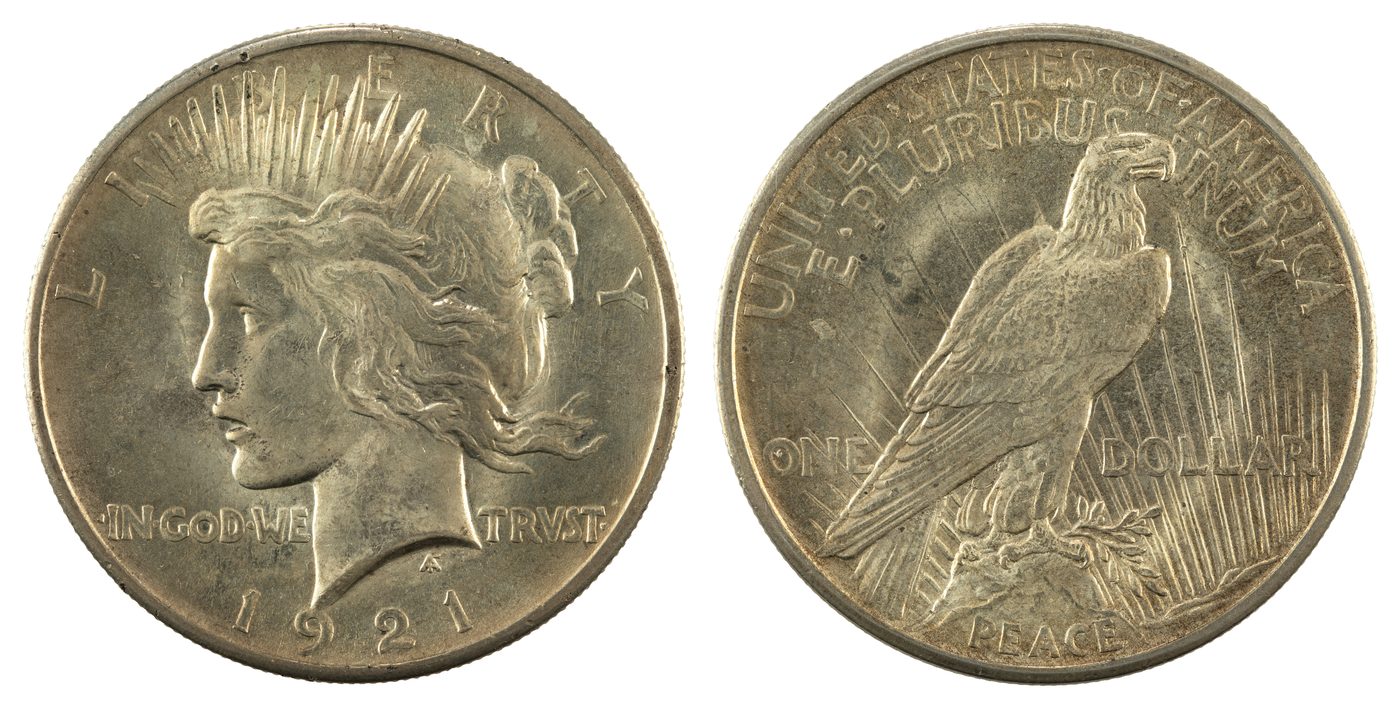
The sculptor was Anthony de Francisci, an Italian-born American and, at 34, the youngest artist invited to compete. He designed both sides of the coin. For the obverse — the heads side — he needed a face for Liberty, and he used the one closest to him: his wife, Teresa de Francisci, who had emigrated from Naples as a girl. Her profile, crowned with a spiked radiate tiara like the Statue of Liberty's, became one of the most recognizable faces in American coinage.

The reverse — the tails side — shows a bald eagle perched on a rock, at rest, clutching an olive branch, with the word PEACE carved into the stone beneath it. An eagle that isn't ready to fight is the whole point.

But de Francisci's original eagle stood over a broken sword — the ancient image of "swords into plowshares," a weapon laid down. Before the coin was released, the press got wind of it. The New York Herald argued the snapped blade read as defeat, not disarmament — as if America had been beaten rather than victorious. The criticism stuck. Chief Engraver George T. Morgan — the man behind the very Morgan dollar the new coin was replacing — reworked the hub to remove the sword entirely, reportedly without de Francisci's sign-off. The version that reached pockets has the eagle and the olive branch, and no sword at all. Look closely at the rock below the eagle's talons on a sharp early strike and you can still trace where the design was reshaped.

Key facts

Years struck
1921–1928, 1934–1935; revived 2021–present (none dated 2022)
Designer
Anthony de Francisci — both obverse and reverse
Liberty model
Teresa de Francisci, the designer's wife
Composition (classic)
90% silver, 10% copper
Composition (modern revival)
99.9% fine silver
Weight / Diameter
26.73 g / 38.1 mm
Silver content (classic)
0.77344 troy oz
1921 first year
High relief, 1,006,473 struck
Lowest business strike
1928 (Philadelphia) — 360,649 struck
Mint marks
None (Philadelphia), D (Denver), S (San Francisco)

Collecting it: the dates that matter

A complete classic Peace Dollar set runs from 1921 to 1935 — only 24 date-and-mint combinations, which is part of why the series is so collectible. You can build most of it without breaking the bank. A handful of coins are the challenge.

The 1921 high relief is the romantic first year — the only one struck in that deep, original relief, and a coin that always wears its detail a little softly because the design fought the press. Sharp, fully struck examples command a premium.

The 1928 Philadelphia dollar is the textbook key date by mintage: just 360,649 struck, the lowest of any business strike in the series. It's scarce in every grade and a coin collectors hunt for specifically.

The 1934-S is the one that separates serious sets from casual ones. Its mintage isn't the lowest — but almost all of them went straight into commerce and got beaten up. Finding a genuinely uncirculated 1934-S, one that never circulated and kept its original surfaces, is the real test of the series. In top mint-state grades it is the undisputed king of the Peace Dollar.

Then there's the ghost: the 1964-D. In 1965, the Denver Mint struck 316,076 Peace Dollars dated 1964 — a brief, congressionally authorized run to address a coin shortage. Politics turned against it almost immediately, and the government ordered every one melted. The Mint reports all 316,076 were destroyed. Because the melt was verified by weight rather than counted coin by coin, the question has haunted the hobby for sixty years: could one have walked out a door? None has ever been legally certified, and owning one would not be legal. It remains the most famous American coin you cannot have.

A note on jargon you'll see on slabs: VAM refers to a catalog of minor die varieties (named for researchers Van Allen and Mallis) — tiny doubling and die-marker differences that a deep specialist chases. They're real, but most are footnotes, not key dates.

Questions collectors ask

Why was the Peace Dollar made?

To commemorate the peace that followed World War I. Numismatists lobbied Congress for a coin carrying the word PEACE, and with the Mint already due to strike new silver dollars in 1921, the moment was seized for a fresh design.

Who designed the Peace Dollar?

Anthony de Francisci, an Italian-born American sculptor, designed both sides. He modeled the Liberty head on the obverse after his wife, Teresa de Francisci.

What happened to the broken sword on the reverse?

De Francisci's original design showed the eagle over a broken sword, symbolizing disarmament. After the press argued it looked like defeat, Chief Engraver George T. Morgan removed it before the coin was released.

What is the rarest Peace Dollar?

It depends on how you count. The 1928 Philadelphia has the lowest business-strike mintage (360,649). The 1934-S is the rarest in uncirculated condition and the key to the series in high grade. The 1964-D was struck but entirely melted and cannot be legally owned.

What is a 1921 high relief Peace Dollar?

The 1921 first-year coins were struck in a deep, sculptural relief that proved hard to strike fully and cracked the dies. Starting in 1922 the relief was lowered for production, making 1921 the only regular high-relief issue in the series.

Are modern Peace Dollars real Peace Dollars?

Yes — the U.S. Mint revived the design in 2021 for the 100th anniversary, struck in 99.9% fine silver as collector coins. They are not the same composition or purpose as the 1921–1935 circulating dollars.

Sources