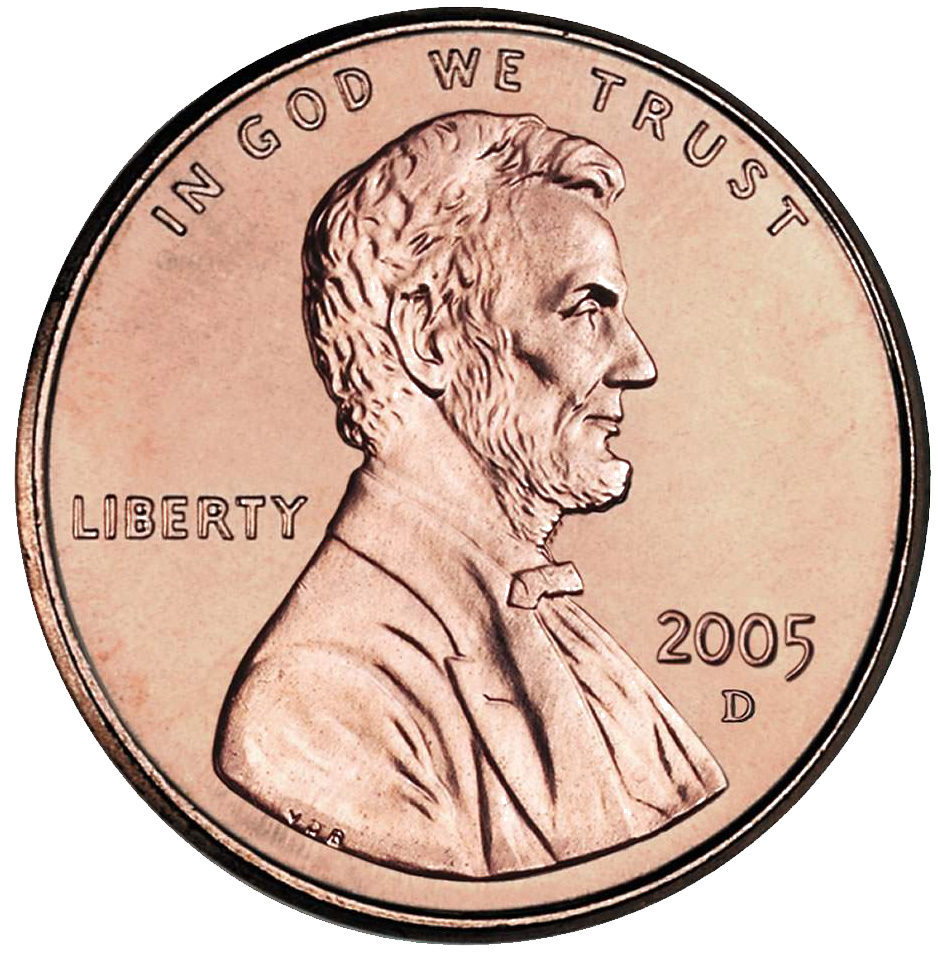
This is one of the most-produced coins in human history, so the value isn't in the ordinary dates — it's in the errors and the few transitional moments when the Mint changed its mind.
The 1982 switch from copper to zinc. For over a century the cent was mostly copper. As copper prices climbed, that became unsustainable — by the early 1980s the metal in a penny was creeping toward the value of the penny itself. In 1982 the Mint changed the core to 99.2% zinc with a thin copper plating. Both versions were struck that year, so 1982 alone yields seven business-strike varieties, split by metal (the copper ones weigh 3.11 g, the zinc ones 2.5 g) and by the size of the date ("Large Date" vs "Small Date"). The prize is the 1982-D Small Date in copper — a transitional coin that wasn't supposed to exist, first confirmed by a collector in 2016.
The doubled dies. When a die is made, the design is impressed into it more than once; if those impressions are misaligned, every coin struck from that die shows ghosted, doubled lettering. The great Memorial-era examples:
- 1969-S Doubled Die Obverse — the king of the series, and the one with a crime story. When the first examples surfaced in 1970, federal agents seized some as suspected fakes — there genuinely was a ring counterfeiting doubled cents at the time — before the real coins were vindicated. Fewer than a hundred are thought to exist; a finest-known gem sold for $601,875 at auction in 2023.
- 1972 Doubled Die Obverse — bold doubling on the date, LIBERTY, and the motto. Visible to the naked eye, and the doubled die most collectors can actually hope to own.
- 1983 Doubled Die Reverse — the entire back is doubled, lettering and building alike. The signature error of the early zinc years.
- 1984 Doubled Die Obverse — the "Doubled Ear," because the clearest doubling sits on Lincoln's ear.
- 1995 Doubled Die Obverse — strong doubling on LIBERTY and IN GOD WE TRUST, and the one major doubled die most people could still pluck from circulation, because it turned up in huge quantities.
The "AM" varieties — a spacing mistake worth hundreds. Look at the word AMERICA on the reverse. On some coins the letters A and M nearly touch ("Close AM"); on others they're clearly apart ("Wide AM"). The Mint used one reverse for business strikes and a slightly different one for proofs — the polished collector coins. When a proof die slipped onto the regular presses (or the reverse), you get a transitional error:
- 1992 Close AM (both Philadelphia and Denver) — a business-strike penny wearing the next design early. Only a handful are known of each.
- 1998, 1999, and 2000 Wide AM — ordinary pennies struck with a proof-style reverse. The 1999 Wide AM is the scarcest of the three.
Why high grades are genuinely scarce. A coin meant to be spent was never meant to be perfect. Pennies clattered through bags, counting machines, and cash drawers; copper and zinc both spot, tone, and scratch easily. A Memorial cent that survived in full original red color, untouched, at the top of the Mint State scale is far rarer than the billions of mintage figures suggest — which is exactly why condition, not date, drives most of the value here.
The coin that never circulated: the 1974 aluminum cent. With copper prices spiking in 1973, the Mint struck more than 1.5 million experimental cents in a 96% aluminum alloy, dated 1974, to test a cheaper penny. The vending-machine industry objected; doctors warned that an aluminum coin would be nearly invisible on an X-ray if a child swallowed one. Congress balked, and the Mint ordered every example recovered and melted. Only an estimated dozen or so survive — one sits in the Smithsonian — and their legal ownership is still contested. It's the great "what if" of this design.