US coin · series

The Indian Head Eagle: a Liberty in a war bonnet, and a president's 'pet crime'

Augustus Saint-Gaudens's last coin design — $10 in gold, struck 1907 to 1933, and ended by a presidential order that made owning some of them a crime.

The Indian Head Eagle: a Liberty in a war bonnet, and a president's 'pet crime'
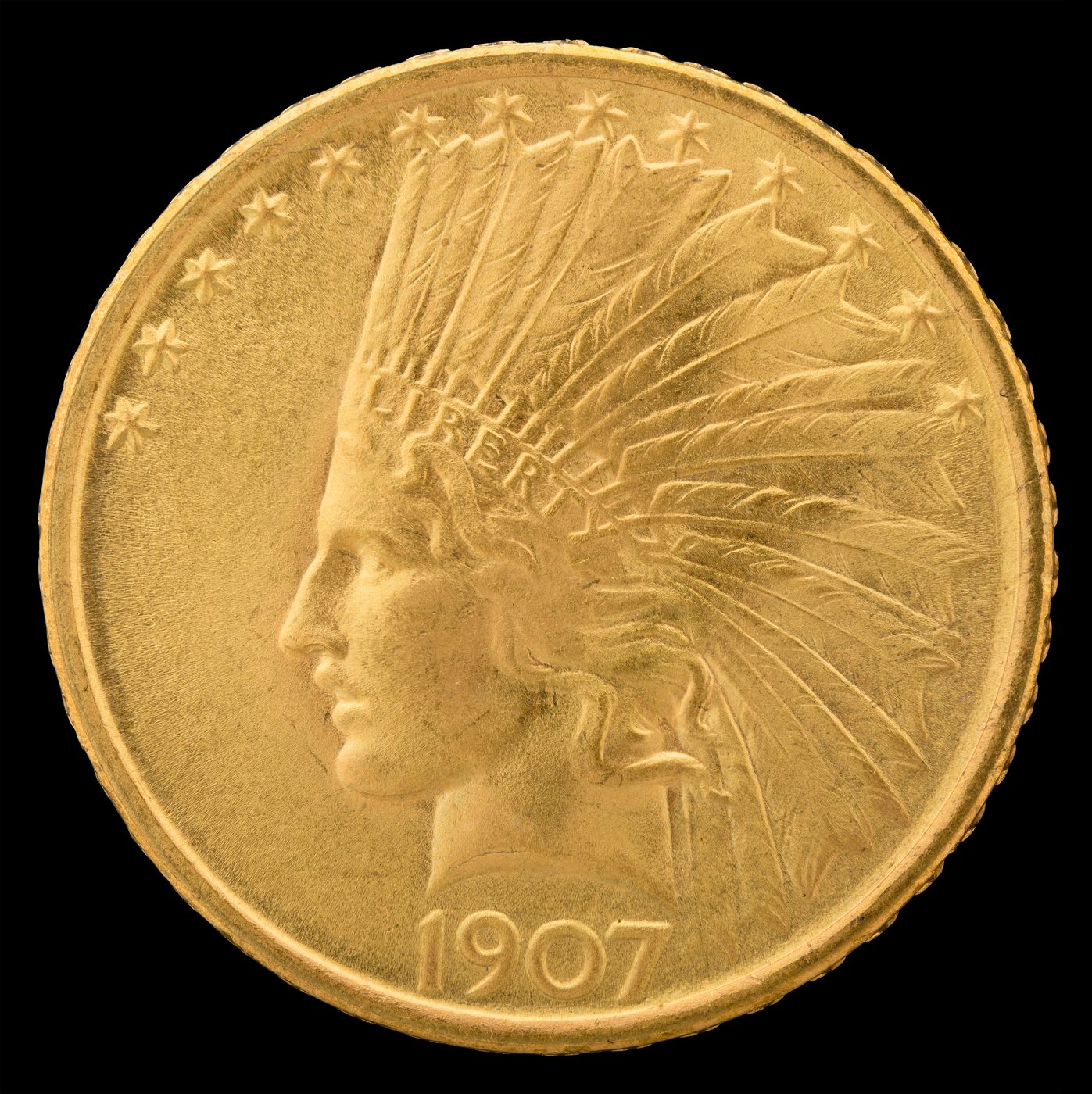
US Mint (coin), National Numismatic Collection (photograph by Jaclyn Nash); credit: National Numismatic Collection, National Museum of American His… · public domain · source

In 1904 a sitting president called America's money "artistically of atrocious hideousness" — and decided to fix it himself. The $10 Indian Head eagle is what that decision produced: a dying sculptor's final work, a Liberty wearing a Native American headdress, and a coin whose last year almost no one was ever allowed to keep.

The story behind the coin

Theodore Roosevelt hated the money in his own pocket. He thought U.S. coins were dull, flat, and embarrassing next to the coins of ancient Greece. So around 1904 he did something no president had really tried: he set out to redesign the nation's coinage himself, and he hired the most celebrated sculptor in America to do it.

That sculptor was Augustus Saint-Gaudens — the man behind the Sherman Monument in New York and some of the finest public statuary of the age. Roosevelt called the whole project his "pet crime," and he meant it fondly. He wanted beauty, and he wanted it badly enough to push past the Mint's own engravers to get it.

Saint-Gaudens drew up two gold coins for Roosevelt: the $20 double eagle and the $10 eagle (an "eagle" was simply the old name for the ten-dollar gold piece). The double eagle became the most famous American coin ever struck. The eagle — the coin on this page — is its quieter, stranger sibling: the one with Liberty in a feathered war bonnet.

There was a deadline of a different kind hanging over the work. Saint-Gaudens was dying of cancer. He finished the models, handed the fight with the Mint to his assistant, and died on August 3, 1907 — before a single one of his eagles reached the public. The coin you can hold today is, in a real sense, the last thing he made.

The design — and who made it

Look at the obverse — the heads side. It's a left-facing Liberty, but not the usual robed goddess. She wears a tall Native American feather headdress with the word LIBERTY running across the band, and thirteen stars arc above her for the original colonies.

That headdress was Roosevelt's idea, and it caused an argument. Saint-Gaudens had drawn Liberty in a classical style. Roosevelt wanted the headdress added, and he had an answer ready for anyone who objected: in his words, the feather head-dress could be treated "as being the conventional cap of Liberty quite as much as if it was a Phrygian cap" — the soft liberty cap of the French and American revolutions. In other words: if a Roman cap can stand for freedom, why not an American one? The headdress went on.

Turn it over. The reverse — the tails side — shows a standing eagle, wings folded, perched on a bundle of arrows wrapped in an olive branch: war held in one talon, peace in the other. It echoes the eagle Saint-Gaudens had designed for Roosevelt's 1905 inaugural medal. Around it run UNITED STATES OF AMERICA and TEN DOLLARS, with E PLURIBUS UNUM above the bird.

One thing was missing at first, and people noticed. The early coins carried no IN GOD WE TRUST. Roosevelt had deliberately left it off — he thought putting God on money you'd spend on anything was close to sacrilege. The public disagreed loudly, Congress stepped in, and by late 1908 the motto was added to the reverse, to the left of the eagle. You can date an eagle at a glance by whether it has the motto.

Two more details give the coin away. The relief — how far the design rises off the surface — started out too high for the Mint's presses, so Saint-Gaudens's assistant Henry Hering and the Mint's chief engraver, Charles Barber, brought it down to something that would actually strike. And the edge isn't reeded; it's studded with raised stars — 46 of them through 1911, then 48 from 1912 on, one star per state as the Union grew.

Key facts

Denomination
$10 (eagle), gold
Years struck
1907–1916, then irregularly to 1933
Designer
Augustus Saint-Gaudens (obverse and reverse)
Finished for striking by
Henry Hering and Charles E. Barber
Commissioned by
President Theodore Roosevelt
Composition
90% gold, 10% copper
Gold content
0.48375 troy oz
Weight
16.718 g
Diameter
26.92 mm
Edge
Raised stars — 46 (1907–1911), 48 (1912–1933)
Motto
IN GOD WE TRUST added late 1908
Famous final year
1933 — 312,500 struck, roughly 40 survive

Collecting it: key dates, varieties, and scarcity

This is a series where the rarities come from how the coin was made and how it died, not just from low mintages.

The 1907 first-year varieties. The very first eagles were struck from Saint-Gaudens's original high-relief dies and show a thin, sharp "wire rim" — a fin of metal squeezed up at the edge. Only a few hundred were made (Mint records point to roughly 500 struck), and these 1907 Wire Rim pieces are treated as a quasi-pattern issue and command enormous prices. Barber then added a proper raised rim to keep the coins at legal weight, producing the 1907 Rounded Rim — also tiny, with most of the run melted, leaving only a handful. Both also exist in a "With Periods" form, with small dots flanking the lettering. These are blue-chip rarities, not coins you stumble on.

The condition rarities. Two later dates are scarce not because few were made, but because few survived in high grade. The 1920-S and 1930-S are the classic key dates of the series — both were struck in modest numbers and then caught in the great gold melt of the 1930s, so survivors, especially sharp uncirculated ones, are genuinely hard to find. The low-mintage 1911-D (Denver) is another date that carries a real premium in mint state.

The 1933 — the coin almost no one kept. Here's the gut-punch. The Philadelphia Mint struck 312,500 eagles in early 1933. Then, in April, President Franklin Roosevelt signed Executive Order 6102, pulling gold coins back from circulation. Nearly the entire 1933 mintage was melted into bars before it could go out. Only about 40 are believed to survive — coins collectors had pulled directly from the Mint before the door slammed. A 1933 eagle isn't rare because it was special; it's rare because the government unmade almost all of it.

That's the deeper reason these coins fascinate people. Almost every Indian Head eagle is gold that escaped a melting pot — first the World War I melts, then the New Deal recall. The series didn't fade out. It was switched off, by order, in the middle of a national emergency. What's left is what slipped through.

A note on grade: because these are soft, high-gold coins that often saw rough handling in bank vaults and overseas trade, truly clean, lustrous uncirculated examples of even "common" dates are scarcer than the mintages suggest. Eye appeal — original surfaces, strong luster — drives value as much as the date.

Questions collectors ask

Who designed the Indian Head eagle?

Augustus Saint-Gaudens designed both the obverse and the reverse, on commission from President Theodore Roosevelt. He died in August 1907 before the coins reached the public; his assistant Henry Hering and the Mint's chief engraver Charles Barber finished lowering the relief so the coin could be struck on regular presses.

Why does Liberty wear a Native American headdress?

It was Theodore Roosevelt's request. Saint-Gaudens had drawn a classical Liberty; Roosevelt wanted the feather war bonnet added and argued it could symbolize freedom 'quite as much as if it was a Phrygian cap' — the liberty cap of the revolutions. So this is really Liberty in a headdress, not a portrait of a specific person.

Why is the 1933 Indian Head eagle so rare?

About 312,500 were struck in early 1933, but President Franklin Roosevelt's Executive Order 6102 that April recalled gold coins, and nearly the whole mintage was melted into bars before release. Only around 40 are believed to survive — the ones collectors obtained from the Mint before the recall.

What are the key dates in the series?

The 1907 Wire Rim and 1907 Rounded Rim first-year varieties are top rarities. Among regular issues, the 1920-S and 1930-S are the classic key dates (scarce survivors of the 1930s gold melt), and the 1911-D is a low-mintage date prized in mint state.

Some 1907 and 1908 eagles say 'IN GOD WE TRUST' and some don't — why?

Roosevelt deliberately left the motto off the early coins. Public objection led Congress to require it, and the motto was added to the reverse in late 1908. So 'No Motto' and 'With Motto' are simply early-vs-later production, and they're collected as separate types.

How much gold is in an Indian Head eagle?

Each coin is 90% gold and 10% copper, holding 0.48375 troy ounces of pure gold in a 16.718-gram coin. That gold content gives even common dates a hard floor of value tied to the metal.

Sources