US coin · series

The Columbian Half Dollar: America's First Commemorative Coin

Sold for a dollar at the 1893 World's Fair — and the first one sold for $10,000.

The Columbian Half Dollar: America's First Commemorative Coin
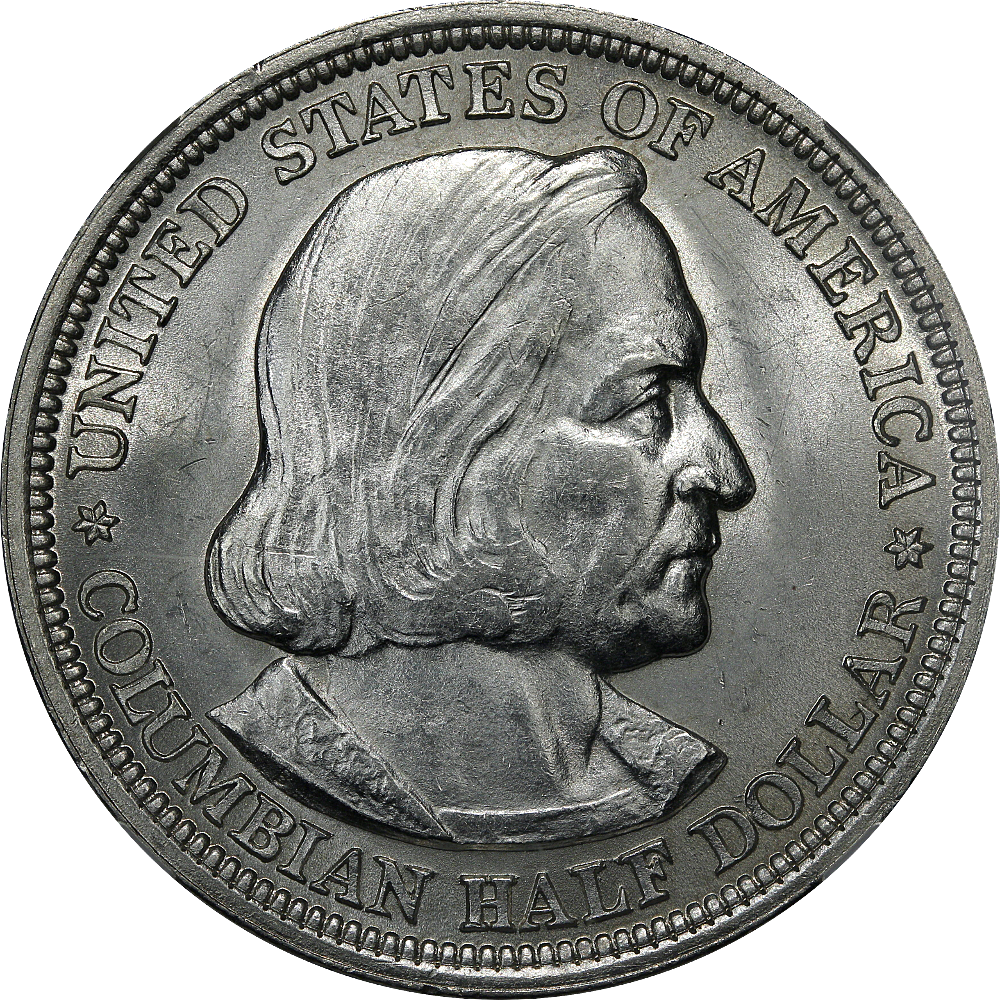
Brandon Grossardt (photographer); coin design by Charles E. Barber · public domain · source

In 1892 the U.S. Mint did something it had never done before: it struck a coin to remember an event rather than to spend. The Columbian half dollar was the start of the entire American commemorative tradition — and its very first example sold for $10,000, a stunning sum for a fifty-cent piece.

The story behind the coin

For a hundred years, the United States had made coins for one reason: to spend them. Then came Chicago.

The city had won the right to host the World's Columbian Exposition — a vast world's fair marking 400 years since Columbus reached the Americas. It was meant to open in 1892, the anniversary year, but the scale of it pushed the opening to May 1893. To help pay for the fair, Congress did something genuinely new. On August 5, 1892, it authorized up to five million special fifty-cent pieces — and the fair would sell them to the public for a dollar each, double face value, pocketing the difference.

That made the Columbian half dollar the first commemorative coin in U.S. history — the first American coin struck to honor an event rather than to circulate. Every commemorative that followed, from the Oregon Trail to the modern Mint's annual programs, traces back to this one.

The launch was pure showmanship. The first coin off the press was sold as a publicity stunt to Wyckoff, Seamans & Benedict, the firm behind the Remington typewriter, for $10,000 — by far the most ever paid for a single U.S. coin at the time. The company donated it to Chicago's new Columbian Museum, which became the Field Museum of Natural History. A fifty-cent coin had just become a national headline.

The design

The coin tells the Columbus story across both faces.

The obverse — the "heads" side — carries a profile portrait of Christopher Columbus, with the legends honoring the exposition. The reverse — the "tails" side — shows Columbus's flagship, the Santa Maria, sailing above two globes representing the Old World and the New.

The credits are a small puzzle that collectors still enjoy. The obverse was executed by Charles E. Barber, the Mint's Chief Engraver, and the reverse by George T. Morgan — the same Morgan whose name rides on the famous silver dollar. Both worked from concepts and plaster models by the sculptor Olin Levi Warner. So the coin is, in a real sense, a collaboration: an outside artist's vision, finished by the Mint's two best hands. (Who deserves the most credit has been argued ever since — a reminder that a "designer" line on a coin can hide a committee.)

There were no mint marks: every Columbian half dollar was struck at the Philadelphia Mint.

Key facts

Years struck
1892–1893
Denomination
Half dollar (50 cents)
Commemorates
World's Columbian Exposition (Chicago); 400th anniversary of Columbus's 1492 voyage
Authorizing act
Act of August 5, 1892 (up to 5,000,000 authorized)
Obverse designer
Charles E. Barber, after Olin L. Warner
Reverse designer
George T. Morgan, after Olin L. Warner
Mint
Philadelphia (no mint mark)
1892 mintage (distributed)
950,000
1893 mintage (distributed)
1,550,405
Composition
90% silver, 10% copper
Weight
12.50 grams
Diameter
30.6 mm
Original sale price
$1.00 (double face value), to fund the fair

Collecting it

Here is the irony that shapes the whole market for this coin: it was a fundraiser, and it didn't fully work.

The fair simply could not sell all of them at a dollar. Over three million went unsold. The Treasury melted a large portion and quietly released the rest into ordinary circulation at their fifty-cent face value. So millions of people ended up spending a coin that had been minted to be kept — which is why worn, circulated Columbian halves are common and inexpensive today. For a first commemorative, it is one of the most affordable coins a newcomer can own in collectible condition.

The scarcity lives at the top. Because so many were handled, spent, and knocked around, examples that survived in pristine Mint State — never circulated, sharp original surfaces — are far harder to find, and prices climb steeply as the grade rises. A nicely toned, high-grade Columbian is a genuine prize.

Both dates are collectible and both are needed for a complete set; the 1892 is the smaller-mintage year. A handful of special proof strikings — coins struck with extra care on polished dies for presentation, not circulation — exist for each date, but they are rare and their status has been debated among specialists. For most collectors, the goal is one clean 1892 and one clean 1893 — the coins that started it all.

Questions collectors ask

Was the Columbian half dollar really the first U.S. commemorative coin?

Yes. Authorized in 1892 to help fund the World's Columbian Exposition in Chicago, it was the first coin the United States struck to commemorate an event rather than for general circulation. Every later U.S. commemorative descends from it.

Why are most Columbian half dollars worth so little?

The fair couldn't sell all of them at the $1 price. The Treasury melted a large share and released the rest into circulation at face value, so worn examples are common. The value is in high-grade, uncirculated coins, which are far scarcer.

What's the difference between the 1892 and 1893 coins?

Only the date and the quantity. The 1892 was distributed in fewer numbers (about 950,000) than the 1893 (about 1,550,405). Both share the same Columbus / Santa Maria design and were struck at Philadelphia.

Did one really sell for $10,000?

The very first coin struck was bought for $10,000 by the makers of the Remington typewriter (Wyckoff, Seamans & Benedict) as a publicity stunt. They donated it to what became Chicago's Field Museum. It was an enormous sum for a fifty-cent coin in 1892.

How much silver is in it?

It's 90% silver, 10% copper, weighing 12.50 grams, with roughly a third of a troy ounce of silver — the same alloy as a standard circulating half dollar of the era.

Sources