US coin · series

The Classic Head Quarter Eagle: the gold coin America had to shrink

In 1834 the United States made its $2.50 gold piece smaller on purpose — and for the first time, people kept it.

The Classic Head Quarter Eagle: the gold coin America had to shrink
US Mint (coin); National Numismatic Collection, National Museum of American History — photograph by Jaclyn Nash · public domain · source

For decades, America's gold coins were worth more melted than spent, so they vanished into crucibles almost as fast as the Mint could strike them. In 1834 Congress fixed that with a quieter, lighter coin — and built the design out of a borrowed portrait under a deadline.

The coin America had to shrink

For most of its early life, the United States quarter eagle — the $2.50 gold piece — barely circulated. The problem wasn't demand. It was arithmetic.

By law, the U.S. valued gold against silver at about 15 to 1. Europe valued it closer to 15.5 to 1. That gap was small on paper and enormous in practice: an American gold coin was worth more as raw metal abroad than as money at home. So bullion dealers bought gold coins, shipped them out, and melted them. One often-cited figure has 40,000 U.S. half eagles melted in Paris alone in 1831. The Mint was, in effect, striking coins for the furnace.

Congress ended the bleeding with the Act of June 28, 1834. The fix was blunt: make the coins lighter. The quarter eagle's weight dropped from 4.37 grams to 4.18 grams, its diameter from 20 millimeters to 18.2, and the gold-to-silver ratio was nudged toward 16 to 1. Now the metal in the coin was worth a little less than the coin's face value — so it paid to spend it, not melt it. Almost overnight, gold that had been hoarded or shipped overseas began circulating in American hands again.

There was a catch the public needed to see at a glance. The old, heavier quarter eagles were suddenly worth more than $2.50 as bullion — about $2.66 — so people had every reason to pull the old ones out and melt them down. The new coins had to look unmistakably different from the old. That requirement is what gave us the design.

The design, and the man on a deadline

The job of redrawing the coin fell to William Kneass, the Mint's Chief Engraver. Mint Director Samuel Moore needed new dies fast, and Kneass was pressed for time. So he did what a hurried engraver does — he reached for something proven.

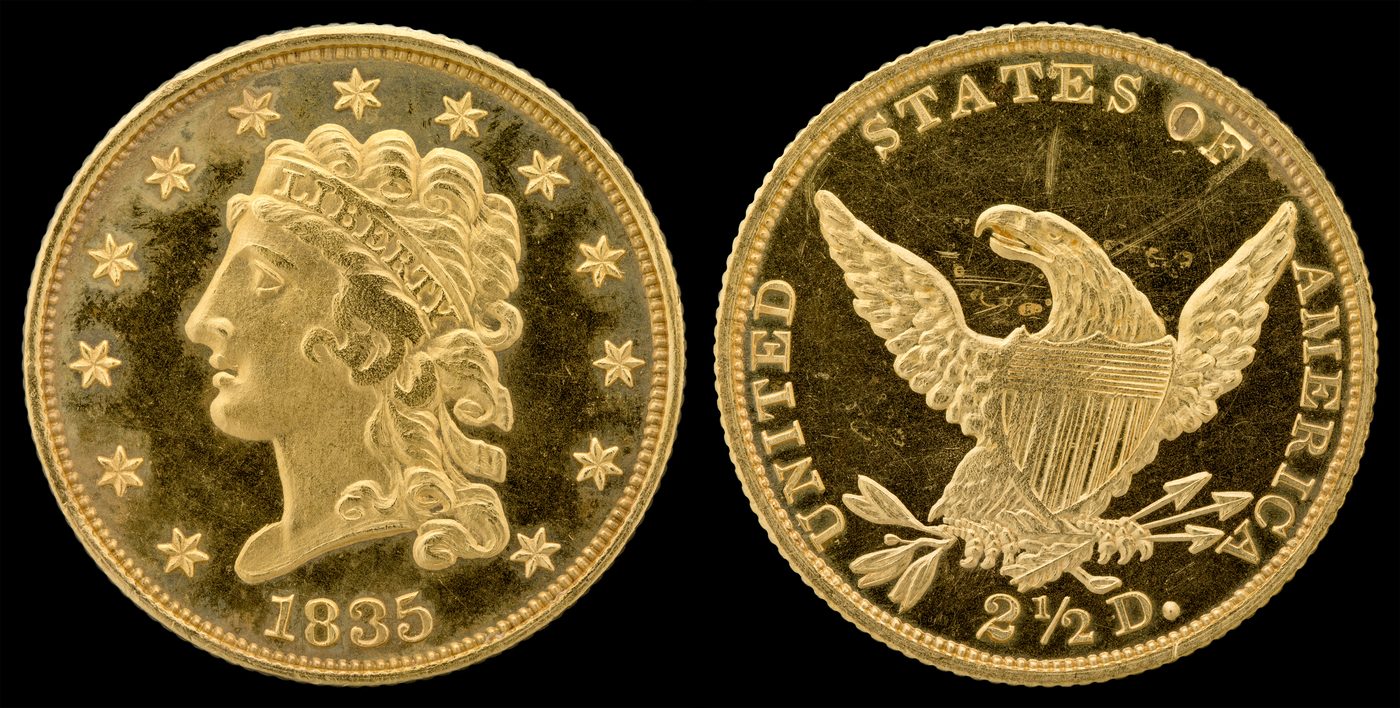
He adapted the "Classic Head" portrait of Liberty that the earlier Mint engraver John Reich had created for the large cent back in 1808. (The nickname "Classic Head" came later, from the classical fillet — the narrow headband — that crosses Liberty's hair, reading LIBERTY.) On the obverse — the heads side — Liberty faces left, her curls bound by that band, ringed by thirteen stars with the date below. The reverse carries an eagle clutching arrows and an olive branch, with UNITED STATES OF AMERICA and the denomination 2½ D.

To set the new coin apart from the old at a glance, the Mint dropped the motto E PLURIBUS UNUM from the reverse. The plan was to bring it back a year later. It never returned to this design — the motto stayed gone until the whole quarter eagle was redrawn in 1840.

Numismatists have never loved the result. Critics through the years called Kneass's Liberty plainer and less refined than the elegant Capped Head portrait it replaced — a workaday design born of a deadline, not an artist's ambition. But it did exactly what it was asked to do: it looked different, and it stayed in people's pockets.

Key facts

Years struck
1834–1839
Denomination
Quarter eagle ($2.50 gold)
Designer
William Kneass (obverse & reverse engraving), adapting John Reich's Classic Head portrait
Composition
.8992 fine gold (1834–1836); .900 fine (1837–1839)
Weight / Diameter
4.18 g / 18.2 mm (reeded edge)
Mints
Philadelphia (no mark), Charlotte (C), Dahlonega (D), New Orleans (O)
Total business strikes
~968,228, plus fewer than forty proofs
Highest mintage
1836 — 547,986 (figures of 547,989 also cited)
Lowest mintage
1838-C — 7,880
Why it exists
Act of June 28, 1834 — lighter gold coins, to stop melting

Collecting it: key dates, branch mints, and why gems are rare

A first lesson in collector shorthand: a mint mark is the small letter showing which Mint struck a coin (no letter means Philadelphia), and a proof is a special presentation strike made from polished dies, not for circulation. With those in hand, the series sorts itself out fast.

The Philadelphia coins of 1834 through 1837 were made in huge numbers for the time. In the first three years, the Mint struck more Classic Head quarter eagles than every previous quarter eagle, of all designs, combined — with 1836 alone topping half a million. Those years are the affordable, available end of the series. The 1834 first-year coins often show prooflike surfaces — mirror-like fields from fresh dies — and are prized for it.

The prizes are the branch-mint coins. In the late 1830s the U.S. opened its first mints outside Philadelphia, in the Southern gold country, and this series carries their debut gold. The 1838-C was among the very first coins struck at the brand-new Charlotte, North Carolina Mint — a first-year coin from a first-year mint, and at just 7,880 pieces, the lowest mintage in the series. The 1839 branch issues — 1839-C (Charlotte), 1839-D (Dahlonega, Georgia), and 1839-O (New Orleans) — are all keys. The 1839-D is the only Classic Head quarter eagle from Dahlonega and the mint's first quarter eagle of any kind; every known example is an 1839/8 overdate, where traces of an "8" show beneath the final "9." Collectors generally rate it the toughest of the three 1839 branch coins.

Why are high grades so scarce across the whole type? Because these coins did their job. They circulated — hard — as everyday money in the 1830s, so survivors are usually worn. Mint State examples exist, especially of 1834, but most cluster in the MS61–MS64 range; true gems are very rare, with the finest 1834 reported as a single coin graded MS66. About-Uncirculated coins are scarce, and the branch-mint dates are scarce in any grade at all. The series rewards patience over budget.

Questions collectors ask

Why did the U.S. make the quarter eagle smaller in 1834?

Older gold coins were worth more as metal than as money, so they were melted and shipped abroad — by one account 40,000 U.S. half eagles were melted in Paris in 1831 alone. The Act of June 28, 1834 cut the coins' weight (the quarter eagle from 4.37 to 4.18 grams) so the gold inside was worth slightly less than face value. That tipped the math, and the coins finally stayed in circulation.

Who designed the Classic Head Quarter Eagle?

Chief Engraver William Kneass cut the dies for both sides. Short on time, he adapted the 'Classic Head' Liberty portrait that John Reich had created for the large cent of 1808. So Kneass is the engraver of the coin, working from Reich's earlier design.

Why is there no E PLURIBUS UNUM on the reverse?

The Mint deliberately removed the motto so the public could instantly tell the new lighter coins from the old heavier ones, which were now worth melting. It was supposed to come back in 1835 but didn't — it stayed off this design until the quarter eagle was redrawn in 1840.

What is the rarest Classic Head Quarter Eagle?

The 1838-C (Charlotte) has the lowest mintage at 7,880 and the prestige of being a first-year coin from a first-year branch mint. The 1839-D (Dahlonega) is also avidly chased: it's the only Dahlonega coin of this type, an 1839/8 overdate, and is often called the hardest of the three 1839 branch issues. All branch-mint dates are key dates.

What is the gold content of a Classic Head Quarter Eagle?

Each coin weighs 4.18 grams. The fineness was .8992 gold for 1834–1836, then .900 (90%) from 1837 onward following further coinage adjustments.

Sources