The story behind the coin
By 1890 the United States was tired of its money. The Seated Liberty design had been on the half dollar since the 1830s, and critics savaged it — The Galaxy magazine called America's coins "the ugliest money of all civilized nations." So Congress passed the Coinage Act of September 26, 1890, which finally allowed the Mint to redesign coins that had been in service more than 25 years.
The new Mint Director, Edward O. Leech, decided to do it with a public competition. In April 1891 he invited ten of the country's leading artists — among them Augustus Saint-Gaudens, the most celebrated sculptor in America — and dangled a single $500 prize for the winner. The artists found the terms insulting. Saint-Gaudens reportedly dismissed the whole effort as something that looked "like it had been designed by a young lady of sixteen." Almost everyone declined. When Leech opened the contest to the public instead, he got roughly 300 entries and judged the result "too wretched a failure" — only two designs earned even an honorable mention.
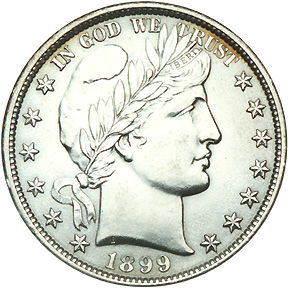
So on June 11, 1891, Leech turned to the one person obligated to deliver: Charles E. Barber, the Mint's Chief Engraver. Barber designed both sides himself. President Benjamin Harrison and his Cabinet approved the work on November 6, 1891, and the first coins were struck at the Philadelphia Mint on January 2, 1892. The same Liberty head went onto the dime, quarter, and half dollar — three denominations, one face, all bearing Barber's name in shorthand ever since.