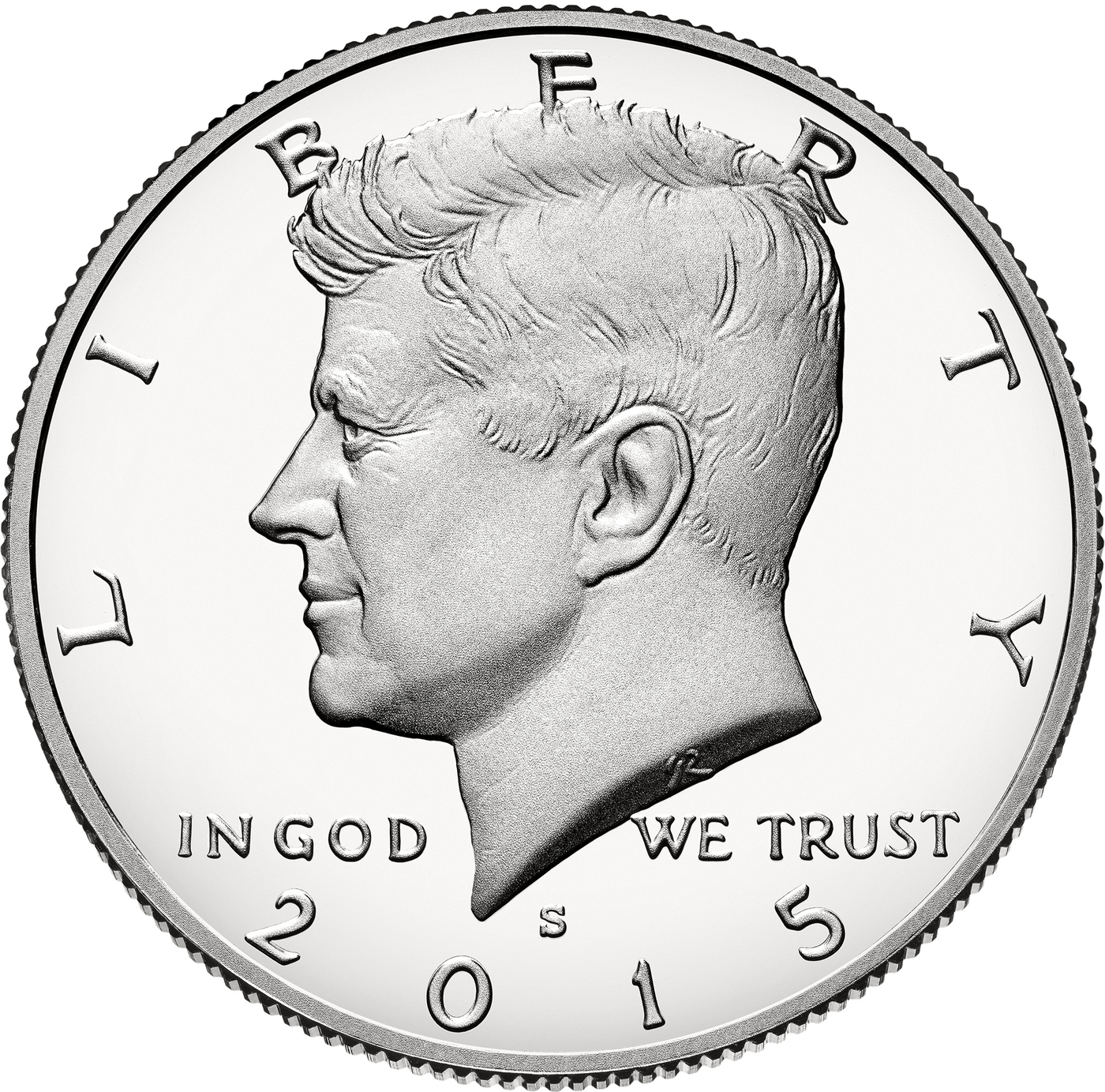
US coin · series

The Kennedy Half Dollar: Grief Struck in Silver

A coin the Mint designed in weeks, the public hoarded in hours, and collectors have chased ever since.

The Kennedy Half Dollar: Grief Struck in Silver
United States Mint (official U.S. Mint photo repository) · public domain · source

In December 1963, a grieving country decided it wanted to carry its murdered president in its pocket. Six weeks after the assassination, Congress had authorized a new coin. Three months after that, it was in the hands of the public — and almost as fast, it disappeared.

The story behind the coin

On November 22, 1963, John F. Kennedy was assassinated in Dallas. Within hours — before the country had finished absorbing the news — Mint Director Eva Adams was already on the phone to the Mint's chief engraver, asking whether Kennedy could be put on a coin.

The decision came fast and from the top. Jacqueline Kennedy, the president's widow, was consulted on which coin to use. She chose the half dollar rather than the quarter, because the quarter would have meant displacing George Washington — and she did not want to push the first president aside to honor her husband. Congress passed the authorizing legislation on December 30, 1963, just over a month after Kennedy's death.

The Mint moved at a speed it almost never moves. The first circulating Kennedy half dollars were struck at the Denver Mint on January 30, 1964, with Philadelphia following the next week. On March 24, 1964, the coins went out to the public — and the response was something the Mint had never seen. People lined up at banks. By the end of the first day the coins were gone, but the line had not gotten any shorter.

Then the coin did something stranger still. It vanished. By late 1964 the Mint had struck roughly 160 million Kennedy halves, yet you almost never saw one in actual circulation. Two forces emptied the country's pockets at once: grief and silver. People kept the coins as keepsakes of a beloved president — and, as the price of silver climbed, the 90% silver in each coin became worth hoarding for the metal alone. The Kennedy half is one of the rare coins that was a collector's item the moment it existed, before a single example had a chance to wear.

The design — and who made it

The portrait was not invented from scratch. It couldn't be — there was no time. The obverse (the heads side) carries a left-facing bust of Kennedy adapted by Gilroy Roberts, the Mint's chief engraver, from a portrait he had already sculpted for Kennedy's 1961 inaugural medal. The reverse (the tails side) is a heraldic eagle drawn from the Presidential Seal, executed by Frank Gasparro, then the assistant engraver. The two men had already worked the same split — Roberts on the front, Gasparro on the back — for the official Kennedy presidential medal, which is why they could adapt a finished coin design in a matter of weeks rather than years.

There is a small, human footnote in the metal itself. Jacqueline Kennedy reviewed the trial strikes and asked that the detail in the president's hair, just above the ear, be softened. That request created two slightly different portraits in 1964 — a detail that turned an ordinary proof coin into one of the series' most prized varieties (more on that below).

The composition tells the story of an entire era of American money. The 1964 coin is 90% silver — the last circulating half dollar struck in that traditional alloy. Then the silver started draining away. The Coinage Act of 1965 cut the half dollar to a 40% silver clad sandwich (struck on coins dated 1965 through 1970). In 1971, silver left circulating halves entirely, replaced by the copper-nickel "clad" composition — a pure-copper core bonded between layers of 75% copper, 25% nickel — that still defines the everyday coin today.

For one two-year stretch the reverse changed completely. For the nation's 1976 Bicentennial, the eagle gave way to Independence Hall, designed by Seth G. Huntington, with the dual date 1776–1976 on the obverse. Those Bicentennial halves were struck across 1975 and 1976; the eagle returned in 1977.

Key facts

Years struck
1964–present
Obverse designer
Gilroy Roberts (chief engraver) — JFK portrait
Reverse designer
Frank Gasparro — Presidential Seal eagle
Bicentennial reverse
Seth G. Huntington — Independence Hall (1975–1976)
Denomination
50 cents (half dollar)
1964 composition
90% silver, 10% copper
1965–1970 composition
40% silver clad
1971–present composition
Copper-nickel clad (pure copper core)
Authorized
December 30, 1963 (six weeks after the assassination)
First struck / released
Denver, January 30, 1964 / public release March 24, 1964

Collecting it: key dates and varieties

For a coin minted by the hundreds of millions, the Kennedy half hides a surprising number of rarities — and almost all of them come down to how a coin was made, not just when.

The 1964 "Accented Hair" proof. This is the variety born from Jacqueline Kennedy's request. The first proof dies of 1964 — proofs are specially polished presentation strikes — showed heavier, sharper hair detail above the president's ear before the design was softened. By the time the change was made, an estimated 100,000 Accented Hair proofs had already been struck, fewer than 5% of the year's proof total. Look for the heavier strands above the ear and a weak lower-left serif on the "I" in LIBERTY.

The 1970-D. The undisputed key date of the regular series. By 1970 the half dollar was still 40% silver, and circulating coins simply weren't needed — so the 1970-D was struck only for sale in mint sets, never released into change. With around 2.1 million pieces, it is by far the scarcest date a collector must hunt down to finish the set.

The 1964 SMS. The deepest mystery in the series. A tiny number of 1964 halves exist with an unusual, satiny "Special Mint Set" finish that the Mint never officially explained — only about a dozen examples are known. One sold for $47,000 in 2016. These are the kind of coin most collectors will only ever read about.

The 1998-S Matte Finish. Struck with an unusual matte (non-mirror) surface for a special Robert F. Kennedy commemorative set, with a reported mintage between roughly 62,000 and 64,000 — the lowest mintage of any Kennedy half — which makes it a modern key.

Why high grades are scarce. Here is the quiet truth of the series: most Kennedy halves were saved, but few were saved well. They were tossed in drawers, run through proof sets, bag-handled at the Mint. The relief of the design — how far the portrait stands up from the field — leaves Kennedy's cheek and the eagle's breast exposed to every contact mark. A common date in a worn grade is worth its silver; the same date in pristine, mark-free condition can be genuinely hard to find and command a real premium. With the Kennedy half, condition is the whole game.

Questions collectors ask

Who designed the Kennedy half dollar?

Two U.S. Mint engravers split the work. Gilroy Roberts, the chief engraver, designed the obverse portrait of John F. Kennedy, adapting it from his own 1961 Kennedy inaugural medal. Frank Gasparro, then assistant engraver, designed the reverse eagle, based on the Presidential Seal. For the 1975–1976 Bicentennial, Seth G. Huntington designed a one-off Independence Hall reverse.

Why is the 1964 Kennedy half dollar special?

It is the only Kennedy half struck in the traditional 90% silver — the last circulating 90% silver half dollar the U.S. ever made. It was also the first year, struck in a wave of national mourning, and was hoarded so heavily for both sentiment and silver that it barely circulated.

Which Kennedy half dollar is the rarest key date?

Among coins a collector can realistically hunt, the 1970-D is the key date: with about 2.1 million struck and sold only in mint sets, it never reached circulation. Rarer still — but more curiosity than collectible — is the 1964 SMS, with only about a dozen known.

What is the 'Accented Hair' Kennedy half?

A 1964 proof variety from the very first dies, showing heavier hair detail above Kennedy's ear. The detail was softened — reportedly at Jacqueline Kennedy's request — after roughly 100,000 had been struck, making the Accented Hair version a scarce and sought-after proof.

Do Kennedy half dollars still get made?

Yes. The Kennedy half is still an active U.S. coin design, but since 2002 it has been struck mainly for collectors and mint sets rather than for general circulation. The Mint also issues special silver proof versions; since 2019 those are struck in .999 fine silver.

Are Kennedy half dollars worth anything?

It depends entirely on the year and the grade. Anything dated 1964 is 90% silver and 1965–1970 is 40% silver, so those carry real metal value. Coins from 1971 on are copper-nickel and are usually worth face value — unless they are a scarce date like the 1970-D or 1998-S, or a top-grade survivor of a common date.

Sources