Designer

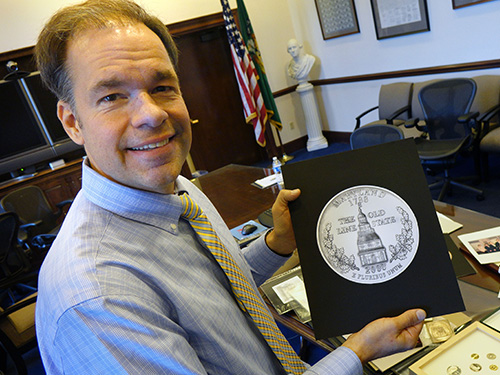
William Krawczewicz

His friends call him 'Dollar Bill' — and he earned it twice, on the coins in your pocket and the bills in your wallet.

William Krawczewicz
U.S. Mint · public domain · source

Most coin artists spend a career chasing one small disc of silver. William Krawczewicz designed the money itself. He drew coins at the U.S. Mint, then moved across town and redrew the $10, $20 and $50 bills — one of only three people in the country whose job is to design American paper money.

The man they call "Dollar Bill"

William Krawczewicz grew up in Severna Park, Maryland, born in 1967. He studied at the University of Maryland, and straight out of college he landed a job at the United States Mint — the federal agency that strikes the nation's coins. That is where the coin work in this catalog comes from.

But coins were only the start. Along the way he spent time in the design department at the Clinton White House, and then made the move that defined his career: he joined the Bureau of Engraving and Printing, the agency that prints America's paper money. As of 2007 he was one of just three banknote designers in the entire country.

That is the joke behind the nickname. His friends call him "Dollar Bill" — and he has now designed both kinds of dollar, the coin and the note. He is, by his own account, not a coin collector at all. What he collects is foreign banknotes, studying how other countries solve the same design puzzles he faces at work. "I just really enjoy my job," he told the numismatic newsletter The E-Sylum in 2007. "I want the notes to look as beautiful as possible."

The craft — one drawing, four coins

To read Krawczewicz's coins correctly, you have to understand a quiet split in how the U.S. Mint makes them. A designer draws the image. A sculptor-engraver then carves that drawing into the raised, three-dimensional model the coin's dies are cut from. Krawczewicz worked mostly as the designer — the artist whose drawing starts the whole process — while staff sculptors like Thomas D. Rogers and T. James Ferrell turned his art into metal.

His most efficient piece of work is also his most-seen. For the 1995 run of Atlanta Olympic silver dollars, Krawczewicz designed a single reverse — the tails side — showing two hands clasped beneath the Olympic flame and rings. That one drawing was then used as the common reverse across all four of the 1995 silver dollars: Cycling, Track & Field, Gymnastics, and the Paralympic Blind Runner. Four different obverses, one Krawczewicz reverse tying the set together.

His banknote work runs on a different logic. On the redesigned $10, $20 and $50 bills, he handled the color, the layout, and the "freedom" icons woven through the security background — but, notably, not the portraits. The faces of Hamilton, Jackson and Grant were already fixed. Krawczewicz designed everything around them: the architecture of a bill that has to be both beautiful and nearly impossible to counterfeit.

A career in coins and currency

  1. 1967Born in Severna Park, Maryland.
  2. 1990sGraduates from the University of Maryland and joins the United States Mint as a designer.
  3. 1993Designs the obverse portrait of James Madison for the Bill of Rights commemorative silver dollar.
  4. 1995Designs the clasped-hands reverse shared by all four Atlanta Olympic silver dollars (Cycling, Track & Field, Gymnastics, Paralympic Blind Runner).
  5. 1996Designs the swimmer obverse of the Olympic Swimming half dollar and the laurel-and-logo reverse of the Olympic Flag Bearer $5 gold coin.
  6. 2000Designs the Maryland state quarter, later struck more than 1.2 billion times.
  7. 2007Working as one of three banknote designers at the Bureau of Engraving and Printing, having redesigned the $10, $20 and $50 bills.

Key facts

Born
1967 — Severna Park, Maryland
Nationality
American
Training
University of Maryland
Roles
Designer at the U.S. Mint; banknote designer at the Bureau of Engraving and Printing
Nickname
"Dollar Bill"
Signature coin
Clasped-hands reverse shared by all four 1995 Atlanta Olympic silver dollars
Most-struck design
2000 Maryland state quarter (1.2+ billion struck)
Currency
Redesigns of the $10, $20 and $50 bills

Questions collectors ask

Who designed the reverse of the 1995 Atlanta Olympic silver dollars?

William Krawczewicz. He designed a single reverse — two hands clasped beneath the Olympic flame and rings — that was used as the common reverse on all four of the 1995 silver dollars: Cycling, Track & Field, Gymnastics, and the Paralympic Blind Runner. The sculptor T. James Ferrell modeled it into the dies.

Did Krawczewicz design the James Madison portrait on the Bill of Rights dollar?

Yes. He designed the obverse — the heads side — of the 1993 Bill of Rights commemorative silver dollar, a portrait of James Madison, the principal author of the Bill of Rights. It was sculpted by Thomas D. Rogers. The reverse, showing Madison's Virginia home Montpelier, was designed by Dean McMullen.

Which Atlanta Olympic coins did Krawczewicz design?

Several. He designed the shared clasped-hands reverse on the four 1995 silver dollars, the swimmer obverse on the 1996 Olympic Swimming half dollar, and the laurel-and-logo reverse on the 1996 Olympic Flag Bearer $5 gold coin. He has described designing three Olympic coins for the 1996 Atlanta summer games.

Why is he called 'Dollar Bill'?

Because he has designed both kinds of dollar — the coin and the note. After his coin work at the U.S. Mint, Krawczewicz became a banknote designer at the Bureau of Engraving and Printing, where he worked on the redesigned $10, $20 and $50 bills. The nickname stuck.

Did William Krawczewicz design any circulating coins?

Yes — the 2000 Maryland state quarter, his home state's entry in the 50 State Quarters program. It went on to be struck more than 1.2 billion times, making it by far his most widely produced design.

Sources