Designer
Robert Ingersoll Aitken
The sculptor who carved 'Equal Justice Under Law' — and designed the rarest American commemorative coin ever made.
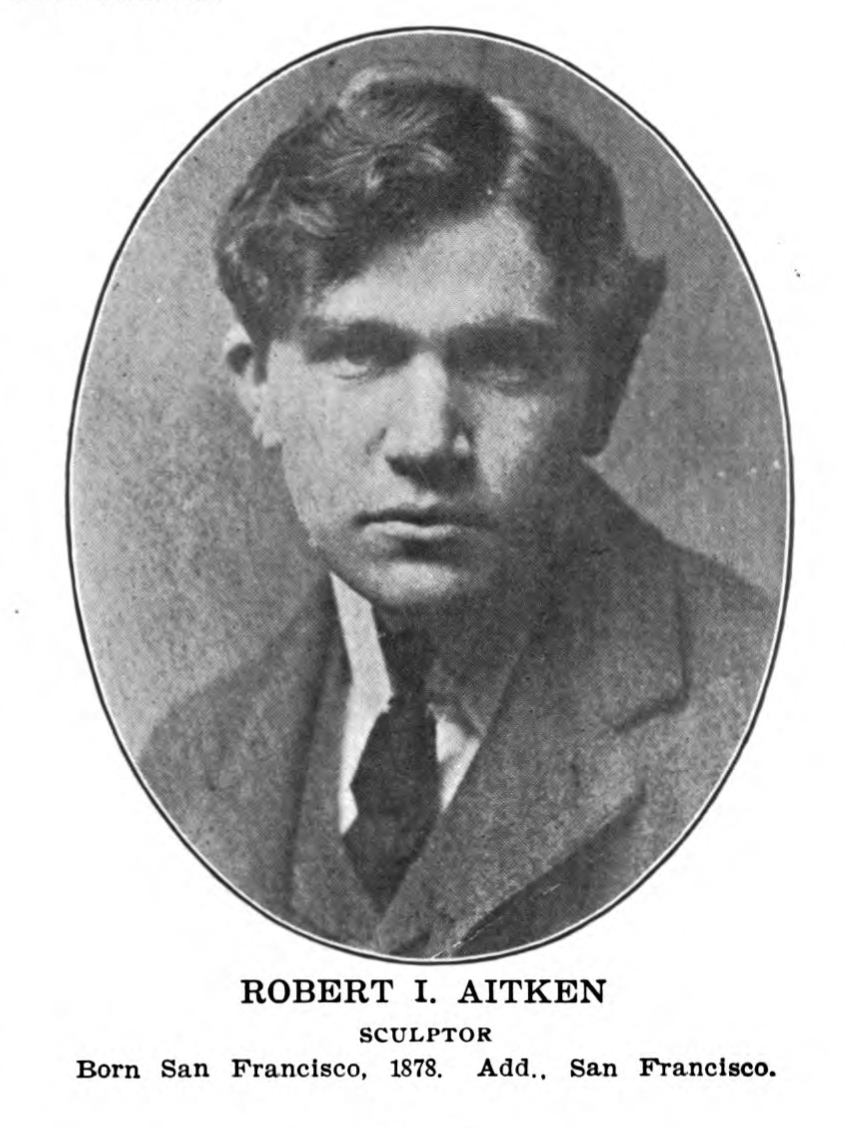
His words are chiseled over the entrance to the U.S. Supreme Court. His owl and his goddess sit on a gold coin so scarce that fewer than five hundred survive. Robert Aitken worked at both scales — the monumental and the palm-sized — and brought the same Beaux-Arts grandeur to each.
Who he was
Robert Ingersoll Aitken was born in San Francisco on May 8, 1878, and he was sculpting professionally before most artists finish school. He trained at the Mark Hopkins Institute of Art — the school that became the San Francisco Art Institute — under the noted sculptor Douglas Tilden. By 1901 he was teaching there himself, still in his early twenties.
His early work is woven into the city that raised him. The winged figure of Victory atop the Dewey Monument in Union Square is his. So is the towering "Republic" figure of the William McKinley Memorial in the Panhandle of Golden Gate Park. These are the kind of public, allegorical statues a young Beaux-Arts sculptor built a reputation on — confident, classical, larger than life.
Aitken moved to New York, taught at the Art Students League, and rose to the top of his field. He was elected to the National Academy of Design and the American Academy of Arts and Letters. In an era when the Olympics still awarded medals for art, he entered the sculpture competition at the 1928 Summer Games in Amsterdam. He died in New York on January 3, 1949.
The craft
Aitken belonged to the Beaux-Arts tradition — the turn-of-the-century style that reached for ancient Greece and Rome to dignify modern American institutions. His figures are calm, idealized, and built to carry meaning at a glance: a goddess for wisdom, an owl for learning, a frontiersman for the westward push.
His most famous work needs no museum visit. The west pediment of the U.S. Supreme Court building in Washington — the sculptured triangle above the columns — is his. The architect Cass Gilbert gave him a free hand, asking only that the result "be worthy of the great Supreme Court." Aitken filled it with allegorical figures of Liberty, Order, and Authority, and carved beneath them three words that have become the building's motto: Equal Justice Under Law.
That same instinct — make the idea legible, make it noble — is exactly what coin design demands. A coin is a relief sculpture a few centimeters wide, struck millions of times, read in a glance. Aitken approached his coins the way he approached a pediment: a clear allegory, classically posed, with the lettering and the symbolism doing real work. The scholar Cornelius Vermeule, in his standard history Numismatic Art in America, singled out Aitken's coinage for its Renaissance medallic sensibility — the look of a struck art medal rather than a piece of pocket change.
The clearest proof is the coin collectors prize most. In 1915, asked to design a fifty-dollar gold piece for San Francisco's Panama-Pacific International Exposition, Aitken put the goddess Minerva on the obverse — the "heads" side — in a crested helmet pushed back to signal peace. On the reverse he placed her sacred owl, perched on a pine branch. The coin came in two shapes: a round version and a striking octagonal one, its eight sides ringed with eight dolphins. The dolphins, Aitken said, expressed "the uninterrupted water route" the new Panama Canal had opened between the oceans. It was his first coin, and it remains one of the most admired in the American series.
Key facts
- Born
- May 8, 1878 — San Francisco, California
- Died
- January 3, 1949 — New York, New York
- Nationality
- American
- Trained at
- Mark Hopkins Institute of Art (under Douglas Tilden)
- Best-known sculpture
- West pediment, U.S. Supreme Court — 'Equal Justice Under Law' (1935)
- First coin design
- Panama-Pacific $50 gold, round & octagonal (1915)
- Other U.S. coins
- Missouri Centennial half dollar (1921); San Diego / California-Pacific Exposition half dollar (1935–1936)
- Honors
- National Academy of Design; American Academy of Arts and Letters
The coins he designed
- 1915Panama-Pacific $50 gold (round & octagonal). Minerva and her owl. Aitken's first coin — and the rarest type in the entire U.S. commemorative series.
- 1921Missouri Centennial half dollar. Daniel Boone on the obverse; a frontier scene on the reverse. The famous '2★4' variety marks Missouri as the 24th state.
- 1935–1936San Diego (California-Pacific Exposition) half dollar. Minerva again — this time from the Great Seal of California — with exposition buildings on the reverse.
Questions people ask
Who designed the 1915 Panama-Pacific $50 gold coin?
Robert Ingersoll Aitken, the San Francisco-born sculptor who also carved the west pediment of the U.S. Supreme Court. The Pan-Pac $50 was his first coin design. It was struck in both a round and an octagonal version, with Minerva on the obverse and her owl on the reverse.
Why is the Panama-Pacific $50 gold piece so rare?
Very few were made and even fewer kept. Only about 1,500 of each shape were struck, and net distribution came to roughly 483 of the round version and 645 of the octagonal — the rest were melted. The round $50 has the lowest distribution of any U.S. commemorative coin, which is why high-grade examples sell into the six figures.
What does the '2★4' on the Missouri Centennial half dollar mean?
It marks Missouri as the 24th state admitted to the Union — '2', a star, then '4'. Aitken's earliest 1921 strikes carried it, and the mark was then removed from the dies. Both the '2★4' and plain varieties are collected.
Did Robert Aitken design more than coins?
Yes — he was first and foremost a monumental sculptor. His best-known work is the U.S. Supreme Court's west pediment with the inscription 'Equal Justice Under Law.' He also created the Victory figure on San Francisco's Dewey Monument and the 'Republic' figure of the city's McKinley Memorial.
Sources
- Robert Ingersoll Aitken — Wikipedia
- Panama–Pacific commemorative coins — Wikipedia
- Missouri Centennial half dollar — Wikipedia
- California Pacific International Exposition half dollar — Wikipedia
- The West Pediment — Office of the Curator, Supreme Court of the United States
- 1915-S Panama-Pacific $50 Gold Coins — PCGS
- Missouri Centennial Half Dollar — U.S. Mint
- Art competitions at the 1928 Summer Olympics — Wikipedia