US coin · series

The Silver Dollar That Carries D-Day and Eisenhower's Last Order

A 1993 commemorative, dated 1991–1995, struck to honor the men who waded onto Normandy's beaches — and to help build the memorials that remember them.

The Silver Dollar That Carries D-Day and Eisenhower's Last Order
www.usmint.gov (United States Mint) · public domain · source

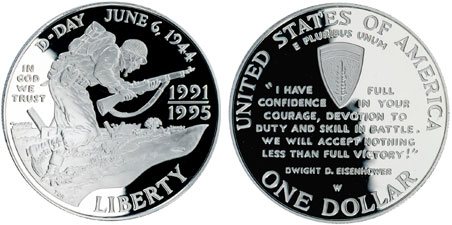
On its face, a soldier wades ashore under fire at Normandy. On its back, the words General Eisenhower gave his troops the morning of D-Day: "We will accept nothing less than full victory." This is a coin built around a single sentence — and the half-million Americans who lived it.

The story behind the coin

By the early 1990s, the men who had stormed the beaches of Normandy were turning seventy. The country wanted to thank them while they were still here to be thanked. So Congress did something coins do well: it turned an anniversary into a small object of metal that ordinary people could hold.

The result was the World War II 50th Anniversary Commemorative Coins Act — Public Law 102-414 — which President George H. W. Bush signed on October 14, 1992. It authorized three coins: a clad half dollar, this 90% silver dollar, and a gold five-dollar piece. All three carry the same unusual dual date, 1991–1995, instead of a single year. That span marks the fifty years from America's entry into the war in 1941 to the surrender of Japan in 1945, counted forward half a century.

Here's the quiet trick the date plays. The coins were actually struck and sold in 1993 — but you will never find "1993" on one. The Mint stamped them with the four-year commemorative window instead. To a newcomer it reads like a mistake. To the people who wrote the law, it was the whole point: this wasn't a coin for one moment, but for an era the country was determined not to forget.

Sales opened on May 28, 1993. The timing was deliberate — close enough to the run-up to the 50th anniversary of D-Day the following June that buying one felt like joining a national act of remembrance.

The design

Both sides were designed by Thomas D. Rogers Sr., a U.S. Mint sculptor-engraver. He built the coin around a single morning: June 6, 1944.

The obverse — the heads side — shows an American soldier wading through the surf toward the beach at Normandy, rifle up, landing craft and fellow servicemen behind him. The legend reads "D-DAY JUNE 6, 1944." It is not a portrait of a general or a politician. It is an ordinary infantryman, mid-stride, in the most dangerous water of the twentieth century.

The reverse — the tails side — is even more pointed. At its center sits the shoulder-sleeve insignia of SHAEF (Supreme Headquarters Allied Expeditionary Force), the command that ran the invasion. Around it runs a line from the order General Dwight D. Eisenhower issued his troops before the assault: "I HAVE FULL CONFIDENCE IN YOUR COURAGE, DEVOTION TO DUTY AND SKILL IN BATTLE. WE WILL ACCEPT NOTHING LESS THAN FULL VICTORY!"

That's the rare thing about this dollar. Most coins commemorate an event. This one quotes a man giving an order, in his own words, at the moment everything hung in the balance. You hold a piece of silver and you are reading what Eisenhower told boys half their size were about to die — and many did.

Key facts

Denomination
Silver dollar ($1)
Dated
1991–1995 (dual date; struck and sold in 1993)
Designer
Thomas D. Rogers Sr. (both sides)
Composition
90% silver, 10% copper
Weight / Diameter
26.730 g · 38.10 mm · reeded edge
Uncirculated (Denver, D)
≈107,240 (some sources cite ~94,708 net)
Proof (West Point, W)
342,041
Surcharge
$8 per coin, to fund WWII memorials
Authorizing act
Public Law 102-414, signed Oct 14, 1992

Collecting it

This is a modern commemorative, not a rarity, and that shapes everything about collecting it. Both versions survive in large numbers, almost always in pristine condition — these coins were bought by mail, dropped straight into a drawer, and never spent. So the game here is not "is it rare?" but "is it perfect?"

The coin came in two flavors. The uncirculated business strike wears a D mint mark (Denver) and has the lower mintage of the two — somewhere near 107,000 pieces, the figure most catalogs cite, though a few sources list a slightly smaller net total after returns. The proof version — struck twice from polished dies for a mirror finish — wears a W (West Point) and is the more common of the pair at 342,041.

That flip surprises newcomers: the prettier proof is the more plentiful coin, because that's what most buyers wanted. The plainer uncirculated D is the scarcer one. Neither commands a fortune, but among collectors who chase the modern commemorative series, the D is the harder box to tick.

Because nearly every example is high grade, value lives at the very top of the scale. A common coin in an ordinary holder is worth little more than its silver. The same coin certified at the ceiling grade — a flawless MS70 or PR70 — is a different object entirely. With this issue, condition isn't a detail. It's the whole story.

Questions collectors ask

Why does the coin say 1991–1995 if it was made in 1993?

The dual date marks the 50th anniversary span of America's war, 1941 to 1945, counted forward fifty years. Congress wanted the coin to honor the whole era, not a single year — so the Mint stamped all three WWII commemoratives with 1991–1995 even though they were actually struck and sold in 1993.

Who is the soldier on the front?

No one in particular. Designer Thomas D. Rogers Sr. depicted an anonymous American infantryman wading ashore at Normandy on D-Day, June 6, 1944 — a stand-in for every soldier who made that landing, rather than a named commander.

What is the quote on the back?

It is from General Dwight D. Eisenhower's order to the Allied troops before the D-Day assault: 'I have full confidence in your courage, devotion to duty and skill in battle. We will accept nothing less than full victory!' It surrounds the shoulder insignia of SHAEF, the command that ran the invasion.

Is the 1993 World War II silver dollar rare or valuable?

It isn't rare — hundreds of thousands were made and most survive in mint condition. Ordinary examples trade close to their silver value. The money is in perfection: a coin graded at the top of the scale (MS70 or PR70) is worth a sizable premium, because flawless examples are scarce even when the coin itself is common.

What was the extra money used for?

Each silver dollar carried an $8 surcharge. The law sent the first $3 million to the Battle of Normandy Foundation for a U.S. D-Day memorial in France, and the next $7 million to the American Battle Monuments Commission toward a World War II memorial in Washington, D.C. — work that fed into what became the National World War II Memorial.

Sources