US coin · series

The 1871 Standard Silver Dollar

Longacre's Indian Princess — a dollar its designer drew, died, and never saw struck.

The 1871 Standard Silver Dollar
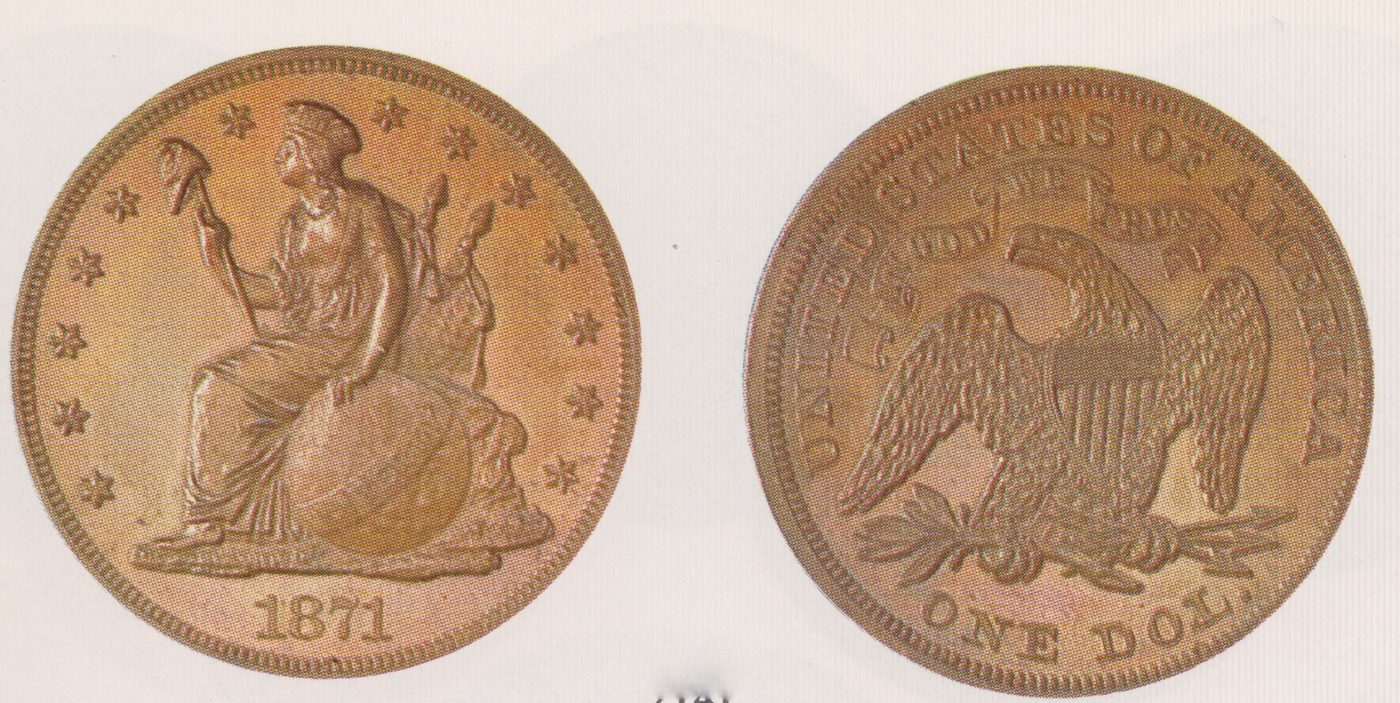
Coin design by James Barton Longacre (Engraver, U.S. Mint, Philadelphia). Photograph published in the 1977 American Numismatic Association Auction… · public domain · source

In 1871 the U.S. Mint struck a silver dollar that wears a face the country never put into pockets: Liberty in a feathered headdress, seated on a globe, the word STANDARD arching over the back. The man who designed her had been dead two years. Only a handful of these dollars exist.

The story behind the coin

After the Civil War, American silver had vanished from circulation. To pay for the war the government had printed paper money — "greenbacks," backed by promise rather than metal — and suspended specie payment, meaning you could no longer walk into a bank and trade a paper note for gold or silver coin. When that happens, people hoard the real metal. By the late 1860s the small change of daily life wasn't coins at all but fractional currency — flimsy paper notes worth a few cents each, easy to lose and easy to fake.

The Mint wanted those coins back. But there was a trap: if a silver coin held more silver than its face value during a money panic, people would just melt it. So engineers and officials floated a fix. Make new silver coins that were deliberately lighter — worth a bit less than their stamped value — so no one would ever profit by melting them. Coins like that could safely circulate and quietly redeem the hated paper. The Mint stamped these trial pieces with a single word so no one would mistake the idea: STANDARD.

This is the Standard Silver pattern series — a sprawling run of experimental dimes, quarters, half dollars, and dollars struck from 1869 onward. A pattern is a trial coin: struck to test a design or a recipe before any mass production begins, never meant to be spent. More than 280 Standard Silver patterns were made across the series, and the Mint sold many of them straight to collectors. The 1871 dollar you see here is the crown of that experiment — the largest denomination, carrying the most ambitious face. Congress never adopted the plan. The lighter subsidiary silver that finally redeemed the fractional notes didn't arrive until the 1870s under different laws. The Standard Silver dollar was a road the country chose not to take.

The design — a face its maker never saw

The obverse — the heads side — is one of the most striking things ever to come out of the 19th-century Mint. Liberty sits in a full Native American feathered headdress, one hand resting on a globe marked LIBERTY, the other holding a pole topped with a liberty cap — the soft Phrygian cap that has meant "freedom" since Roman times. Flags rise behind her. Collectors call her the Indian Princess.

She was drawn by James Barton Longacre, the Mint's chief engraver from 1844 to 1869 — the same artist who gave America the Indian Head cent, the two-cent piece, and the shield nickel. Longacre loved this headdressed Liberty; he had used the motif before. But here is the haunting part: Longacre died on January 1, 1869. The Standard Silver dollars carrying his Indian Princess weren't struck until 1871, two years later, under his successor as chief engraver, William Barber. The face on this coin belongs to a man who never lived to see it pressed into metal.

The reverse — the tails side — keeps it plain. A large 1 above the word DOLLAR, wrapped in a wreath of cotton and corn, with STANDARD arching across the top near the rim. The cotton and corn are not decoration for its own sake: they're the produce of a reuniting North and South, an agrarian nation putting its harvest on its money. And STANDARD, again, is the whole argument in a single word — a new standard of silver, lighter than the law of 1853 allowed.

Key facts

Year struck
1871 (pattern / trial coin)
Denomination
One dollar
Series
Standard Silver patterns (1869 onward)
Obverse designer
James Barton Longacre (d. Jan 1, 1869) — "Indian Princess" Liberty
Struck under
William Barber, Chief Engraver, 1871
Obverse
Liberty in Indian headdress on a globe marked LIBERTY; pole and cap; flags; date 1871
Reverse
1 over DOLLAR in a cotton-and-corn wreath; STANDARD above
Composition
Silver (the series was also struck in copper and aluminum)
Edge varieties
Reeded edge (Judd-1120) and plain edge (Judd-1121)
Rarity
Very rare — roughly three or four known in silver (High R.7)

Collecting it — a coin of single digits

You do not assemble a "set" of 1871 Standard Silver dollars. In silver, only about three or four are believed to survive. Numismatists rate the rarity at High R.7 — a rarity scale where R.7 means roughly four to twelve pieces exist, and "High R.7" sits at the scarcer end of even that thin band. When one appears, it's an event.

Collectors sort the 1871 dollar by Judd numbers — the standard reference system for U.S. pattern coins — and the split here is mostly about the edge:

  • Judd-1120 — silver, reeded edge (the fine vertical ridges you feel on a modern quarter's rim).
  • Judd-1121 — silver, plain edge (smooth, no ridges).

Beyond silver, the same Indian Princess dies were also struck in copper and in aluminum — and aluminum, in 1871, was an exotic, expensive novelty metal, not the cheap foil of today. These off-metal strikes are part of why the Standard Silver series fascinates specialists: the Mint was experimenting with everything at once, and selling the results to collectors. One 1871 Indian Princess dollar struck in aluminum, graded Proof 67★ Cameo, sold for $31,200 at a Heritage Platinum Night session.

A word on what you're actually buying. Because every survivor is a near-unique object, condition matters less than mere existence — though grade still moves the price hard. These were struck as proofs (coins made with polished dies and planchets for sharpness and mirror finish, never for change), so the ones that survive tend to be beautiful. What you're really collecting is the moment itself: a dollar that records, in metal, an economic argument the country had and then walked away from.

Questions collectors ask

Why is it called a Standard Silver dollar?

Because the word STANDARD is stamped on the reverse. It refers to the Standard Silver pattern series of 1869 onward — an experiment in coins made of deliberately lighter (lower-value) silver, meant to circulate safely and redeem the paper fractional currency left over from the Civil War. The plan was never adopted.

Who designed the 1871 Standard Silver dollar?

The Indian Princess obverse — Liberty in a feathered headdress on a globe — was designed by James Barton Longacre, the Mint's chief engraver. Longacre died on January 1, 1869, so the 1871 dollars carrying his design were actually struck under his successor, William Barber.

Is this a real circulating dollar?

No. It is a pattern — a trial coin struck to test a design and a money idea. It was never released for circulation. The Standard Silver plan it represented was never enacted into law.

How rare is the 1871 Standard Silver dollar?

Extremely. In silver, only about three or four are believed to exist (rated High R.7). The same design was also struck in copper and aluminum as separate, very rare pattern issues.

What's the difference between Judd-1120 and Judd-1121?

Mainly the edge. Judd-1120 is the silver dollar with a reeded (ridged) edge; Judd-1121 is the silver dollar with a plain (smooth) edge. Both share Longacre's Indian Princess obverse and the STANDARD reverse.

Is this the same as the trade dollar?

No, though they're cousins from the same restless moment at the Mint. The Standard Silver dollar was about domestic small change; the trade dollar (authorized in 1873) was a heavier coin built for commerce in Asia. The early 1870s saw the Mint testing several rival silver-dollar ideas at once.

Sources