US coin · series

The Shield Nickel With Rays: a coin too stubborn to strike

America's first modern nickel arrived hard, ornate, and almost impossible to make cleanly — so the Mint changed it in barely a year.

The Shield Nickel With Rays: a coin too stubborn to strike
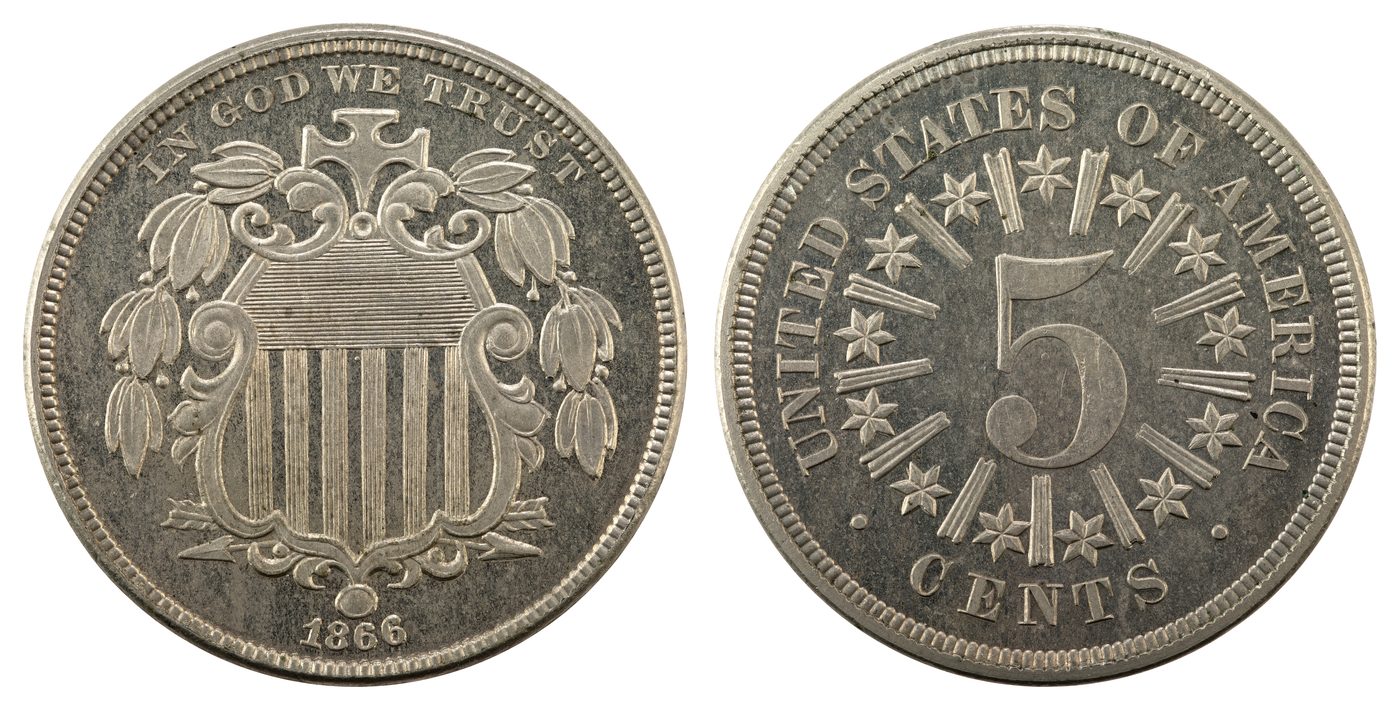
US Mint (coin), National Numismatic Collection, National Museum of American History (photograph by Jaclyn Nash) · public domain · source

In 1866 the United States struck a five-cent piece out of a brand-new alloy nobody had coined before — and it fought back. The metal was so hard, and the design so busy, that the dies cracked, the details blurred, and within months the Mint quietly erased part of the artwork. The version with the original rays survives as one of the shortest-lived designs in American coinage.

The story behind the coin

The Civil War made small change disappear. As the war dragged on, Americans hoarded anything with metal value — gold, silver, even copper-nickel cents — and what was left in pockets was a mess of grimy paper "fractional currency," some of it worth as little as three cents. People hated the flimsy notes. The Mint hated them too.

Into that gap stepped Joseph Wharton, an industrialist who controlled most of the nickel mining in the United States. Wharton had product to sell and the ear of Congress. He pushed hard for coins made of nickel — and the heavier the coin, the more nickel each one would consume. His lobbying helped shape the Coinage Act of May 16, 1866, which authorized a new five-cent piece: five grams of metal, 75% copper and 25% nickel. The "nickel" was born, named for the minority metal that made it stand out from the silver coins it replaced.

It also solved a different problem. With no silver half dimes circulating, the country needed a hard, durable five-cent coin that anyone would accept — one worth far less as metal than as money, so no one would melt it. The new nickel fit exactly.

The design and who made it

The job fell to James Barton Longacre, the Mint's Chief Engraver, who designed both sides. For the obverse — the "heads" side — he reached for a motif he had already used on the two-cent piece: a heavy ornamented shield drawn from the Great Seal, topped by a cross, framed by laurel branches, with crossed arrows below and "IN GOD WE TRUST" arcing over the top. It reads less like a portrait and more like a national emblem — fitting for a country that had just fought to stay one nation.

The reverse is where the trouble started. Longacre placed a large numeral 5 at the center and ringed it with thirteen stars for the original states. Between those stars he set thirteen rays — short bursts of metal radiating outward (early Mint paperwork even called them "bars"). It was striking to look at. It was also a nightmare to make.

Before settling on the shield, Longacre had worked up other ideas, including pattern coins carrying portraits of Washington and Lincoln. (A pattern is a trial coin struck to test a design that may never reach circulation.) Unease about putting any individual's face on the money sent him back to the safe, symbolic shield.

Key facts

Years struck (With Rays type)
1866–1867
Designer
James Barton Longacre (obverse and reverse)
Composition
75% copper, 25% nickel
Weight
5.00 grams
Diameter
20.5 mm
Edge
Plain
Authorizing law
Coinage Act of May 16, 1866
1866 With Rays mintage
14,742,500 business strikes
1867 With Rays mintage
2,019,000 business strikes
1867 With Rays Proof
Major rarity — estimates vary (~25 to ~100 struck)

Collecting it: why the rays vanished — and why that matters

The new copper-nickel alloy was punishingly hard, and the rayed reverse asked too much of it. To fill all those sharp angles and recesses, the dies had to slam down with enormous pressure — and they kept cracking. Coins came out with weak, mushy details. Die life was short, and the Mint was burning through steel.

So the rays were cut. On January 21, 1867, the Treasury ordered them removed; production of the simplified "No Rays" reverse began that February. That single decision splits the whole series into two collectible types. The With Rays type — Type 1 — exists only for part of 1866 and part of 1867. Everything struck from 1867 through 1883 is the plainer No Rays type.

That makes the math simple for collectors. The 1866 With Rays is the affordable, available date — the one most type collectors buy to represent the design, since over fourteen million were made. The 1867 With Rays is the scarce one: far fewer business strikes, and as a proof (a specially struck presentation coin with mirror fields) it is one of the great rarities of the series, with only a handful believed to survive.

Two more things keep collectors hunting. First, because the rayed dies struck so poorly, a fully sharp, well-detailed example is genuinely hard to find — even a common 1866 in a high grade with crisp rays commands a premium that a worn one never will. Second, the design's brief life gives it outsized appeal: a complete U.S. type set needs a With Rays nickel, and there are only two dates to choose from.

A small, true aside on the legend: some accounts say the rays were dropped partly because the radiating-stars motif reminded people of the Confederate "stars and bars." It's a recurring story — and it may have played a role — but the documented, decisive reason was production: cracking dies and weak strikes. Treat the politics as plausible color, not settled fact.

Questions collectors ask

What is the difference between the With Rays and No Rays Shield nickel?

Look at the reverse. The With Rays type (1866 and part of 1867) has short rays radiating between the thirteen stars around the numeral 5. The No Rays type (1867–1883) removed those rays, leaving a cleaner field. The change was made in early 1867 because the rayed dies cracked and struck poorly.

Why was the Shield nickel made of nickel instead of silver?

The Civil War drove silver and gold out of circulation as people hoarded precious metal. The country needed a durable coin worth far less as metal than as money, so it would stay in pockets rather than be melted. Nickel-mining magnate Joseph Wharton lobbied hard for a copper-nickel alloy, which became 75% copper and 25% nickel under the Coinage Act of 1866.

Why is the 1867 With Rays so much rarer than the 1866?

The rays were removed early in 1867, so the With Rays design was only struck for part of that year — about 2 million business strikes versus over 14 million in 1866. The 1867 With Rays proof is rarer still: estimates of how many were struck vary, but only a small number survive, making it a key coin of the series.

Who designed the Shield nickel?

James Barton Longacre, the Mint's Chief Engraver, designed both sides. The shield obverse echoes a motif he had already used on the two-cent piece; the rayed reverse with its large 5 was his original work for this coin.

Why are well-struck Shield nickels with rays so hard to find?

The copper-nickel alloy was hard, and the rayed design demanded high striking pressure to render fully. Many coins came out with weak, blurred details, and the dies cracked quickly. A piece with sharp, complete rays and crisp shield detail is scarce in any grade and trades at a premium.

Sources