US coin · series

The Saint-Gaudens Ultra High Relief Double Eagle

A 1907 masterpiece the Mint couldn't strike — finally realized, a century later, in pure gold.

The Saint-Gaudens Ultra High Relief Double Eagle
Professional Coin Grading Service (credit: pcgs.com CoinFacts). License does not require attribution · public domain · source

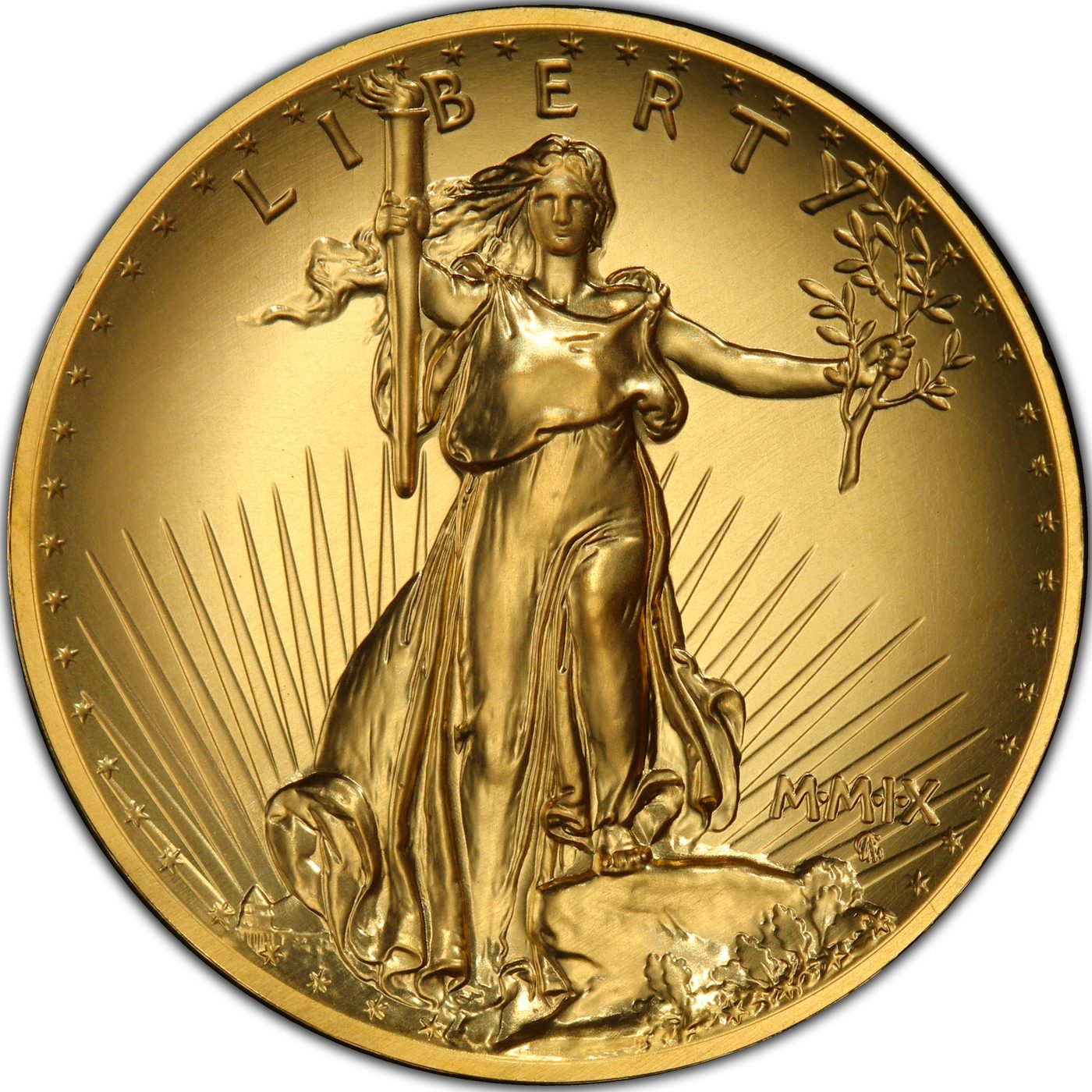
In 1907, Augustus Saint-Gaudens designed what many still call the most beautiful coin in American history. The Mint of his day couldn't strike it. In 2009, using his original models and modern dies, the United States Mint finally did — and stamped the year in Roman numerals, MMIX, exactly the way he wanted.

The story behind the coin

Augustus Saint-Gaudens never saw his coin succeed. He sculpted it in 1907 at the request of President Theodore Roosevelt, who wanted American money to rival the coins of ancient Greece. The result was a striding Liberty in breathtaking depth — sculpture, not stamping. But the relief was so high it fought the machinery. The earliest ultra-high-relief pieces of 1907 had to be struck up to nine times each on a hydraulic press to bring up the detail. That is not a coin you can mass-produce. Saint-Gaudens died in August 1907, before the fight was settled, and the Mint's chief engraver flattened the design into something the presses could handle.

So for a hundred years, the ultra-high-relief version stayed a near-myth — a handful of 1907 patterns, locked away in museums and elite collections. The dream sat unfinished.

In 2009 the United States Mint finished it. Working from Saint-Gaudens' original artwork and the galvano models his assistant Henry Hering had made, the Mint used digital scanning and modern die technology to strike the design the way the sculptor first imagined it — in full, uncompromised ultra high relief. They called it the Ultra High Relief Double Eagle. On the coin, the year reads MMIX: Roman numerals, the classical touch Saint-Gaudens had always wanted and the older Mint had stripped away. It is, in a real sense, a 1907 coin that took 102 years to come out.

The design — and who made it

The artist is Augustus Saint-Gaudens, one of the great American sculptors, and he made both sides. The obverse — the heads side — shows Liberty striding forward out of the dawn, a torch raised in one hand for enlightenment and an olive branch in the other for peace, the Capitol dome small at her feet and sun rays bursting behind her. The reverse — the tails side — is a young eagle in flight, seen from below, gliding over a rising sun. The two sides rhyme: dawn behind both, motion across both.

The 2009 coin is the same design, with a few honest updates. The original 1907 obverse carried 46 stars for the 46 states of that year; the 2009 version carries 50, one for every state today. The motto IN GOD WE TRUST — which Roosevelt and Saint-Gaudens had deliberately left off, believing it cheapened both the words and the art — appears on the modern coin, as federal law now requires. And the edge is lettered, not reeded: E PLURIBUS UNUM runs around the rim, stars standing in for the spaces, struck in raised relief just as the 1907 originals were.

The physical coin is different from the old double eagle in one big way. The 1907–1933 double eagle was 90% gold and worth twenty dollars in commerce. The 2009 piece is one full troy ounce of .9999 fine gold — nearly pure — pressed onto a thick, small planchet (about 27 mm across and 4 mm deep) precisely so the metal could hold that towering relief. It was never meant to spend. It is Saint-Gaudens' sculpture, finally given room to breathe.

Key facts

Year struck
2009 (dated MMIX)
Designer
Augustus Saint-Gaudens (obverse and reverse)
Modern adaptation
U.S. Mint, from Saint-Gaudens' 1907 models, under Mint Director Edmund C. Moy
Composition
One troy ounce of .9999 fine (24-karat) gold
Diameter / thickness
About 27 mm wide, ~4 mm thick
Edge
Lettered — E PLURIBUS UNUM in raised relief, stars between letters
Mint
West Point — struck as a business strike, no mint mark
Released
January 2009, in a mahogany box with a Certificate of Authenticity
Mintage
About 115,000 struck (published figures vary, ~114,400–115,200)

Collecting it — dates, varieties, and grade

This is a one-date series. There is only the 2009 MMIX coin — no earlier or later dates, no mint marks to chase, no rare branch-mint rarity. That simplicity is part of its appeal: what you are buying is the design itself, not a hunt across years.

The collecting action is in quality and surface, not dates. Because it is a thick coin in soft 24-karat gold struck with enormous force, the fields can come out unusually mirror-like. Both major grading services recognize this. A coin with reflective, mirror fields can earn a Prooflike (PL) or even Deep Prooflike / Deep Mirror Prooflike (DPL/DMPL) designation, and those bring a premium over an ordinary brilliant example. By the published submission data, only a minority of coins earn PL, and a small fraction reach the deep-mirror tier — which is why graders' population reports matter here.

The other axis is grade. Top grades like MS69 and MS70 (a flawless coin under magnification) sell for more, and on a coin this prone to tiny handling marks in pure gold, a true gem is genuinely scarcer than the mintage alone suggests. Original packaging counts too — collectors prize the example still in its U.S. Mint mahogany box with the Certificate of Authenticity. For everyone else, the floor is the metal: this is a full ounce of nearly pure gold, so its value never falls far below the gold price of the day.

Questions collectors ask

Why does the 2009 Double Eagle say MMIX instead of 2009?

MMIX is 2009 in Roman numerals. Saint-Gaudens used Roman numerals on his 1907 design to give it a classical, ancient-Greek feeling. The Mint of 1907 later switched to ordinary numbers; the 2009 coin restores the Roman date the sculptor wanted.

Is this the same as the old 1907–1933 Saint-Gaudens Double Eagle?

It's the same design by the same artist, but a different coin. The original circulated as $20 in 90% gold. The 2009 version is a collector and bullion piece in one ounce of .9999 fine gold, struck in the full ultra-high relief the 1907 Mint couldn't mass-produce.

What does 'ultra high relief' actually mean?

Relief is how far the design rises off the coin's surface. Higher relief means deeper, more sculptural detail — and a much harder coin to strike. Saint-Gaudens' ultra-high relief was so deep that 1907 presses needed many blows per coin. Modern dies finally made it practical in 2009.

Does it have a mint mark?

No. It was struck at the West Point Mint but carries no mint mark, like several modern U.S. gold issues.

What makes one worth more than another?

Grade and surface. Flawless high-grade examples (MS69, MS70) and coins with mirror-like Prooflike or Deep Prooflike fields trade above ordinary ones. The original mahogany box and Certificate of Authenticity add value too. Below all of that sits the gold floor — it's a full ounce of nearly pure gold.

Sources