US coin · series

The Pilgrim Half Dollar: a 300-year anniversary, struck two years running

A Plymouth governor on one side, the Mayflower on the other — and a second-year reissue that quietly tested how much collectors would buy.

The Pilgrim Half Dollar: a 300-year anniversary, struck two years running
Coin image sourced from Numismatic Guaranty Corporation (ngccoin.com); uploaded to Wikimedia Commons by user ZLEA. Public domain (work of the U.S.… · public domain · source

In 1920, the United States minted a coin to mark 300 years since the Pilgrims landed at Plymouth. The next year it minted the same coin again — with a tiny "1921" added so collectors would need to buy both. Most of that second batch never sold, and the Mint melted it down. That melting is exactly why the 1921 Pilgrim is the one people chase today.

The story behind the coin

In 1620, a leaky merchant ship called the Mayflower dropped about a hundred English settlers on the coast of what is now Massachusetts. Three centuries later, Plymouth wanted to throw a party — and pay for it.

So Massachusetts congressman Joseph Walsh introduced a bill, and on May 12, 1920, President Woodrow Wilson signed it into law. It authorized up to 300,000 silver half dollars to mark the Pilgrim Tercentenary — tercentenary simply meaning the 300th anniversary. The coins weren't a gift from the government. The Mint struck them at face value, handed them to the organizers, and the organizers sold them to the public for a dollar apiece. The profit funded the celebration. This was the standard playbook for early U.S. commemoratives: a coin doubling as a fundraiser.

The first year went well. Then came the second year — and the second year is where this coin earns its reputation.

The design

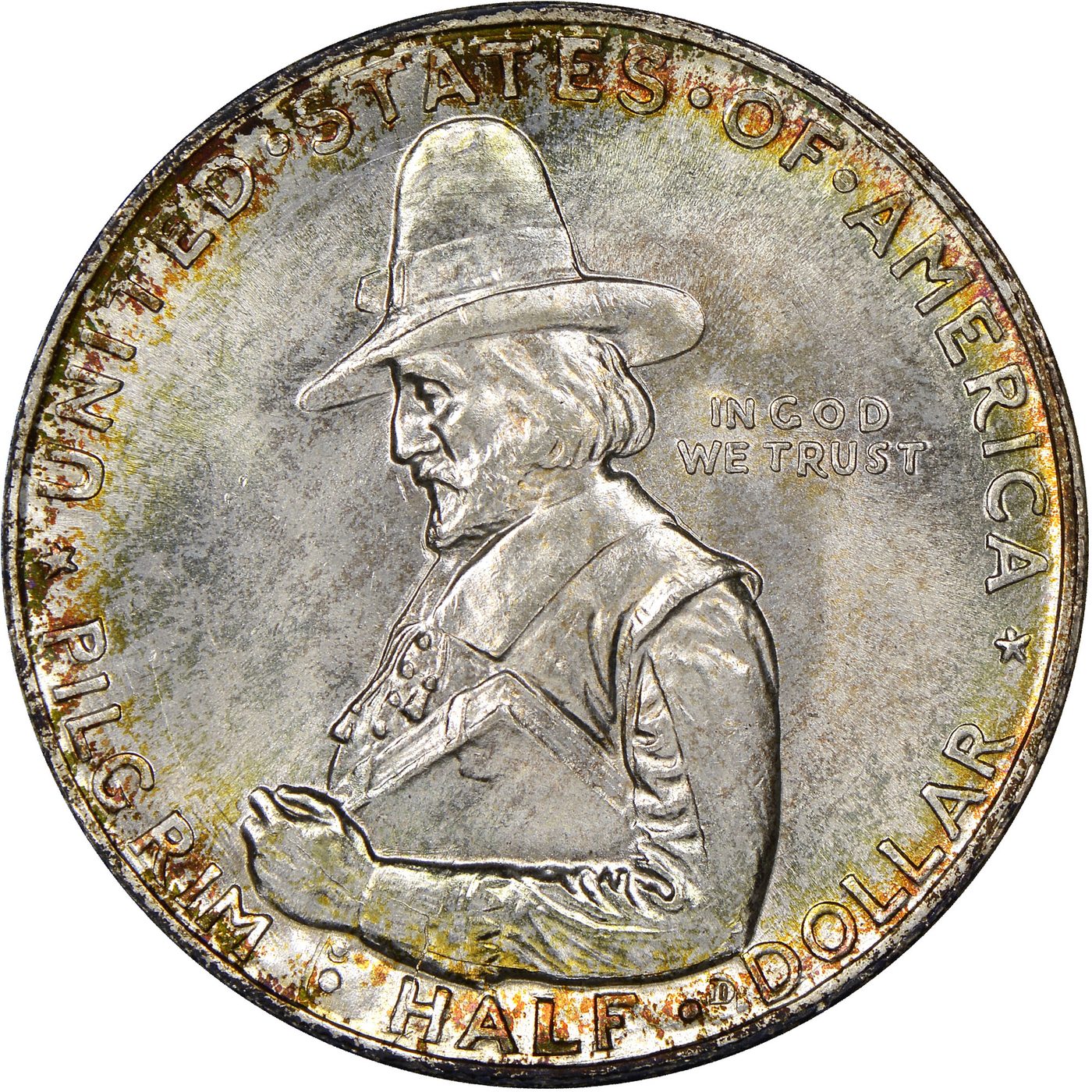
The obverse — the heads side — shows Governor William Bradford in a tall Pilgrim hat, a book tucked under his arm, lost in thought. Bradford led the Plymouth Colony and wrote its history, Of Plymouth Plantation, which is the book he's carrying. There's a catch worth knowing: no real portrait of Bradford survives, so the face on the coin is invented. It's a Pilgrim, not the Pilgrim.

The reverse — the tails side — gives you the Mayflower in full sail, riding the Atlantic. It reads "PILGRIM TERCENTENARY CELEBRATION" with "1620 – 1920" below. Look closely and you'll spot a small historical slip: the ship flies a triangular jib sail off its bow, a rig that didn't exist on ships of 1620. A charming anachronism that numismatists have pointed out for a century.

The artist was Cyrus E. Dallin, a Boston sculptor far better known for his monumental Native American figures — his Appeal to the Great Spirit still sits outside Boston's Museum of Fine Arts. He worked from sketches supplied by the Tercentenary Commission and turned them into the plaster models the Mint used. Not everyone admired the result: sculptor James Earle Fraser, the man behind the Buffalo nickel, criticized the coin's crude lettering. The Treasury approved it anyway.

Key facts

Years struck
1920 and 1921
Denomination
Half dollar (50 cents)
Designer
Cyrus E. Dallin
Obverse
Governor William Bradford (an idealized likeness — no true portrait survives)
Reverse
The Mayflower under sail
Composition
90% silver, 10% copper
Weight
12.5 grams (~0.3617 troy oz silver)
Diameter
30.61 mm; reeded edge
Mint
Philadelphia (no mint mark)
1920 mintage
200,112 struck; 48,000 melted → 152,112 distributed
1921 mintage
100,053 struck; 80,000 melted → 20,053 distributed
Authorizing act
Act of May 12, 1920
Original sale price
$1 each

Collecting it

There are only two coins in this series, and the gap between them is the whole game.

The 1920 issue is common. Over 150,000 reached collectors and the public, so a presentable example has never been hard to find. The 1921 is the prize — and the reason is a melting pot.

When the organizers came back for a second year, they added a tiny "1921" to the obverse, just left of Bradford's face, so the date sat on the coin for the first time. The plain commercial logic was that anyone building a set would now need two coins instead of one. But 1921 brought a sharp recession, the novelty had worn off, and demand collapsed. Of the 100,053 struck, 80,000 came back unsold. The Mint melted them. Only about 20,053 survived — making the 1921 roughly seven times scarcer than the 1920, and worth a large multiple of it in every grade.

The numismatist Q. David Bowers singled out this second-year reissue as an early example of a coin made less to commemorate than to "get" the collector — to lean on the urge to complete a set. Decades of multi-year commemorative programs would follow that template. As with most early commemoratives, the prices climb fastest at the top: mint-state coins with full, frosty original luster and clean fields command real premiums, because so many were spent, cleaned, or knocked around in the century since.

Questions collectors ask

Why is the 1921 Pilgrim half dollar worth so much more than the 1920?

Scarcity, created by a melting pot. The 1921 reissue arrived during a recession with the novelty gone, and 80,000 of the 100,053 struck came back unsold and were melted. Only about 20,053 survive, versus 152,112 of the 1920 — so the 1921 trades at a large multiple in every grade.

How do I tell a 1920 Pilgrim from a 1921?

Look at the obverse, just to the left of Bradford's face. The 1920 issue carries no date there; the 1921 issue adds a small '1921'. Both reverses read '1620 – 1920', so the obverse date is the only reliable tell.

Is the man on the coin a real portrait of William Bradford?

No. Bradford was a real person — the long-serving governor of Plymouth Colony — but no authentic likeness of him survives. The face Cyrus Dallin sculpted is an idealized Pilgrim, not a portrait from life.

Was William Bradford the first real person on a U.S. coin?

No — that distinction goes back to the 1892 Columbian Exposition half dollar with its bust of Columbus, nearly thirty years earlier. The Pilgrim half is notable for other reasons: its two-year run and the heavily melted 1921 issue.

What is the Pilgrim half dollar made of?

The standard U.S. silver alloy of the era — 90% silver, 10% copper — weighing 12.5 grams, the same as a circulating half dollar of the time. It contains about 0.36 troy ounces of silver.

Sources