US coin · series

The Monroe Doctrine Centennial Half Dollar — Hollywood's Coin

A 100-year-old foreign policy on the front. A movie-industry damage-control campaign behind it.

The Monroe Doctrine Centennial Half Dollar — Hollywood's Coin
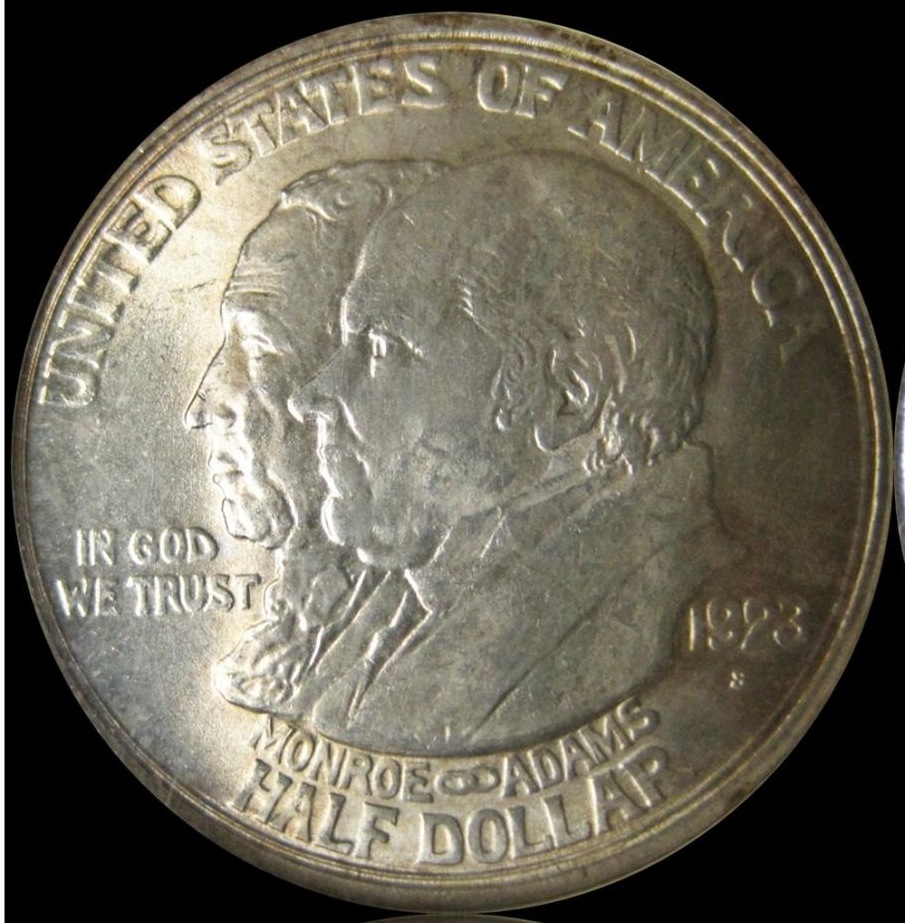
Coin design: Chester Beach. Image by user "green18" at cointalk.com (via Wikimedia Commons) · public domain · source

In 1923, the U.S. Mint struck a half dollar to honor a 100-year-old foreign policy. The real reason it exists has almost nothing to do with diplomacy — and almost everything to do with Hollywood trying to clean up its image.

The story behind the coin

The Monroe Doctrine is a piece of foreign policy, not the kind of thing you'd expect on a coin. In 1823 President James Monroe warned European powers to stop colonizing the Americas. A hundred years later, that anniversary became the official excuse for a fifty-cent piece — but the people who actually wanted the coin had a very different problem on their minds.

In the early 1920s, Hollywood was reeling. A string of scandals — the manslaughter trials of comedian Roscoe "Fatty" Arbuckle, the still-unsolved murder of director William Desmond Taylor, the troubles of actress Mabel Normand — had turned the young film industry into a national punchline. Studio executives wanted good press, and fast.

Their answer was a public spectacle: the American Historical Revue and Motion Picture Industry Exposition, held in Los Angeles from July 2 to August 4, 1923. To fund it and lend it a patriotic gloss, backers reached for a tool that had worked for other groups in the 1920s — a commemorative coin. Congressman Walter Franklin Lineberger of California introduced the bill; it passed the House on January 24, 1923, and the Senate soon after, authorizing up to 300,000 silver half dollars.

So a coin officially honoring 1820s diplomacy was, in practice, a fundraiser and a publicity prop for the movie business. That gap between the stated reason and the real one is the most interesting thing about it.

The design

Sculptor Chester Beach prepared the models, with the prominent medalist James Earle Fraser involved in shaping the concept. The obverse — the "heads" side — shows the conjoined busts of two presidents who built the doctrine: James Monroe, who delivered it, and John Quincy Adams, his Secretary of State, who is widely credited as its true author.

The reverse is the talking point. Two female figures are arranged so their bodies form the outline of the Western Hemisphere — one is North America, one is South America. The northern figure holds a laurel of peace and reaches down to clasp hands with the southern figure near the Panama Canal. Faint lines in the field stand for ocean currents, including the Gulf Stream.

It's a clever idea. The problem is it wasn't original. Artist Raphael Beck had used almost exactly this conceit — two female figures as the two continents — in a seal he designed for the 1901 Pan-American Exposition in Buffalo, copyrighted back in 1899. On July 23, 1923, Beck wrote to the Mint to complain that Beach's reverse copied his work and that Beach deserved no further credit for it. Fraser said he hadn't seen Beck's seal until the letter arrived — a claim the great numismatic scholar Q. David Bowers found hard to believe, given how closely the two designs match. Treat the resemblance as documented fact; treat the question of who knew what as an honest dispute.

Critics weren't kind even setting the borrowing aside. The relief — how far the design rises off the coin's surface — is very shallow, so the figures read as flat. Art historian Cornelius Vermeule dismissed the allegory as figures that "seem like mounted cut-outs," and Bowers noted that even freshly struck examples had an "insipid" look.

Key facts

Year struck
1923
Mint
San Francisco (mint mark S, under the date)
Designer
Chester Beach (concept with James Earle Fraser)
Obverse
Busts of James Monroe and John Quincy Adams
Reverse
Two female figures forming the Western Hemisphere
Authorized
Up to 300,000 (Act of January 24, 1923)
Mintage struck
274,077
Sold at premium
About 27,000 at $1 each; the rest went into circulation
Composition
90% silver, 10% copper
Weight
12.5 g (0.36169 troy oz silver)
Diameter
30.6 mm
Edge
Reeded

Collecting it

Here's the twist that shapes the whole market for this coin. The exposition was a flop. People didn't line up to buy half dollars at a dollar apiece, and only roughly 27,000 of the 274,077 struck actually sold at that premium. The rest — about nine-tenths of the mintage — were quietly released into ordinary circulation by October 1923.

That single fact explains almost everything a collector needs to know. A commemorative that's supposed to be saved instead spent years rattling around in pockets and tills. So while the mintage sounds modest, surviving coins are mostly worn, and worn examples are common and inexpensive. There's only the one issue — 1923-S — so there are no rare date varieties to chase.

The scarcity flips entirely at the top of the grading scale. Because so few were set aside untouched, a coin that survived in pristine, fully lustrous condition — high "mint state" — is genuinely hard to find, and the shallow relief means crisp, well-struck pieces are scarcer still. The gap is dramatic: a low-end uncirculated example trades for modest money, while a top-population gem is a different animal. A superb MS-67 specimen brought $29,900 at auction in 2009. For this coin, condition isn't one factor among many — it's the whole game.

Questions collectors ask

Why was a coin made for the Monroe Doctrine?

Officially, to mark the doctrine's 100th anniversary in 1923. In practice, the coin was a fundraiser and publicity vehicle for the American Historical Revue and Motion Picture Industry Exposition in Los Angeles — a campaign by Hollywood backers to repair the film industry's image after the scandals of the early 1920s.

Who is on the Monroe Doctrine half dollar?

The obverse shows the conjoined busts of James Monroe and John Quincy Adams. The reverse depicts two female figures arranged to form the outline of North and South America.

Why is the 1923 Monroe half dollar so common?

Only about 27,000 of the 274,077 struck actually sold at the $1 premium. The unsold remainder — roughly nine-tenths — was released into circulation, so most surviving coins are worn rather than preserved.

Is the Monroe Doctrine half dollar valuable?

In worn or low-end uncirculated grades it is inexpensive and easy to find. Value rises sharply only in the highest mint-state grades, which are scarce because so few were saved untouched. A gem MS-67 example sold for $29,900 in 2009.

Did the design copy an earlier artwork?

The reverse closely resembles Raphael Beck's seal for the 1901 Pan-American Exposition, which he had copyrighted in 1899. Beck complained to the Mint in 1923. The resemblance is well documented; the question of whether the design was knowingly borrowed remains disputed.

What mint struck the Monroe Doctrine half dollar?

All were struck at the San Francisco Mint in 1923 and carry an S mint mark below the date on the obverse.

Sources