US coin · series

The 1920 Maine Centennial Half Dollar

A state's hundredth birthday, cast in silver — and delivered too late for the cake.

The 1920 Maine Centennial Half Dollar
Professional Coin Grading Service (PCGS) · public domain · source

In 1920 Maine turned one hundred, and to mark it the state asked Congress for a silver half dollar. The coins were struck in Philadelphia that summer. They arrived after the celebration was over — and then sat in the State Treasurer's office, selling a dollar at a time, for the better part of a decade.

The coin that missed its own party

On March 15, 1820, Maine broke away from Massachusetts and joined the Union as the 23rd state. A century later, Portland threw a centennial celebration to mark the moment — and the state wanted a souvenir worthy of it.

So Maine's congressman, John A. Peters, introduced a bill for a commemorative half dollar. A commemorative is a coin Congress authorizes for a single occasion — not for spending, but for selling to the public to raise money or simply to honor an event. The bill passed both houses without recorded opposition, and President Woodrow Wilson signed it into law on May 10, 1920.

Then came the problem that haunts so many of these stories: time. The designs still had to be drawn, sculpted, approved, and struck. The plaster models weren't approved until July 9 — five days after the celebration the coin was meant to crown. By the time the finished half dollars reached Maine, the party in Portland was already over.

What's on the coin

The design began not with a Washington sculptor but with a Maine painter. Harry Cochrane of Monmouth prepared the initial sketches. They were then turned into the finished models — the relief, the depth, the working sculpture a die can be cut from — by Anthony de Francisci, the sculptor who that same year would design the Peace dollar.

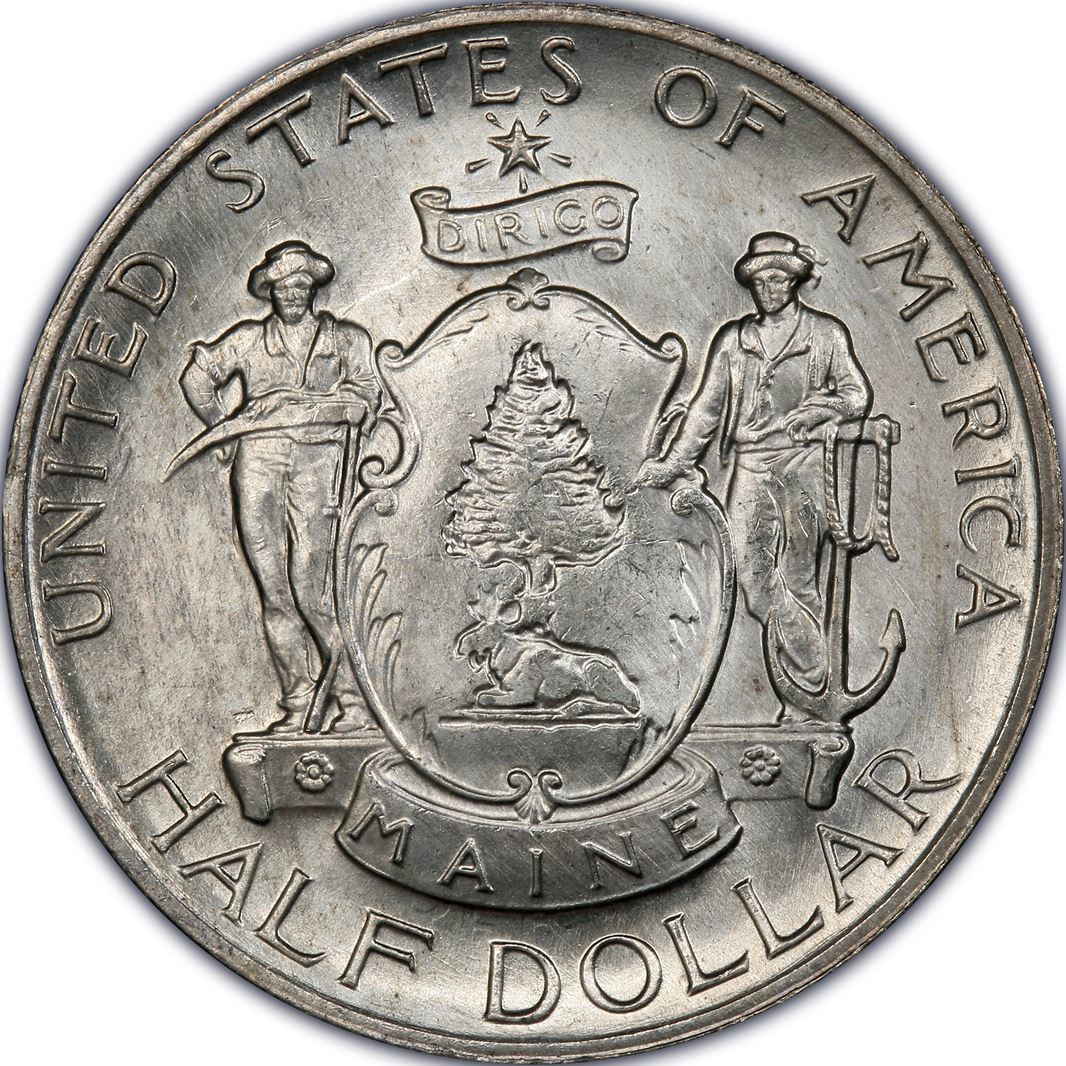
The obverse — the heads side — is the arms of the State of Maine. A shield carries a pine tree, with a moose resting beneath it. Flanking the shield stand two figures: a farmer leaning on a scythe for Agriculture, and a sailor with an anchor for Commerce — the two old pillars of the state's economy. Above them, on a scroll, sits Maine's one-word motto: DIRIGO, Latin for "I direct" or "I lead," a nod to the North Star and to Maine's sense of itself as a guide among states.

The reverse — the tails side — keeps it simple: a wreath of pine needles and cones circling the legend MAINE CENTENNIAL 1820–1920. There's a quiet quirk here that collectors enjoy. The way the lettering is arranged, the word MAINE reads almost as though it were the coin's date, sitting where a denomination or year would normally go.

Key facts

Year struck
1920
Denomination
Half dollar (50 cents)
Commemorates
Maine's 100th year of statehood (1820–1920)
Designers
Harry Cochrane (sketches), Anthony de Francisci (models)
Mint
Philadelphia (no mint mark)
Mintage
50,028 (including 28 reserved for the Assay Commission)
Composition
90% silver, 10% copper
Weight
12.5 g
Diameter
30.61 mm
Authorizing act
Signed by President Wilson, May 10, 1920
Original sale price
$1 (sold through the State Treasurer's office)

Collecting it

Congress authorized up to 100,000 Maine half dollars. The Philadelphia Mint struck only 50,028 — and even that turned out to be more than the market wanted. The coins were sent to Maine and sold at the Office of the State Treasurer for one dollar each.

Sales were slow. About half the mintage moved before the end of 1920; after that, demand dried up, and no one bothered ordering the rest of the authorized run. Here's the part that matters to collectors: the leftovers were not melted. Unlike some early commemoratives that came back to the Mint, the remaining Maine halves simply stayed on the shelf — available, reportedly, into the late 1920s — until the entire mintage was eventually sold.

That history shapes what survives today. With a single date, a single mint, and a fixed run of about 50,000, the Maine half dollar is one of the more affordable classic commemoratives in circulated and lower mint-state grades. Because they were sold one at a time to the public rather than dumped or saved in bulk bank-wrapped rolls, finding examples with full, frosty original surfaces and sharp detail in the highest grades is a different and scarcer pursuit. The value lives in the grade — the condition and eye-appeal of an individual coin — far more than in the date itself.

Questions collectors ask

Why is it called the Maine Centennial half dollar?

It was struck in 1920 to mark 100 years since Maine entered the Union on March 15, 1820. 'Centennial' means hundredth anniversary. The reverse spells it out: MAINE CENTENNIAL 1820–1920.

Who designed the Maine Centennial half dollar?

Maine painter Harry Cochrane of Monmouth prepared the original sketches. Sculptor Anthony de Francisci — designer of the 1921 Peace dollar — turned those sketches into the finished models from which the dies were cut.

How many were made?

The Philadelphia Mint struck 50,028 pieces, including 28 set aside for the annual Assay Commission. Congress had authorized up to 100,000, but the rest were never struck because sales were slow.

What does DIRIGO mean on the coin?

DIRIGO is Maine's state motto — Latin for 'I direct' or 'I lead.' It refers to the North Star and to Maine's view of itself as a guiding light among the states.

Were any Maine half dollars melted?

No. Unlike some early commemoratives that were returned and melted, the unsold Maine halves stayed available through the State Treasurer's office — reportedly into the late 1920s — until the full 50,028-piece mintage was eventually sold.

Is the Maine half dollar rare?

Not in lower grades — with about 50,000 struck it's one of the more affordable classic commemoratives. Truly high-grade, original-surface examples are scarcer, so condition drives the price more than the date.

Sources