US coin · series

The Year the Penny Changed Its Back Four Times

In 2009 the U.S. Mint told Lincoln's whole life on the smallest coin in your pocket — one chapter at a time.

The Year the Penny Changed Its Back Four Times
United States Mint · public domain · source

For one hundred years the Lincoln cent had carried the same man on its face and never more than two designs on its back. Then, in 2009, the Mint did something it had never done before: it gave the penny four different reverses in a single year, each a scene from a different chapter of Abraham Lincoln's life.

The story behind the coin

The math lined up perfectly. In 2009 Abraham Lincoln would have turned 200, and the coin that bears his profile — the Lincoln cent — turned 100 the same year. Congress saw the coincidence and acted on it. Buried inside the Presidential $1 Coin Act of 2005 was a provision to mark both anniversaries at once, on the humblest coin America makes.

The idea was bigger than a single commemorative design. The Mint would strike four reverses in one year — the reverse being the "tails" side — each showing a different stage of Lincoln's life, released roughly three months apart. No U.S. circulating coin had ever rolled out four backs in twelve months. For a single year, the penny became a four-part biography you could collect from your spare change.

It was a one-year detour by design. The Lincoln cent had worn just two reverses in its century: the wheat ears of 1909–1958, then the Lincoln Memorial of 1959–2008. The 2009 quartet interrupted that run, and in 2010 a fifth, permanent design — the Union Shield — took over. So the bicentennial cents are bracketed cleanly: not Wheat, not Memorial, not Shield. Their own small chapter.

The four designs

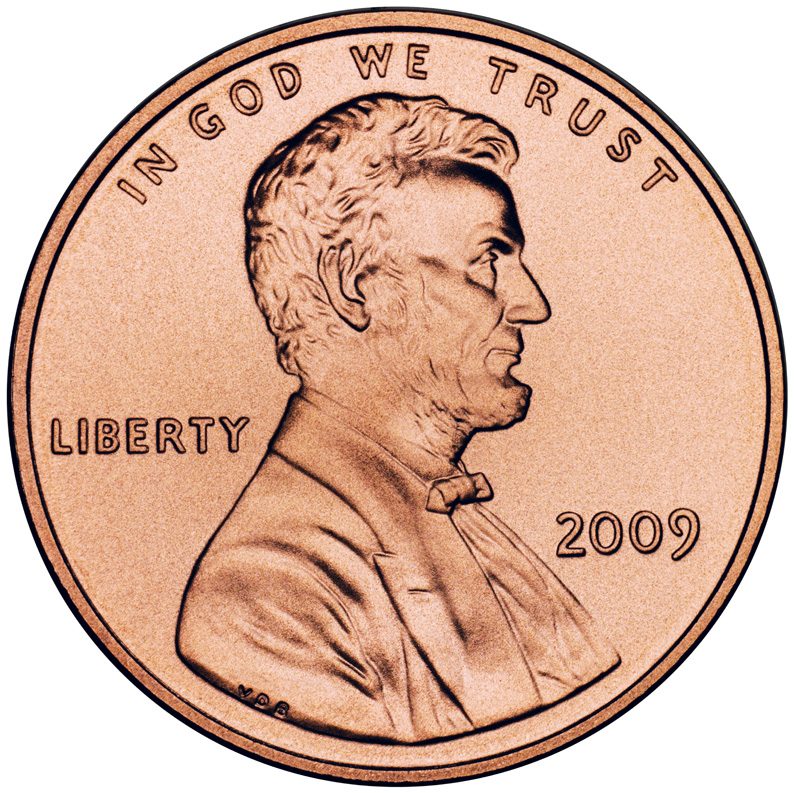
Read in order, the four backs walk you from a dirt-floor cabin to the seat of national power. The obverse — the "heads" side — never changed: it's Victor David Brenner's 1909 Lincoln portrait, the same one that has ridden the cent for over a century. Everything new in 2009 is on the reverse.

Birth and Early Childhood in Kentucky (1809–1816) opens on a log cabin — the frontier home where Lincoln was born. It was designed by Richard Masters of the Mint's Artistic Infusion Program and sculpted by Mint engraver Jim Licaretz.

Formative Years in Indiana (1816–1830) shows a young Lincoln taking a break from splitting rails, sitting on a log with a book — the self-taught reader who would become a lawyer. It was both designed and sculpted by Mint engraver Charles Vickers, whose initials, CLV, sit at the base of the log.

Professional Life in Illinois (1830–1861) lifts him to his feet: Lincoln stands before the Illinois State Capitol in Springfield, the lawyer-turned-statesman. Designed by Artistic Infusion artist Joel Iskowitz, sculpted by Mint engraver Don Everhart.

Presidency in Washington, D.C. (1861–1865) is the quietest and the most loaded. It shows the U.S. Capitol dome — still under construction, scaffolding and all. Lincoln insisted the building keep rising through the Civil War, calling it a sign the Union would go on. Designed by Susan Gamble, sculpted by Joseph Menna. The half-finished dome is the whole point: a nation, like the building, still being held together.

Key facts

Year struck
2009 (one year only)
Reverse designs
Four — Birthplace, Formative Years, Professional Life, Presidency
Obverse designer
Victor David Brenner (1909 portrait, unchanged)
Reverse designers
Richard Masters, Charles Vickers, Joel Iskowitz, Susan Gamble
Circulating composition
Copper-plated zinc (2.5% copper, 2.5 g)
Collector composition
95% copper, 5% tin and zinc (3.11 g) — the original 1909 recipe
Total circulating mintage
2,354,000,000 across all four designs
Scarcest circulating design
Presidency — 327,600,000 (P 129.6M + D 198M)
Satin-finish mintage (each design)
784,614 — Uncirculated Mint Set only
Proof mintage
2,995,615 proof sets (San Francisco, 95% copper)
Authorizing law
Presidential $1 Coin Act of 2005 (Public Law 109-145)
Replaced by
Union Shield cent, 2010

Collecting it

Here is the twist most people miss. The pennies that came out of cash registers in 2009 are the cheap, modern kind — copper-plated zinc, just a thin copper skin over a zinc core, the recipe the Mint switched to in 1982 to save money. But for collectors, the Mint also struck the four designs the old way: solid 95% copper, the exact alloy of the 1909 original. For the first time since 1982, the Lincoln cent was made of real copper again. It was a deliberate nod to the centennial — the coin's hundredth birthday, struck in its birth metal.

Those copper coins came two ways. The proofs — mirror-field, frosted-device showpieces — were sold only inside the 2009 proof set from San Francisco, 2,995,615 of them. The other copper version is the sleeper: a satin finish (a soft, matte luster, neither shiny-proof nor ordinary-circulation) sold only in the 2009 Uncirculated Mint Set. Just 784,614 sets were made. That gives each satin copper design one of the lowest mintages of any business-strike-style copper Lincoln cent — second only, by the count collectors cite, to the legendary 1909-S VDB. A genuinely scarce coin hiding inside a routine Mint product.

Then there are the errors, and one design owns them. The Formative Years reverse spawned a swarm of doubled dies — coins struck from a die that picked up a doubled image during its making. The doubling lands on Lincoln's hand as he holds the book, so the coins appear to show an extra finger or thumb. Collectors hunt them by the dozens; PCGS recognizes several distinct doubled-die reverses, and varieties like the "extra finger" and "sixth finger" trade for real premiums. You need a loupe to see them, which is exactly why they're fun — a treasure that hides in plain sight in a roll of pennies.

For a clean run, the four circulating designs are easy and cheap in pocket grade. The chase is in the tiers above: the eight-coin satin copper set, the proofs, high-grade red examples, and the Formative Years doubled dies. The Presidency design is the scarcest in circulation — under 14% of the year's output — so a sharp, fully red Presidency cent is the quiet one to set aside.

Questions collectors ask

Why does the 2009 penny have four different designs?

2009 was a double anniversary — the 200th birthday of Abraham Lincoln and the 100th birthday of the Lincoln cent. To mark it, Congress authorized four one-year reverse designs, each a scene from a different stage of Lincoln's life, released about three months apart through the year.

Are 2009 Lincoln Bicentennial pennies made of copper?

The ones from circulation are copper-plated zinc, like every cent since 1982. But the Mint also struck collector versions — proofs and satin-finish coins sold in Mint sets — in solid 95% copper, the original 1909 alloy. Those copper coins were the first real-copper Lincoln cents in over 25 years.

What are the four 2009 penny designs?

Birth and Early Childhood in Kentucky (a log cabin), Formative Years in Indiana (young Lincoln reading on a log), Professional Life in Illinois (Lincoln before the Springfield capitol), and Presidency in Washington (the U.S. Capitol dome under construction).

What is the 2009 penny with the extra finger?

It's a doubled-die error on the Formative Years (Indiana) reverse. A flaw in the die doubled the image on Lincoln's hand, so the coin appears to show an extra finger or thumb on the hand holding the book. Several distinct varieties exist and they sell for premiums — collectors check them with a loupe.

Are the 2009 satin-finish cents rare?

Relatively, yes. They were sold only in the 2009 Uncirculated Mint Set, and just 784,614 sets were made. That makes each satin copper design one of the lowest-mintage copper Lincoln cents — by the count collectors cite, second only to the 1909-S VDB.

Which 2009 design is the scarcest in circulation?

The Presidency cent. Combined Philadelphia and Denver mintage was 327,600,000 — less than 14% of the year's total — making it the lowest-mintage of the four circulating designs.

Sources

2009 Lincoln Bicentennial Cent: Four Reverses | colcur