US coin · series

The 1883 Liberty Nickel That Forgot to Say 'Cents'

One missing word turned a five-cent piece into a $5 gold coin — at least to anyone who wasn't looking closely.

The 1883 Liberty Nickel That Forgot to Say 'Cents'
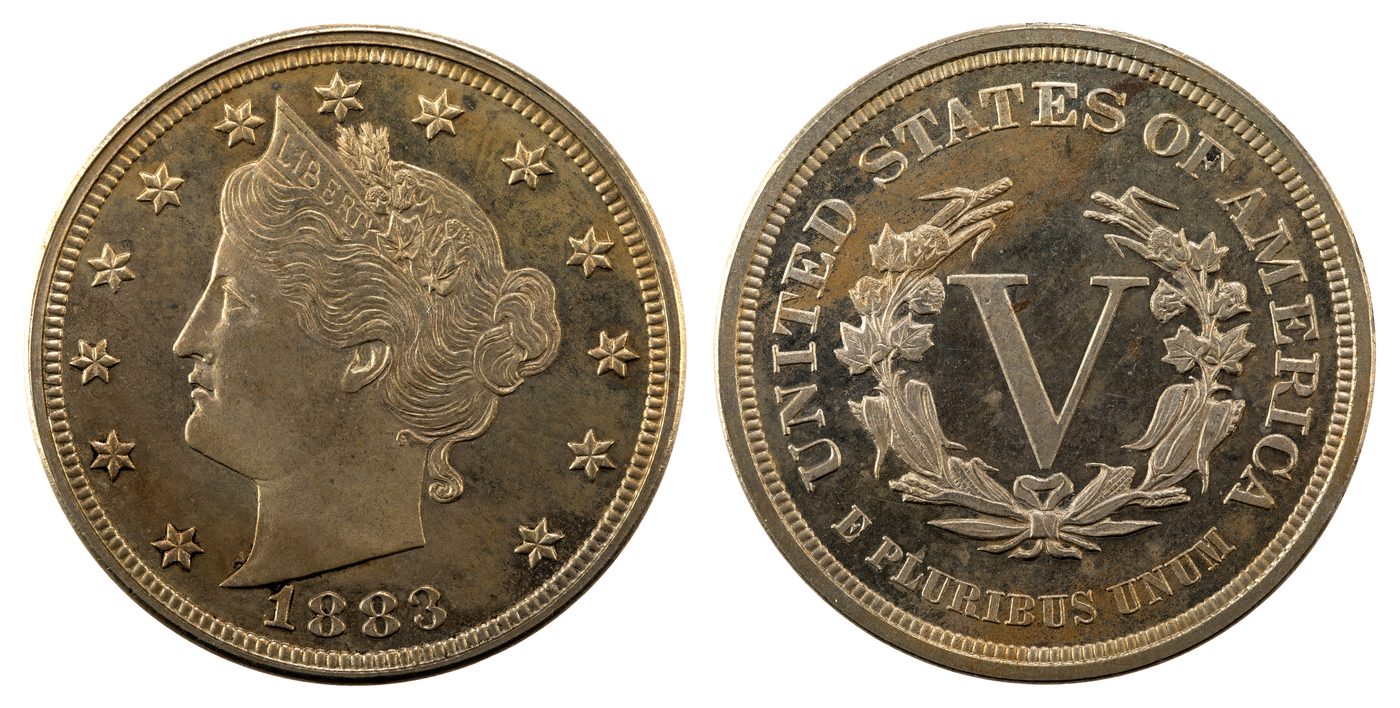
National Numismatic Collection, National Museum of American History (Smithsonian Institution); photograph by Jaclyn Nash · public domain · source

In 1883 the U.S. Mint released a new five-cent piece with a big Roman "V" on the back — and no word telling you what the V meant. Within months, con men were gilding it and spending it as a $5 gold coin. The Mint fixed the design fast, and a one-year curiosity was born.

The story behind the coin

In early 1883, the U.S. Mint retired the homely Shield nickel and rolled out something more elegant: a left-facing head of Liberty in a coronet, with a tall Roman numeral V on the reverse — the reverse being the tails side of a coin. The V meant five. Five cents. Everyone at the Mint knew that.

The trouble was that the coin itself didn't say so. Chief Engraver Charles Barber's first design wrapped the V in a wreath and circled it with "UNITED STATES OF AMERICA" — but nowhere did it print the word CENTS. A foreigner, or anyone in a hurry, had only a big Roman five to go on.

And there was a second problem hiding in the metal. The new nickel was about 21.2 mm across. The $5 gold half eagle was about 21.6 mm — close enough that, gold-plated, the two were hard to tell apart at a glance. A coin worth five cents could be dressed up to look like one worth five dollars: a hundredfold markup, sitting in plain sight.

That is exactly what happened. Sharp operators gold-plated the new nickels — some even added a reeded (grooved) edge to complete the disguise — and passed them as $5 gold pieces to anyone who took a coin on faith. The trick worked well enough to embarrass the government. By June 1883, Barber had revised the reverse to add the word CENTS at the bottom, and the unfinished-looking first design was quietly killed off after a single year.

The design and who made it

The man behind it was Charles Edward Barber, the Mint's Chief Engraver and one of the most prolific coin designers in American history. He cut both sides of this nickel — the obverse (the heads side) and the reverse.

The obverse shows Liberty in profile, facing left, wearing a coronet stamped LIBERTY and crowned with a wreath of grain and cotton, with thirteen stars around her and the date below. It is dignified, classical, and — to its many critics over the years — a little stiff. The reverse is where the whole story lives: that oversized Roman V inside a wreath, with E PLURIBUS UNUM above and, on this first 1883 type, no denomination spelled out at all.

Collectors split the 1883 Liberty nickels into two types by this one detail. Type 1 is the "No Cents" coin — the original, blank-of-its-value design. Type 2 is everything from mid-1883 onward, with CENTS added. Barber's later, longer fix gave the world the V nickel that ran, almost unchanged, until 1912.

Key facts

Type
Liberty Head nickel, Type 1 ('No Cents')
Year struck
1883 only
Designer
Charles Edward Barber (obverse and reverse)
Composition
75% copper, 25% nickel
Weight / diameter
5.00 g / 21.21 mm, plain edge
Business strikes
5,474,000
Proof strikes
5,219
Nickname
Racketeer Nickel

Collecting it: why a 'rare' coin is so easy to own

Here is the twist that surprises newcomers: the "No Cents" nickel is one of the easiest coins in the whole Liberty series to own — even in lovely condition.

The reason is that the public knew, in 1883, that they were holding an oddity. People pulled the No Cents nickels out of pockets and tucked them away, betting a one-year coin would be worth something. They were partly right and partly wrong. So many were saved that millions survive today, and a clean, uncirculated example remains an affordable first "type coin" for almost any collector.

Affordable, though, is not the same as easy to perfect. Grade — the measure of a coin's preservation, on a 1-to-70 scale — is where this issue turns scarce. The design has wide, flat fields that show every hairline and bag mark, so truly pristine survivors are uncommon. At the top end the population thins to almost nothing: PCGS, a leading grading service, had certified only about fifteen coins at MS67+ as of recent counts, and none at all at the perfect MS68. The first MS67+ wasn't even graded until 2016.

A note on the famous "Racketeer Nickel" you'll see sold gold-plated today. Most of those gilded coins were plated long after 1883, by people making souvenirs — not by the original con men. A period-plated original is essentially impossible to authenticate, so treat any gold "racketeer nickel" as a novelty, priced as one, not as a rarity.

And the most famous figure in the legend? A deaf-mute swindler named Josh Tatum, said to have spent gilded nickels on five-cent goods and pocketed the gold-coin change without ever lying out loud. It's a wonderful story — and, by every serious account, unverified. There are no court records, no census trace, no contemporary newspaper report of him. Numismatic researchers treat Tatum as folklore. The gold-plating fraud was real; the man who supposedly perfected it probably was not.

Questions collectors ask

What is the 'No Cents' Liberty nickel?

It's the original 1883 Liberty Head five-cent piece, whose reverse shows a large Roman 'V' but omits the word CENTS. The Mint added CENTS later in 1883, making the first design a one-year type.

Why is it called the Racketeer Nickel?

Because con men gold-plated the new nickels — sometimes adding a reeded edge — and passed them as $5 gold coins, which were nearly the same size. The fraud is what pushed the Mint to add CENTS to the design.

Is the Josh Tatum story true?

It's a popular legend, not documented fact. No court records, census entries, or period newspaper accounts of Tatum have ever surfaced. The gold-plating scheme itself was real; the named swindler appears to be folklore.

Is the 1883 No Cents nickel rare or valuable?

Not in the way its fame suggests. Millions were saved as curiosities in 1883, so circulated and even uncirculated examples are common and affordable. Only the very highest grades — MS67 and above — are genuinely scarce.

Should I buy a gold-plated 'Racketeer Nickel'?

Only as a novelty. Most gold-plated examples were plated decades later as souvenirs, and an original period-plated coin can't be reliably authenticated. Buy it for the story, not as an investment.

Sources