US coin · series

The Lexington-Concord Sesquicentennial Half Dollar

A pocket-sized monument to the morning the Revolution began.

The Lexington-Concord Sesquicentennial Half Dollar
Coin: U.S. Mint. Photograph: Heritage Auctions (Lot 1446, August 2009) — photo credit noted though not legally required for a faithful 2D reproduct… · public domain · source

In April 1925, on the same fields where the first shots of the American Revolution were fired 150 years earlier, you could buy a brand-new silver coin out of a little wooden box for a dollar. This is that coin.

The story behind the coin

On the morning of April 19, 1775, British troops marched out from Boston toward Concord to seize colonial weapons. On the green at Lexington they met a line of local militiamen — farmers, really — and somebody fired. To this day no one knows who. That single unrecorded shot became "the shot heard round the world," and the United States traces its birth to it.

A century and a half later, Massachusetts wanted to mark the anniversary in a way people could hold. So its congressional delegation pushed a bill through Congress, and on January 14, 1925, President Calvin Coolidge signed it. The law created a Sesquicentennial Commission — sesquicentennial simply means a 150th anniversary — and authorized the Mint to strike up to 300,000 silver half dollars to help pay for the celebrations.

Here is the part that makes the coin feel alive. It wasn't sold from a catalog or a coin shop. It was sold on the ground, on the day. During the battle-anniversary festivities of April 18–20, 1925, organizers moved roughly 39,000 coins at Lexington and another 21,000 at Concord — each one handed over for a dollar in a small wooden box decorated with the coin's own designs. You bought a piece of the Revolution standing where the Revolution happened.

The design

The Mint hired sculptor Chester Beach, fresh off the 1923 Monroe Doctrine Centennial half dollar, and the committees from both towns signed off on him. He didn't invent the obverse — the heads side — so much as borrow a beloved one.

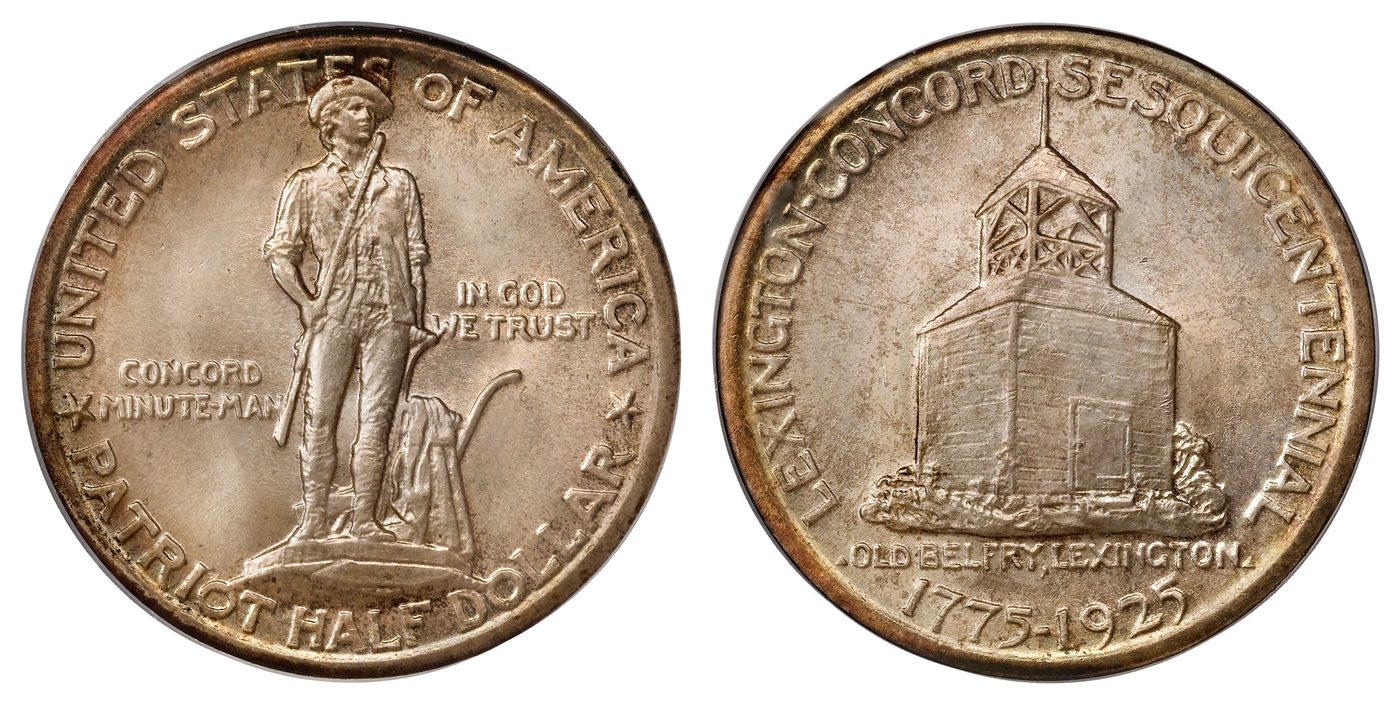
The obverse shows The Minute Man, Daniel Chester French's 1874 statue that stands at Concord: a farmer who has set down his plow, draped his coat over it, and picked up a rifle. (French would later sculpt the seated Lincoln in the Lincoln Memorial.) The image carries the whole idea of the citizen-soldier in a single figure. The reverse — the tails side — shows the Old Belfry at Lexington, the tower whose bell rang out to call the militia to the green.

Translating a tall, narrow statue onto a round coin was not easy. The Commission of Fine Arts, the federal panel that reviews coin designs, approved Beach's work on March 5, 1925 — but noted that French's statue, being so narrow, wasn't really suited to a coin's circle. Look closely at a Lexington half and you can see Beach wrestling that vertical figure into a horizontal frame. It's an honest, slightly awkward design — and that's part of its charm.

Key facts

Years struck
1925 (one year only)
Dual date on coin
1775–1925
Denomination
Half dollar (50 cents)
Designer
Chester Beach (obverse adapts Daniel Chester French's Minute Man statue)
Mint
Philadelphia (no mint mark)
Mintage
162,099 struck (99 reserved for assay)
Composition
90% silver, 10% copper
Weight / Diameter
12.5 g / 30.61 mm, reeded edge
Original price
$1 each, in a decorated wooden box
Authorizing act
Act of January 14, 1925 (signed by President Coolidge)

Collecting it

By the standards of early U.S. commemoratives, this is a friendly coin to collect. The Mint struck 162,099, and almost all of them sold — only 86 pieces ever came back to be melted. There is no rare date, no second mint, no hard-to-find variety. It is a one-year, one-mint coin: if you own a Lexington-Concord half, you own the whole series.

That means the game here isn't hunting a key date — it's hunting quality. Because so many were carried, spent, or tucked into a drawer in their wooden boxes, well-preserved examples with full, sharp detail and original surfaces are scarcer than the big mintage suggests. A mint state coin (one that never circulated, abbreviated MS) in a high grade commands far more than a worn one. The narrow Minute Man figure also makes strike quality easy to judge: on a strong example his face and the folds of the draped coat are crisp; on a weak one they go soft. Collectors prize originality too — coins that still wear their natural toning rather than having been cleaned.

Questions collectors ask

What does the Lexington-Concord half dollar commemorate?

It marks the 150th anniversary — the sesquicentennial — of the battles of Lexington and Concord on April 19, 1775, the opening shots of the American Revolution. That's why the coin is dual-dated 1775–1925.

Who designed it, and is that really the Minute Man statue?

Sculptor Chester Beach designed the coin. The obverse adapts Daniel Chester French's 1874 statue The Minute Man, which still stands at Concord; the reverse shows the Old Belfry at Lexington. Beach had also designed the 1923 Monroe Doctrine Centennial half dollar.

Is the 1925 Lexington half dollar rare or valuable?

It isn't rare. 162,099 were struck and nearly all sold, so the coin is common in worn and lower mint-state grades. Value rises sharply with quality: a high-grade, original, well-struck example is genuinely scarce, while a cleaned or worn one is modest. There's only one date and one mint, so the series is complete with a single coin.

Why was it sold in a wooden box?

The coins were sold for $1 each — twice face value — to raise money for the anniversary celebrations in Lexington and Concord. Each came in a small wooden box decorated with the coin's own designs. Surviving original boxes are collectible in their own right.

Is there a mint mark to look for?

No. Every Lexington-Concord half was struck at the Philadelphia Mint, which used no mint mark at the time. If you see one offered with a mint mark, be cautious.

Sources