US coin · series

The Lewis and Clark Exposition Gold Dollar

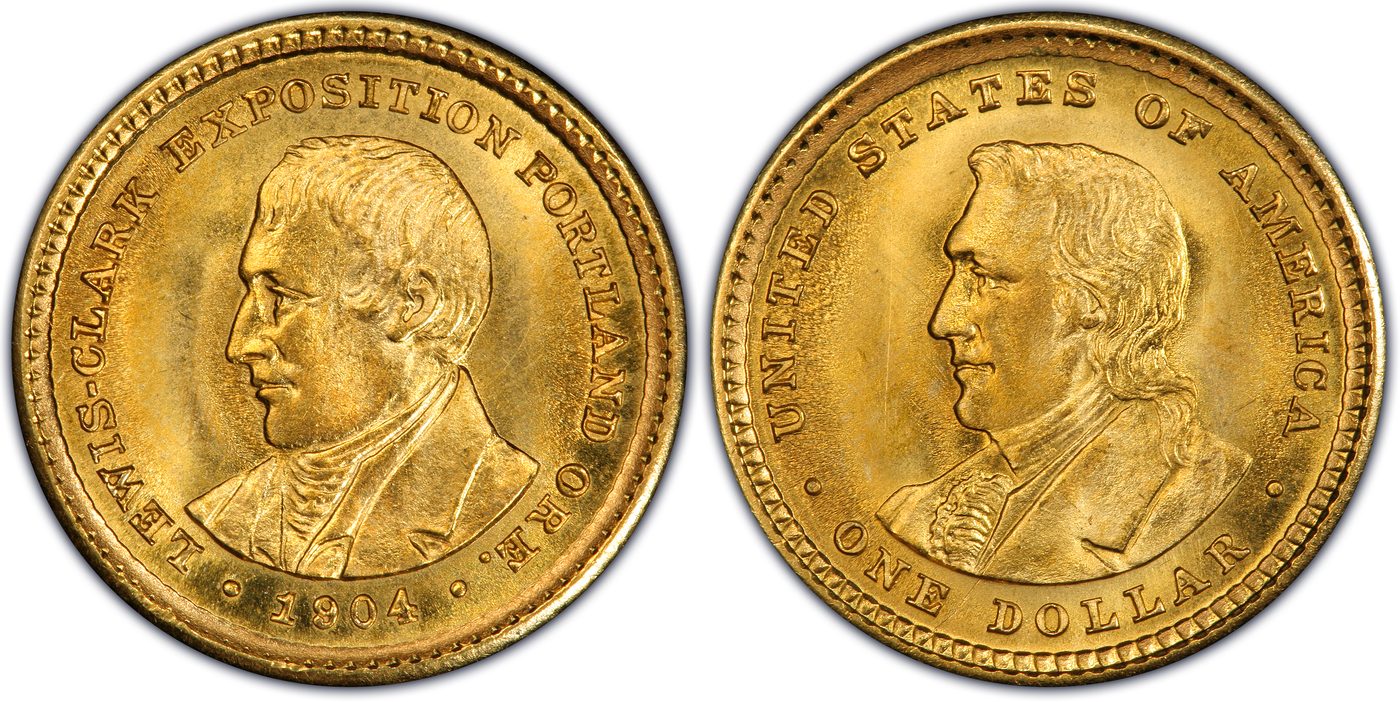
Lewis on one face, Clark on the other — the only US coin that put a portrait on both sides.

The Lewis and Clark Exposition Gold Dollar
Professional Coin Grading Service (PCGS) — credit per Commons file metadata · public domain · source

In 1904 the US Mint did something it had never done before and would never do again: it struck a coin with a head on both sides. Then most of them were melted.

The story behind the coin

A hundred years after Meriwether Lewis and William Clark walked across the continent, Portland, Oregon threw a party. The 1905 Lewis and Clark Centennial Exposition was the city's bid to put itself on the map — a world's fair to mark a century since the Corps of Discovery reached the Pacific.

Fairs needed money, and one reliable way to raise it was a commemorative coin. On April 13, 1904, President Theodore Roosevelt signed the appropriations bill that funded the exposition and authorized a gold dollar to mark the fair. Congress allowed up to 250,000 of them.

The plan was simple. The Mint would strike the coins, the fair would sell them above face value to collectors and visitors, and the difference would help pay for the celebration — including a statue of Sacagawea, the young Shoshone woman who guided the expedition, for Portland's Washington Park. The coins did help fund that statue. What they did not do was sell.

The design — a coin with two fronts

Charles E. Barber, the Mint's chief engraver, made a bold choice. Most coins have an obverse — the "heads" side, usually a portrait or an allegory — and a reverse with a different subject. Barber put a portrait on both sides. Meriwether Lewis faces left on one face; William Clark faces left on the other.

That makes it the only US coin ever struck with a head on each side — a true two-headed coin, and an answer to the old "heads or tails" joke that has no tails at all. Barber drew the explorers' likenesses from period portraits and kept the lettering plain and the relief low, in the restrained style that defined his work.

The result is small. At just 15 millimeters across — smaller than a modern US dime — and weighing 1.672 grams, the gold dollar is a delicate thing. There was barely room for two faces, but Barber fit them.

Key facts

Years struck
1904–1905
Denomination
Gold dollar ($1)
Designer
Charles E. Barber (Chief Engraver, US Mint)
Mint
Philadelphia (no mint mark)
Composition
90% gold, 10% copper
Weight
1.672 g (0.04837 troy oz gold)
Diameter
15 mm
Authorized mintage
Up to 250,000
1904 — struck / melted / net
25,028 struck, 15,003 melted, ~10,025 distributed
1905 — struck / melted / net
35,041 struck, 25,000 melted, ~10,041 distributed
Distinction
Only US coin with a portrait on both sides

Collecting it

The two dates are close cousins, and most collectors want both. Each survives in roughly the same tiny number — only about 10,000 of each year reached buyers after the melting. That makes the 1904 and 1905 a near-matched pair in rarity, unusual for a commemorative.

The bigger problem for collectors is condition. Many of these coins were never tucked into albums. They were mounted in brooches, stickpins, and watch fobs and worn — gold jewelry honoring a famous journey. Worn coins picked up scratches, and removing a coin from a mount often left a faint trace. A piece that survived a century without ever being mounted, with full original strike (the sharpness the dies pressed into the metal) and clean fields, is genuinely scarce. High Mint State grades — coins that never circulated and show little contact — command a steep premium over an average example for exactly this reason.

Both dates belong to the small, prized family of classic US gold commemoratives struck between 1903 and 1926. Collectors chasing that set come straight to the Lewis and Clark dollar, and the two-headed novelty makes it a favorite well beyond the people who try to complete the run.

Questions collectors ask

Why is the Lewis and Clark dollar called a two-headed coin?

Charles Barber put a portrait on both sides — Meriwether Lewis on one face, William Clark on the other. It is the only US coin ever struck with a head on each side, with no traditional 'tails.'

Why were so many Lewis and Clark gold dollars melted?

They didn't sell. Of about 60,000 struck across both years, roughly 40,000 went unsold and were returned to the Mint and melted. Fewer than a tenth of the 250,000 authorized were ever distributed.

How many 1904 and 1905 Lewis and Clark dollars survive?

Only about 10,000 of each date reached buyers after the melting. Many of those were later mounted in jewelry and worn, so high-grade, unmounted examples are scarcer than the distribution numbers alone suggest.

What did the coins pay for?

Sales above face value helped fund the 1905 exposition in Portland, including a statue of Sacagawea — the Shoshone woman who guided the expedition — in the city's Washington Park.

Who promoted and sold the coins?

Numismatist Farran Zerbe was placed in charge of the sale. He offered them at the fair, sometimes mounted in jewelry, and arranged bulk sales to dealers — but demand fell far short of the authorized run.

Sources