US coin · series

The 1928 Hawaiian Sesquicentennial Half Dollar

Ten thousand coins, a two-dollar price, and a sellout that made it the rarest classic commemorative of them all.

The 1928 Hawaiian Sesquicentennial Half Dollar
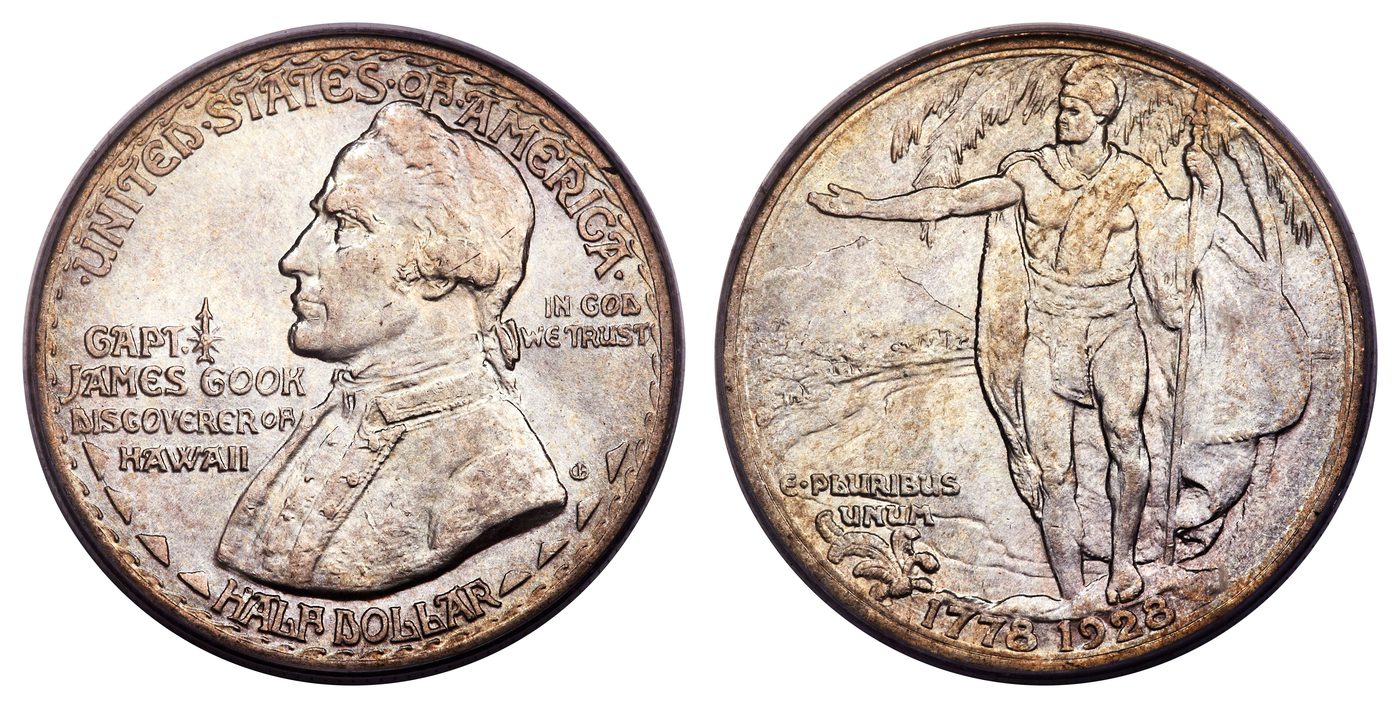
U.S. Mint (coin); image via Heritage Auctions (Lot 6406, January 2015) · public domain · source

In 1928 the U.S. Mint struck just 10,008 of these half dollars — fewer than any other classic commemorative design. They were priced at $2 apiece, twice what any commemorative half had ever cost, and Hawaii sold out anyway. A coin most Americans never had the chance to buy is now one of the great prizes of the series.

The coin nobody could get

Picture a coin so scarce that the people most eager to own it could not buy one. In the fall of 1928, the Bank of Hawaii put a new silver half dollar on sale at $2 each — twice the asking price of any commemorative half dollar that had come before. Collectors grumbled. Hawaii bought them anyway. Within weeks the supply was gone.

The reason was simple arithmetic. The Mint struck only 10,008 of these coins, the smallest production run of any classic U.S. commemorative design. (A commemorative is a coin made to honor an event rather than to circulate as money — sold at a premium, with the markup going to a cause.) Subtract the eight coins held back for the 1929 Assay Commission — the annual federal panel that tested the year's coinage for correct weight and fineness — and just 10,000 were ever offered to the public.

The occasion was the 150th anniversary — the sesquicentennial — of Captain James Cook reaching the Hawaiian Islands in January 1778. Cook was the first European to make landfall there, and his arrival opened the islands to the outside world. By 1928 Hawaii was a U.S. territory looking to mark the moment with something lasting.

The bill sailed through Congress without a fight. Territorial delegate Victor S. K. Houston introduced it in December 1927, and President Calvin Coolidge signed it into law on March 7, 1928. The Cook Sesquicentennial Commission of Hawaii would buy the coins from the Mint at face value and resell them, with the profit funding the celebration — the standard bargain behind every commemorative of the era.

What the coin shows

The design came from two hands working in tandem. Juliette May Fraser, a Honolulu-born painter and muralist, drew the original sketches. The New York sculptor Chester Beach turned them into the plaster models from which the dies were cut, making the final artistic calls along the way. Beach's initials sit on the obverse — the heads side of a coin.

The obverse carries a portrait of Captain Cook in profile, facing a compass needle, ringed by the words "CAPT. JAMES COOK DISCOVERER OF HAWAII." The reverse — the tails side — is the one people remember: a Hawaiian chief in a feather cloak and helmet, arm raised in greeting, standing on a rise above a palm tree, Waikiki Beach, and the unmistakable silhouette of Diamond Head. The dates "1778 1928" anchor the scene.

Getting it right was not easy from a studio in New York. Beach reworked the design under criticism over its accuracy, and at one point grew exasperated. Collectors tell the story — and it is documented — that he wrote that "the proper thing for Mr. Houston to do would be to take the sculptor and family to Hawaii and let us live in the cocoanut trees for a while and absorb the atmosphere of that paradise." The frustration is real; whether anyone took the joke seriously is another matter.

A separate batch tells you how seriously Hawaii took the occasion. The Mint produced 50 specially finished sandblast proof presentation pieces — coins struck with extra care and given a fine matte surface, handed to dignitaries and institutions rather than sold. With only 50 made, these are among the rarest coins of the entire commemorative series, and the names of their recipients were recorded.

Key facts

Year struck
1928 (Philadelphia)
Honors
150th anniversary of Captain Cook reaching Hawaii, 1778
Designers
Juliette May Fraser (sketches), Chester Beach (models)
Total mintage
10,008 — the lowest of any classic commemorative design
Offered to public
10,000 (8 held for the 1929 Assay Commission)
Presentation pieces
50 sandblast (matte) proofs
Composition
90% silver, 10% copper
Weight / diameter
12.5 g / 30.61 mm, reeded edge
Original issue price
$2.00 — highest for a commemorative half at the time
Authorizing act
Act of March 7, 1928 (signed by Calvin Coolidge)

Collecting the Hawaiian half

Scarcity is the whole story here, and it works on two levels. There is only one date, one mint, one design — so unlike most series, there is no rare key date to chase. The entire issue is the key. With 10,008 struck and time taking its toll on the survivors, every genuine Hawaiian half is a coin that started life rare and only got rarer.

Condition then sorts the field. Because so few exist, the price gap between a worn example and a pristine one is enormous. Mint State coins — pieces that never circulated and show no wear — command strong sums, and the highest grades climb into the tens of thousands of dollars. A superb business strike brought $96,000 at auction in August 2022.

The 50 sandblast proofs are a tier of their own. One graded NGC PF66 realized $102,000 in January 2024. At that level you are no longer buying a half dollar; you are buying one of 50 documented presentation pieces from a coin that was scarce on the day it was made.

For a collector, that combination — a single beautiful design, the lowest mintage in the series, and a clear ladder of value from circulated to gem to proof — is exactly what makes the Hawaiian half a cornerstone. It is the coin that defines the high end of classic commemoratives.

Questions collectors ask

Why is the 1928 Hawaiian half dollar so rare?

Only 10,008 were struck — the lowest mintage of any classic US commemorative design — and just 10,000 reached the public. They sold out fast at a then-steep $2, and the survivors have been thinning for nearly a century. Every genuine example is scarce.

Who is on the Hawaiian Sesquicentennial half dollar?

The obverse shows Captain James Cook, the first European to reach Hawaii in 1778. The reverse depicts a Hawaiian chief in a feather cloak with arm raised, standing above Waikiki and Diamond Head. It marks the 150th anniversary of Cook's arrival.

Who designed it?

Honolulu painter Juliette May Fraser made the original sketches, and sculptor Chester Beach turned them into the plaster models used to cut the dies. Beach's initials appear on the obverse.

What is a sandblast proof Hawaiian half dollar?

Of the total mintage, 50 coins were given a special matte, sandblast finish and handed out as presentation pieces to dignitaries and institutions rather than sold. With only 50 made, they are among the rarest coins in the whole commemorative series — one sold for $102,000 in 2024.

How much did the coin cost when it was new?

$2.00 each — twice the price of any earlier commemorative half dollar. The premium over the 50-cent face value funded Hawaii's Cook anniversary celebration, the standard arrangement for commemoratives of that era.

Sources

1928 Hawaiian Sesquicentennial Half Dollar | colcur