US coin · series

The Half Union: America's $50 Gold Coin That Never Was

A coin so big the Mint feared you could hollow it out — struck twice in gold, then locked away forever.

The Half Union: America's $50 Gold Coin That Never Was
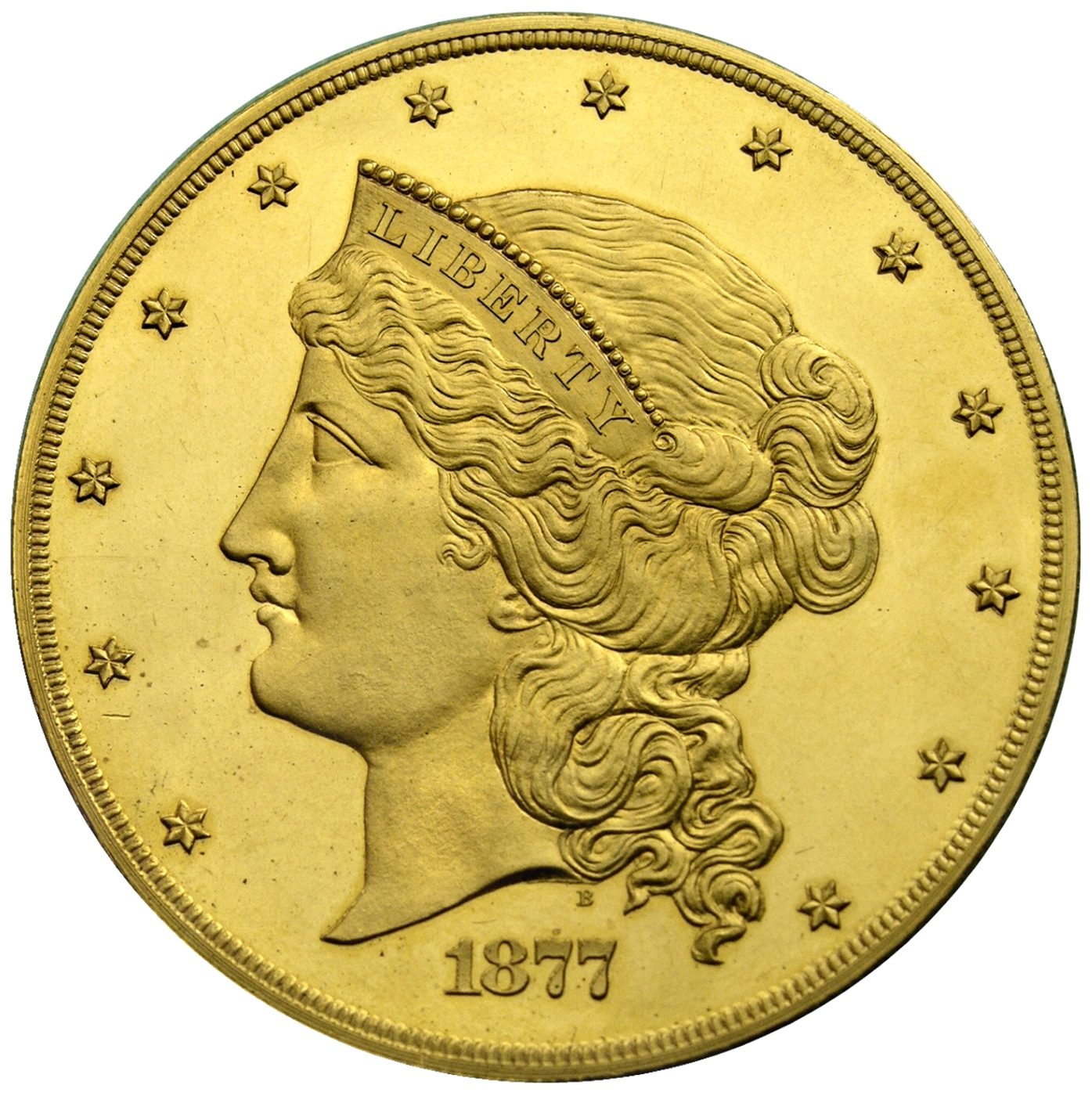
National Numismatic Collection, National Museum of American History (Smithsonian Institution); image uploaded to Commons by Godot13 · public domain · source

In 1877 the United States Mint struck a fifty-dollar gold coin — the heaviest regular-denomination gold piece it ever attempted. Then it decided the thing was too big to spend, and quietly killed it. Only two were ever made in gold. You cannot buy either one. They sit, to this day, inside the Smithsonian.

The story behind the coin

In 1877 the United States Mint made a gold coin worth fifty dollars — and then decided nobody should ever own one.

The idea was older than the coin. It was born in the chaos of the California Gold Rush. After 1849, gold poured out of the West faster than the country could turn it into trustworthy money. Paper notes from frontier "wildcat" banks were taken — if at all — at a steep discount. Merchants moving large sums between San Francisco and the East were hauling around heavy stacks of twenty-dollar Double Eagles, the biggest coin the Mint then made. A few private firms even minted their own giant gold pieces to fill the gap; Wass, Molitor & Co. struck $50 slugs in San Francisco in the mid-1850s.

So in 1854, California Senator William Gwin proposed an official answer: a fifty-dollar gold coin — a "Half Union" — and a hundred-dollar "Union" to go with it. The Senate passed his bill. The House killed it, brushing the idea off as a regional curiosity that mattered only to the West. The Half Union went into a drawer for twenty-three years.

It came back out in 1877 — but the country had changed. The Civil War had filled American pockets with greenbacks — government paper money people actually trusted. A giant gold coin to move big sums was a solution to a problem that no longer existed. The revival came not from public need but from inside the Mint itself, under Director Henry R. Linderman, a powerful official and an avid coin collector. He had Chief Engraver William Barber cut the dies and strike the patterns — patterns being trial coins the Mint makes to test a design or denomination before committing to it.

The Mint never committed. Officials worried a coin that large and valuable was an invitation to fraud — that its broad rim could be quietly filed down, or its body hollowed out and packed with cheap base metal, and still pass at face value. The Half Union was abandoned as impractical almost as soon as it was born.

The design — and the man who made it

William Barber engraved both sides of the Half Union. On the obverse — the heads side — sits Liberty in profile, facing left, wearing a coronet stamped with her name. It is a deliberate echo of the familiar Double Eagle: Barber adapted the Liberty head that James B. Longacre had designed for the $20 gold piece, scaling the whole idea up to monumental size. A tiny B tucked below Liberty's neck is Barber's signature.

The reverse — the tails side — carries a heraldic eagle, wings spread, a shield at its breast, clutching arrows and an olive branch. Around it run UNITED STATES OF AMERICA and the value spelled out: FIFTY DOLLARS. The motto IN GOD WE TRUST — a child of the Civil War, when a shaken nation wanted God on its money — appears above the eagle.

Barber actually cut two slightly different portraits, and collectors name them by the size of Liberty's head: the Large Head and the Small Head. Both were struck in gold; both survive. That two-portrait quirk is part of what makes the Half Union such a prize — there isn't one ultimate U.S. pattern coin in gold at this size, there are two.

And the size is the point. At about 50.8 mm across — roughly the width of a modern hockey puck — and 83.58 grams of 90% gold, the Half Union is the largest-denomination coin in the entire U.S. pattern series. Holding one is the closest thing American coinage has to holding a small gold bar that the government promised to call "money."

Key facts

Year struck
1877 (pattern only — never circulated)
Denomination
$50 ("Half Union")
Designer
William Barber, Chief Engraver — both obverse and reverse
Obverse
Liberty head, adapted from Longacre's Double Eagle
Reverse
Heraldic eagle with shield, IN GOD WE TRUST, FIFTY DOLLARS
Composition
90% gold, 10% copper
Weight
83.58 g
Diameter
50.8 mm
Edge
Reeded
Gold specimens known
Two — both in the Smithsonian (Large Head J-1546, Small Head J-1548)
Pattern catalog
Judd-1546 to Judd-1549 (Pollock-1720 to 1722)
Status for collectors
Gold uncollectible; copper/gilt strikings trade at auction

Collecting it: why it's a legend

Start with the hard truth: you cannot own the Half Union in gold. The only two gold coins ever struck — the Large Head (Judd-1546) and the Small Head (Judd-1548) — belong to the Smithsonian's National Numismatic Collection. For years collectors assumed both had been melted; in fact they survived in the old Mint Cabinet, the government's own coin collection, before passing to the Smithsonian, where they will stay. They are not for sale at any price.

What does change hands is the Half Union in copper — the same dies struck in cheaper metal. These are the coins cataloged as Judd-1547 (Large Head) and Judd-1549 (Small Head), some left plain brown and some gilt (given a thin gold-colored wash). Only a small number exist, several of them in museums, so even the copper versions are among the most coveted patterns in American numismatics. When one surfaces, it is an event. A Large Head gilt-copper example (Judd-1547) from the famed Bob R. Simpson collection, graded Proof-64 Brown, brought $174,000 at a Heritage auction in January 2022 — a copper coin, selling for the price of a house, precisely because of the gold coin it stands in for.

That is the whole appeal in one sentence: the Half Union is a coin you can study, photograph, and admire — but, in gold, can never hold. It is the great "what if" of U.S. gold coinage, the fifty-dollar piece the country designed, struck, and then chose to lock away.

Questions collectors ask

Can I buy an 1877 Half Union?

Not in gold. The only two gold specimens ever struck — the Large Head (Judd-1546) and Small Head (Judd-1548) — are in the Smithsonian and are not for sale. What collectors can pursue are the copper and gilt-copper strikings (Judd-1547 and Judd-1549), which appear at major auctions but are themselves very rare.

Why is it called a 'Half Union'?

Because the Mint also envisioned a $100 'Union' as the top of the gold ladder. A $50 piece was literally half of that — hence the Half Union. Both came from Senator William Gwin's 1854 proposal; only the $50 was ever struck as a pattern.

Who designed the Half Union?

William Barber, the Mint's Chief Engraver, designed and engraved both sides. His Liberty obverse was adapted from James B. Longacre's earlier Double Eagle design. A small 'B' below Liberty's neck is Barber's signature.

Why did the U.S. Mint abandon the Half Union?

Two reasons. By 1877, trusted Civil War paper money (greenbacks) had removed the need for huge gold coins. And Mint officials feared a coin that large was easy to defraud — its rim could be filed or its body hollowed out and filled with base metal while still passing at face value. The project was dropped as impractical.

What's the difference between the Large Head and Small Head?

William Barber cut two slightly different portraits of Liberty for the obverse. Collectors distinguish them by the size of her head. Both were struck in gold (Large Head = Judd-1546, Small Head = Judd-1548) and both survive in the Smithsonian.

Did the U.S. ever actually issue a $50 coin?

Yes — but not the Half Union. The first $50 coins released under federal authority were the 1915-S Panama-Pacific Exposition commemoratives, struck in round and octagonal versions. A modern $50 face value also appears on the one-ounce American Gold Eagle bullion coin, first issued in 1986. The 1877 Half Union, by contrast, never reached the public at all.

Sources