US coin · series

The Half Dollars That Were Never Spent

Fifty-cent coins the Mint designed, struck a handful of, and then locked away — the experimental patterns behind the half dollar.

The Half Dollars That Were Never Spent
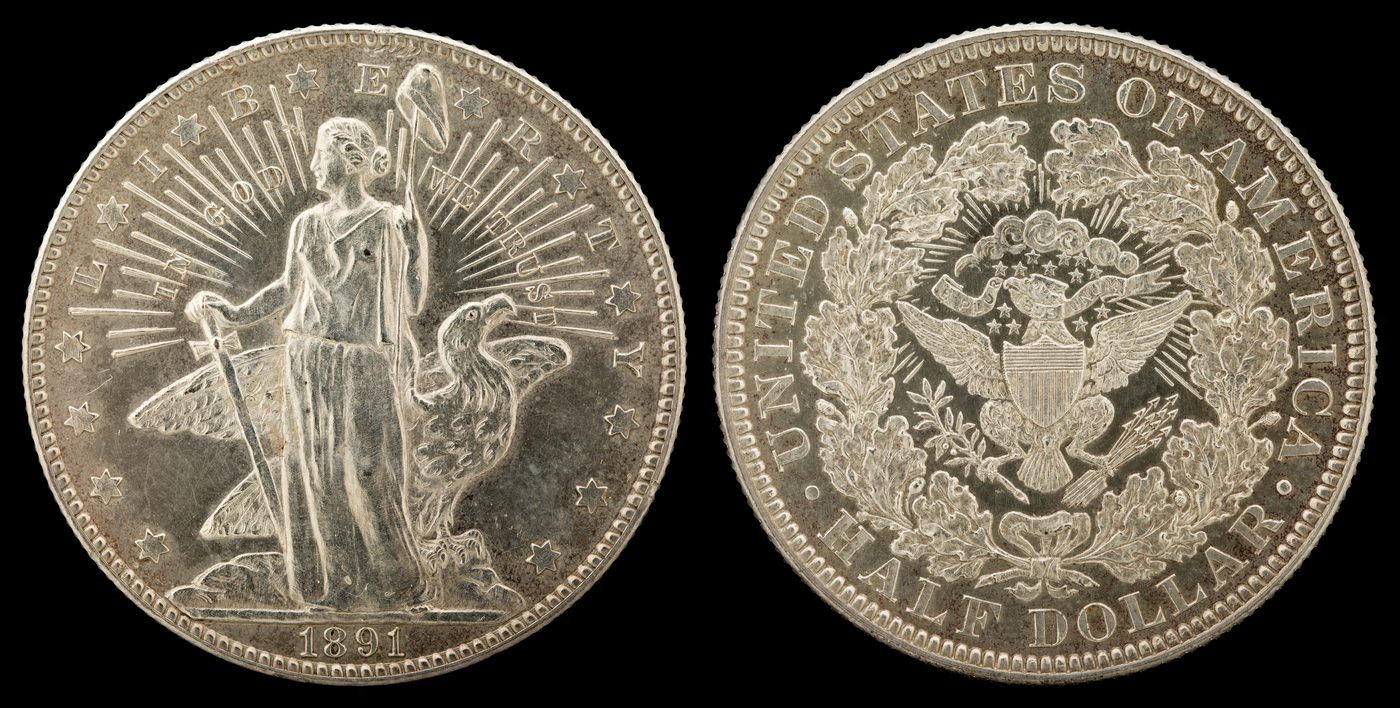
U.S. Mint (pattern coin design by Charles E. Barber); photograph by Jaclyn Nash, National Numismatic Collection, National Museum of American Histor… · public domain · source

Every coin in your pocket beat out a dozen rivals you've never seen. The U.S. Mint drew them, engraved them, even struck a few in silver — then killed them. These are the half dollar patterns: the fifty-cent pieces America tried on and decided against.

The coins that lost

Before a coin reaches your hand, it survives a quiet competition. For most of the 19th century the U.S. Mint in Philadelphia ran that competition with hammer and die — striking trial fifty-cent pieces to see how a new portrait, a new motto, or a new metal would actually look and feel. Most never made it. They were rejected, set aside, and almost never spent.

Collectors call them patterns. A pattern is a proposed coin, struck in tiny numbers to test a design, a denomination, or an alloy before the Mint commits to making millions. The half dollar — fifty cents, a serious sum when a day's wage might be a dollar — drew an enormous share of that experimenting. Decade after decade, the Mint kept asking the same question: what should America's fifty-cent piece look like? The answers it threw away fill catalogues.

Here's the part that makes collectors lean in. These weren't all honest experiments. Some were struck on the quiet, for the private benefit of the very Mint officials who ran the place — and decades later the government tried to declare the whole class of them illegal to own.

What a pattern actually is

There is no single "half dollar pattern." There are dozens of them, spread across roughly a century, and the only thing they share is that they were experiments the Mint never released for circulation.

A few showed up because the country was rethinking its money. In the 1850s and 1860s the Mint tested new portraits and the new motto In God We Trust, born of Civil War piety. In the 1870s came a flood: the Mint debated silver's role in the economy, played with metric weights, and even invented entirely new alloys to test. The half dollar got swept into all of it. The 1859 silver pattern half dollar (catalogued as Judd-241), the lush 1872 "Amazonian" half dollar with its striding, armed Liberty (Judd-1201), and the 1877 fifty-cent designs all came out of this restless period.

The 1877 set is the showpiece. Chief Engraver William Barber cut a series of Liberty heads — collectors nicknamed the best of them the "Sailor Head" — and the Mint struck them across denominations and metals as a kind of grand audition for a new coinage. Barber's helmeted Liberty half dollar (Judd-1526) is one of the most admired faces the U.S. Mint ever cut and never used. None of these designs won. The regular Seated Liberty half dollar kept its job until 1891.

A quick vocabulary, defined as we go. The obverse is the heads side, the reverse the tails. A die is the engraved steel stamp that strikes the design into metal; a die trial is a familiar design struck in an odd metal — copper or aluminum instead of silver — just to test the dies. And the catalogue numbers — Judd (from Dr. J. Hewitt Judd's standard reference) and Pollock — are how collectors name patterns, since the coins themselves carry no special mark saying "rejected."

Key facts

What it is
Experimental 50-cent (half dollar) pattern coins
Struck by
U.S. Mint, Philadelphia
Main period
Mid-1800s to 1880s, with the heaviest output in the 1860s–1870s
Status
Patterns — never released for circulation
Cataloguing
Judd and Pollock reference numbers
Notable designs
1859 silver (Judd-241); 1872 Amazonian (Judd-1201); 1877 Sailor/Liberty Head (Judd-1526)
Key designer
William Barber, Chief Engraver (1877 half dollar designs)
Rarity
Most exist in tens of pieces or fewer; some are unique

Collecting the coins that never circulated

Patterns are scarce by definition — the Mint struck them to decide something, not to spend them — so a "common" half dollar pattern might exist in a few dozen examples, and the great rarities in a handful or even one. That scarcity, plus the beauty of designs that never got worn smooth in circulation, is why a single half dollar pattern can bring six figures at auction.

The reason so many survived at all is a story in itself. Mint directors in the mid-1800s discovered that collectors would pay handsomely for these "what-ifs." Director James Ross Snowden leaned into it; his successors went further. Henry Linderman, who ran the Mint in the 1870s, had patterns struck on his own behalf — pieces that were less true experiments than collectibles made to order for insiders. The line between testing a coin and quietly minting a treasure for yourself got very thin.

It came due in 1887. With Linderman dead, Mint Director James P. Kimball tried to claw the patterns out of his estate, arguing they were, in the law's eyes, government property that could never have legally become private. The attempt largely failed in practice. Today the vast majority of 19th-century patterns — including the half dollars — are openly and legally bought, sold, and slabbed by the major grading services. A small number of much later experimental pieces remain off-limits as government property, but the classic half dollar patterns are not among them.

Questions collectors ask

What is a half dollar pattern coin?

It's an experimental fifty-cent piece the U.S. Mint struck to test a design, denomination, or metal before deciding what to put into circulation. Patterns were made in tiny numbers and, by definition, were never released for everyday use. The half dollar was one of the most heavily experimented-on denominations of the 19th century.

Why didn't these designs ever circulate?

They lost the competition. The Mint tried new portraits, mottos, and alloys, then rejected almost all of them in favor of the regular issue — for the half dollar, that meant the Seated Liberty design held its place until 1891. A pattern is, in effect, a record of a decision the Mint chose not to make.

Are half dollar pattern coins legal to own?

Almost all 19th-century patterns, including the half dollars, are legal to own and trade today — they appear regularly at major auctions and in graded holders. This wasn't always settled: in 1887 the Mint tried to declare patterns illegal government property, but that attempt did not stick for the classic 1800s issues. A few much later experimental pieces remain government property and cannot be privately owned.

What are Judd and Pollock numbers?

They're the two standard cataloguing systems for U.S. patterns — 'Judd' from Dr. J. Hewitt Judd's reference work, 'Pollock' from a later one. Since patterns carry no mark identifying them as experimental, collectors use these numbers (for example, Judd-1526 for Barber's 1877 Sailor Head half dollar) to name and trade specific pieces.

Who designed the famous 1877 half dollar patterns?

Chief Engraver William Barber. His 1877 Liberty heads — the best known nicknamed the 'Sailor Head' — were struck across several denominations as a proposed new coinage. The half dollar version (Judd-1526) is widely admired as one of the finest faces the Mint cut but never adopted.

Sources