US coin · series

The Gold Dollar the Mint Couldn't Strike

A coin redesigned to fix one problem — and abandoned in two years because it created a worse one.

The Gold Dollar the Mint Couldn't Strike
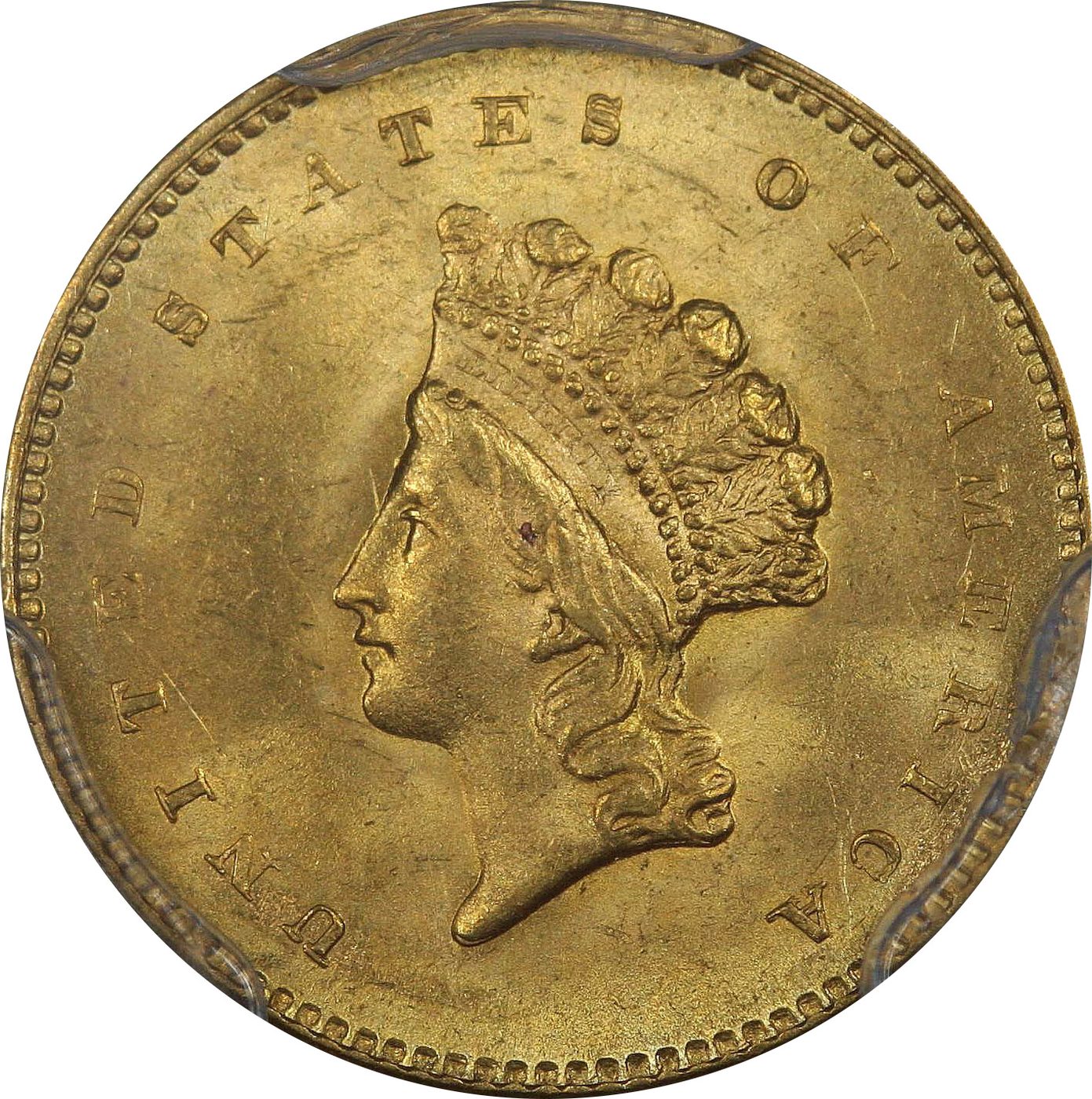
Lost Dutchman Rare Coins (photograph); coin designed by James B. Longacre · public domain · source

In 1854 the U.S. Mint gave its tiny gold dollar a new face: an Indian princess in a feathered headdress. It was meant to be an improvement. Instead the design defeated the presses, and the Mint scrapped it after barely two years — leaving behind one of the shortest-lived gold types in American history.

The story behind the coin

The gold dollar exists because California broke the money supply. When gold poured out of the Sierra foothills after 1848, the country suddenly had more gold than it knew what to do with — and Congress answered with the Act of March 3, 1849, authorizing a one-dollar gold coin. It was the smallest gold coin the United States would ever make.

And that was the problem. The first gold dollar, struck from 1849, measured only about 13 millimeters across — smaller than a modern dime, thin as a fingernail. People lost them. Merchants squinted at them. They were easy to counterfeit and easy to drop down a floorboard crack.

So in 1854 the Mint tried to fix it. The plan was simple on paper: keep the same weight of gold, but spread it into a wider, thinner coin that a human being could actually handle. A new design came with the new shape — and that is the coin on this page, the Type 2 gold dollar, struck only from 1854 to 1856. What looked like a sensible upgrade turned into a small disaster, and the Mint would walk it back within two years.

The design and who made it

The man behind it was James Barton Longacre, the fourth Chief Engraver of the U.S. Mint, who held the post from 1844 until his death in 1869. He designed both sides of the coin.

The obverse — the "heads" side — shows a female head wearing a feathered headdress, long called the "Indian princess." Despite the name, she is a classical, idealized figure; numismatic historians have suggested Longacre adapted a Roman marble bust and simply added the headdress. Collectors know this type as the Small Head because the portrait is noticeably smaller than the one Longacre would carve for the redesign that followed.

The reverse — the "tails" side — carries Longacre's "agricultural wreath" of corn, wheat, cotton, and tobacco, encircling the words ONE DOLLAR and the date. It was a piece of national symbolism: the staple crops of North and South wound together around the value.

Here is where it went wrong. To get the portrait to read on a wider, thinner coin, Longacre cut the design in high relief — meaning the raised parts of the design stood up sharply from the field. When the press struck the coin, metal had to flow into that deep recess on the obverse die. It couldn't flow into both sides at once. So the corresponding spot on the reverse — the date, especially the central two digits — never struck up fully. On a huge share of surviving Type 2 dollars, the "85" of the date is soft or barely there. Longacre had misjudged the power of the presses he was working with.

Key facts

Type
Gold Dollar, Type 2 (Indian Princess, Small Head)
Years struck
1854–1856
Designer
James B. Longacre (obverse and reverse)
Composition
90% gold, 10% copper (.900 fine)
Weight
1.672 grams (~0.0484 troy oz gold)
Diameter
about 14.3 mm (wider than the ~13 mm Type 1)
Mints
Philadelphia, Charlotte (C), Dahlonega (D), New Orleans (O), San Francisco (S)
Rarest date
1855-D — 1,811 struck
Replaced by
Type 3 (Large Head), beginning 1856

Collecting it: key dates and why they're scarce

The Type 2 gold dollar is short, which makes it collectible as a complete set — but it is short for a painful reason, and a few of its dates are genuinely hard to find.

The two Philadelphia issues, 1854 and 1855, carry the series. Each was struck in the hundreds of thousands (1854 at 783,943 pieces; the 1855 Philadelphia coinage in similar volume), so these are the dates most collectors actually own. Even these, though, are tough to find sharply struck — the relief problem hit every coin, not just the rare ones, so a Type 2 dollar with a full, bold date commands a real premium over one with the usual weak "85."

The branch-mint dates are where it gets serious. The Southern gold mints struck Type 2 dollars only in 1855, and barely:

  • 1855-D (Dahlonega): just 1,811 coins. This is the key date of the type — a low-mintage rarity that branch-mint gold specialists chase for years, and one that is almost never found well struck.
  • 1855-C (Charlotte): 9,803 coins. Scarce in its own right, and notorious for weak, granular strikes.
  • 1855-O (New Orleans): 55,000 coins — the only New Orleans Type 2, and the most attainable of the branch issues.
  • 1856-S (San Francisco): 24,600 coins — the only Type 2 struck at San Francisco, and a late one. By the time San Francisco made it in 1856, Philadelphia had already moved on to the redesigned Type 3. That makes the 1856-S a one-year, one-mint coin that closes out the whole type.

Why are high grades so scarce across the board? Two reasons stack on top of each other. First, the design itself fought the presses, so even freshly minted coins often left the Mint looking worn. Second, gold dollars were spent — they were real money in a cash economy, and many circulated hard or were later melted. A Type 2 in true mint condition, with a crisp date and original surfaces, is a coin that beat long odds to survive.

Questions collectors ask

Why is it called the 'Small Indian Head' or 'Small Head' gold dollar?

It's the Type 2 gold dollar of 1854–1856, designed by James B. Longacre with a feathered-headdress portrait often called the 'Indian princess.' Collectors call it the 'Small Head' to tell it apart from the redesigned Type 3 that followed, which used a larger portrait. Despite the nickname, the figure is a classical, idealized one rather than a portrait of a real person.

Why was the Type 2 gold dollar only made for three years?

The design was struck in very high relief, and the presses of the day couldn't fill both dies cleanly in a single blow. Metal flowed into the deep obverse portrait at the expense of the reverse, so the date — especially the '85' — came out weak. The Mint couldn't fix it, so Longacre reworked the design with a larger, lower head, creating the Type 3 that replaced it starting in 1856.

What is the rarest Type 2 gold dollar?

The 1855-D, struck at the Dahlonega, Georgia mint, with a mintage of just 1,811 coins. It is the key date of the type and is exceptionally hard to find with a full strike. The 1855-C (Charlotte, 9,803) is the next-toughest.

Why is the date so often weak on these coins?

It's a built-in flaw of the design, not wear. The high-relief portrait on the front pulled metal away from the back of the coin during striking, leaving the central digits of the date soft. A Type 2 dollar with a fully struck, bold date is genuinely scarce and worth a premium.

How much gold is actually in one?

Each coin is 90% gold (.900 fine) and weighs about 1.672 grams, which works out to roughly 0.0484 troy ounce of pure gold. The weight stayed the same as the earlier Type 1 — the 1854 redesign only changed the shape, spreading the same gold into a wider, thinner coin.

Sources