US coin · series

The Liberty Head Gold Dollar — the smallest coin America ever made

A 13-millimeter speck of Gold Rush gold, designed alone in a few feverish weeks by an engraver his own bosses were trying to fire.

The Liberty Head Gold Dollar — the smallest coin America ever made
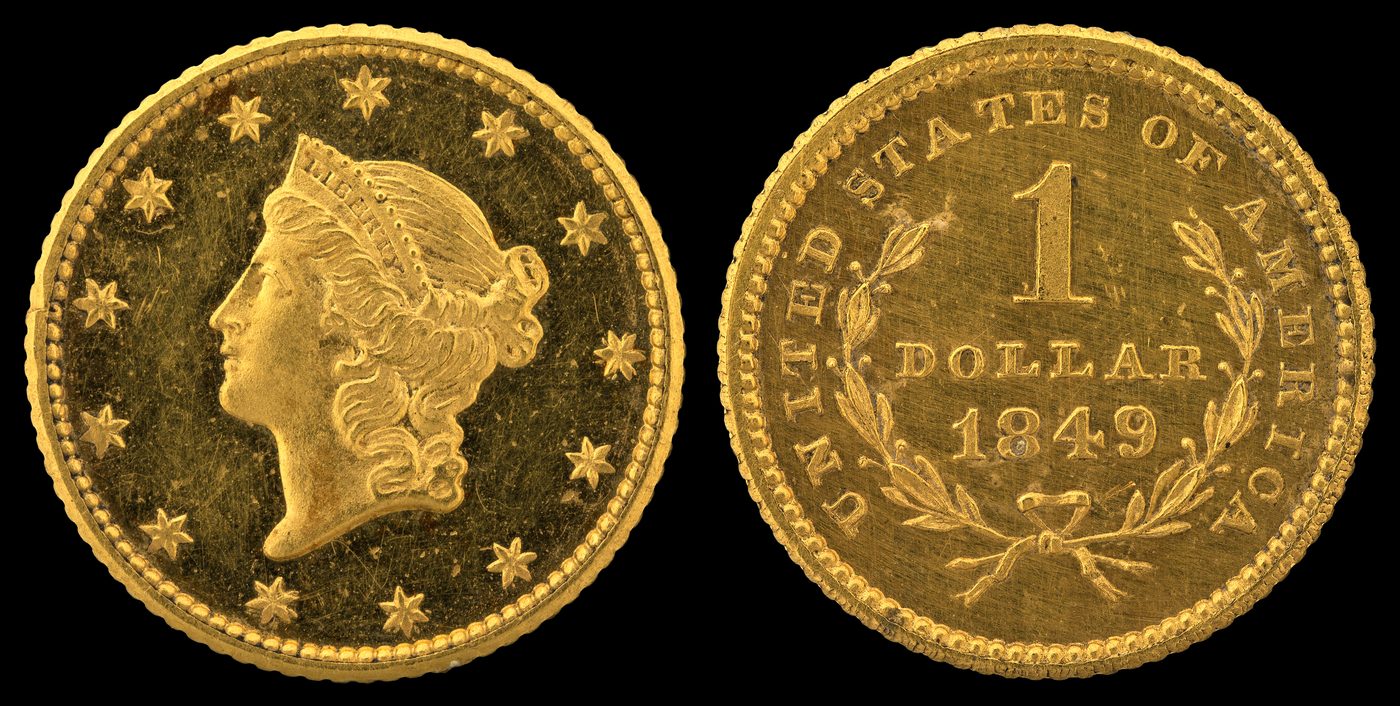
National Numismatic Collection, National Museum of American History (photograph by Jaclyn Nash); coin by US Mint · public domain · source

When California gold poured east in 1849, Congress needed somewhere to put it — so it authorized a gold coin barely wider than a modern dime is thick. The result is the smallest coin the United States has ever struck, and one of the most quietly dramatic stories in American money.

The story behind the coin

In 1848 a carpenter found flecks of gold in a California millrace, and within a year the country's money supply was upside down. Gold flooded east from the diggings faster than the Mint had any use for it. Congress's answer, in the Act of March 3, 1849, was to turn that raw metal into coin — authorizing both the giant $20 double eagle and, at the opposite extreme, a one-dollar gold piece.

The idea of a gold dollar wasn't new. It had been pitched and rejected through the 1830s and 1840s as a gimmick. What changed was the gold itself. With so much bullion arriving, a tiny gold coin suddenly made economic sense — and there was proof it could work. A North Carolina goldsmith named Christopher Bechtler had been privately striking gold dollars since 1831, and people used them. The federal government finally followed.

The job of designing it fell to the Mint's Chief Engraver, James Barton Longacre — and almost nobody at the Philadelphia Mint wanted him to succeed. He had powerful enemies inside the building (more on that below), men who argued a coin this small was a foolish, impractical thing. Longacre did it anyway, alone, in a matter of weeks. The coin that came out the other side is the smallest the United States has ever made: 13 millimeters across — narrower than a dime — and weighing under two grams.

The design and who made it

The obverse — the heads side — shows Liberty as a young woman facing left, her hair gathered in a bun, wearing a coronet (a small crown-like band) stamped with the word LIBERTY. Thirteen stars ring her, one for each original colony. The reverse — the tails side — is plainer still: an open wreath wrapped around the date and the words ONE DOLLAR, with UNITED STATES OF AMERICA running near the rim. There was no room for an eagle. There was barely room for anything.

It is all the work of one man, James Barton Longacre (1794–1869), who designed both sides. Longacre wasn't a sculptor by training — he was a celebrated portrait engraver who had built the best engraving business in the country before the Mint hired him in 1844. He felt the strain of this particular job. The work, he wrote, "was unusually minute and required very close and incessant labor for several weeks." Squeezing a portrait, a wreath, a date, and a country's name onto a coin the size of a fingernail is genuinely hard engraving.

Look closely at Liberty's neck and you'll find a single letter: L, Longacre's initial. It is small, but it is a landmark — the first time the designer of a circulating U.S. coin was allowed to sign his work. That tiny "L" is one of the quiet pleasures of owning the coin.

Key facts

Years struck
1849–1854 (Type 1)
Designer
James Barton Longacre — obverse and reverse
Composition
90% gold, 10% copper
Weight
1.672 grams
Diameter
13 mm — the smallest U.S. coin ever struck
Edge
Reeded
Mints
Philadelphia (none), Charlotte (C), Dahlonega (D), New Orleans (O), San Francisco (S, from 1854)
Most common date
1853 Philadelphia — 4,076,051 struck
Rarest issue
1849-C Open Wreath — roughly 4–5 known
Designer signature
'L' on Liberty's neck — first designer initial on a U.S. circulating coin

Collecting it: dates, varieties, and why high grades are scarce

For a six-year series, the Type 1 gold dollar packs in an enormous range of difficulty — from coins you can buy on a lunch break to one of the genuine giants of American numismatics.

The common ground. Philadelphia struck these by the millions during the good years, peaking at 4,076,051 in 1853 — far and away the easiest date. Circulated Philadelphia coins from the early 1850s are among the most affordable pre-Civil-War U.S. gold you can own. They're where most collectors start.

The 1849 wreath varieties. In its first year the reverse came two ways: an Open Wreath (the tips of the wreath spread apart) and a Closed Wreath (the tips drawn in toward the denomination). The Closed Wreath became standard from 1850 on. The variety matters most at the branch mints — which is where the legend lives.

The 1849-C Open Wreath — the crown of the series. Charlotte, North Carolina struck 11,634 gold dollars in 1849, but only a tiny handful used the Open Wreath die before the Mint switched over. Today only about four or five are known to exist, making it the rarest gold dollar of any date or mint, and one of the rarest regular-issue U.S. gold coins of all. When one appears at auction it commands a fortune; finding one at all is the harder problem.

The southern and western branch mints. Coins from Charlotte (C) and Dahlonega (D) — short-lived gold-region mints in the Carolinas and Georgia — were struck in small numbers from local bullion and are scarce across the board. The 1854-D is a recognized low-mintage rarity. New Orleans (O) issues and the first San Francisco (S) dollars of 1854 round out the date-and-mintmark hunt that keeps specialists busy for years.

Why high grades are so scarce. A "mint state" (uncirculated, never spent) Type 1 dollar in sharp condition is genuinely hard to find, and the reason is built into the coin. At 13 mm and worth a full dollar in 1850, these pieces circulated hard — a dollar was real money. They were also so small they were easy to lose, bend, or mount as jewelry. Branch-mint coins were often weakly struck from worn dies on the frontier, so even an uncirculated survivor can look soft. A well-struck, high-grade branch-mint dollar is the combination collectors pay up for.

The series ended not because it failed but because it shrank too far. By 1854 people complained the coin was too small to handle and too easy to lose. The Mint's fix was to make it thinner and therefore wider — and to swap in a new portrait — creating the larger Type 2 "Indian Princess" dollar. That redesign closed the book on the Liberty Head.

Questions collectors ask

What is the Type 1 Liberty Head gold dollar?

It's the first U.S. gold dollar, struck from 1849 to 1854 and designed by James Barton Longacre. At 13 millimeters and 1.672 grams of 90% gold, it's the smallest coin the United States has ever made. A larger 'Type 2' design replaced it in 1854.

Why is the 1849-C Open Wreath gold dollar so famous?

It's the rarest gold dollar of any date or mint. The Charlotte Mint struck only a handful with the Open Wreath reverse before switching to the Closed Wreath, and today roughly four or five are known to survive. It's one of the great rarities of U.S. gold.

What's the difference between Open Wreath and Closed Wreath?

It's a 1849 reverse variety. On the Open Wreath the tips of the wreath spread apart; on the Closed Wreath they curl in toward the word DOLLAR. The Closed Wreath became standard from 1850 on. The distinction is most important — and most valuable — on the branch-mint coins.

Who designed the gold dollar, and what is the 'L' on it?

James Barton Longacre, the Mint's Chief Engraver, designed both sides. The small 'L' on Liberty's neck is his initial — the first time a circulating U.S. coin carried its designer's signature.

Why did the Mint stop making it in 1854?

It wasn't a failure — it was a victim of its own size. People found the 13mm coin too small to handle and too easy to lose. In 1854 the Mint made it thinner and wider and gave it a new portrait, creating the Type 2 dollar and ending the Liberty Head design.

Is a Type 1 gold dollar affordable to own?

Common Philadelphia dates from the early 1850s, especially 1853, are among the most affordable pieces of pre-Civil-War U.S. gold. The cost climbs steeply for branch-mint coins, high grades, and rarities like the 1849-C Open Wreath.

Sources