US coin · series

1992 Columbus Quincentenary Silver Dollar

The coin that put a wooden caravel and a Space Shuttle on the same silver disc.

1992 Columbus Quincentenary Silver Dollar
US Mint (credit: https://www.usmint.gov/coins/coin-medal-programs/commemorative-coins) · public domain · source

To mark 500 years since Columbus crossed the Atlantic, the U.S. Mint struck a dollar that splits the difference between 1492 and the space age — the Santa María on one side of the reverse, the Space Shuttle Discovery on the other. It arrived in 1992, just as the country was starting to argue about whether Columbus was worth celebrating at all.

The story behind the coin

In 1992, the United States turned 500 years removed from the moment Christopher Columbus made landfall in the Americas. Congress decided to mark the half-millennium the way it usually marks big anniversaries — with a commemorative coin program. The Christopher Columbus Quincentenary Coin Act (Public Law 102-281) authorized three coins for sale to the public: a copper-nickel clad half dollar, a 90% silver dollar, and a $5 gold half eagle.

A commemorative like this isn't pocket change. It's struck in limited numbers, sold straight from the Mint to collectors at a premium, and never meant to circulate. The premium does double duty: part of every sale is a built-in surcharge — effectively a donation baked into the price. Here, $7 from each silver dollar went to the Christopher Columbus Fellowship Foundation, the cause Congress attached to the program.

But the timing was awkward. By 1992, "quincentenary" had become a contested word. As the planned celebrations took shape, Native American groups and many historians pushed back hard on the old story of Columbus discovering a land that was already home to millions. That backlash reached the coins. Of the 4,000,000 silver dollars Congress authorized, fewer than half a million ever sold — a quiet verdict, in copper-nickel and silver, on a hero whose reputation was shifting under his feet.

The design

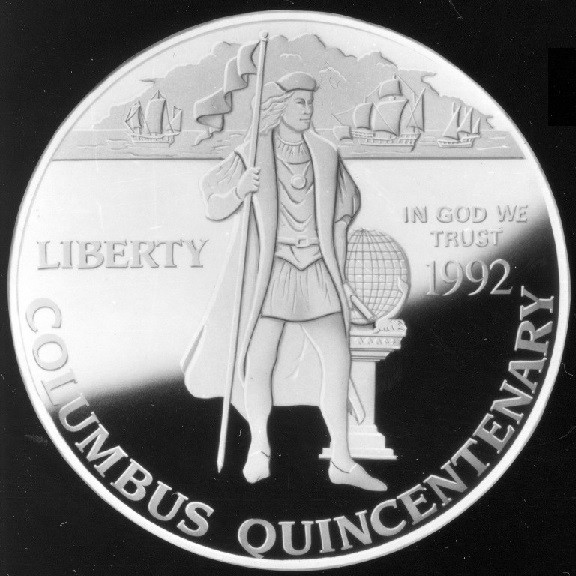
The silver dollar is a tale of two artists and two centuries. The obverse — the heads side — is the work of John Mercanti, then a sculptor-engraver at the Mint and the man behind the American Silver Eagle. He gives us Columbus standing full-length: a banner in one hand, a scroll in the other, a globe on a pedestal at his side. It's the explorer as the 19th century liked to imagine him — confident, draped, monumental.

Then you flip the coin, and the centuries collide. The reverse, designed by Thomas D. Rogers, is split down the middle. On the left, the left half of Columbus's flagship, the Santa María, riding the open sea. On the right, the right half of the Space Shuttle Discovery, climbing past the Earth and a single star. One image of crossing an unknown ocean, fused to another — the same impulse, 500 years apart.

It's an unusually literal piece of symbolism for a U.S. coin, and that's the point. The Mint wanted the dollar to argue that the spirit of 1492 didn't end in 1492 — that the urge to push past the edge of the map runs straight from a wooden caravel to a spacecraft. Whether you find that stirring or strained, it makes this one of the most instantly recognizable modern commemoratives.

Key facts

Years struck
1992
Denomination
Silver dollar ($1)
Obverse designer
John M. Mercanti
Reverse designer
Thomas D. Rogers
Composition
90% silver, 10% copper
Weight
26.73 g (0.7734 oz silver content)
Diameter
38.1 mm
Edge
Reeded
Uncirculated (1992-D)
106,949 struck
Proof (1992-P)
385,241 struck
Maximum authorized
4,000,000 (across all finishes)
Surcharge
$7 per coin to the Christopher Columbus Fellowship Foundation
Authorizing law
Christopher Columbus Quincentenary Coin Act (P.L. 102-281)
First released
August 28, 1992

Collecting it

For a coin only struck in a single year, the Columbus dollar has a clean, two-version structure. The uncirculated coin came from the Denver Mint and carries a D mint mark — the small letter that tells you which facility struck it. The proof — a specially polished, mirror-finish version made for collectors — came from Philadelphia and carries a P.

The mintages tell the real story. The Mint sold 385,241 proofs but only 106,949 uncirculated dollars. So the everyday-finish 1992-D is the scarcer of the two by more than three to one — the opposite of what newcomers often assume, where proofs feel like the "rare" version. Soft demand at the time is exactly why: collectors who bought the program leaned toward the showier proof, and the plain Denver strikes went home in smaller numbers.

For the seasoned collector, the chase is at the top of the grade scale. Modern commemoratives were generally well made and well preserved, so a coin merely in great shape is common. Value concentrates in the highest certified grades — flawless or near-flawless examples — where survivors thin out fast. As always with a slabbed coin, the grade on the holder, not the date alone, does most of the work in setting it apart.

Questions collectors ask

Why is the 1992-D Columbus dollar scarcer than the proof?

The Mint sold 385,241 proof dollars but only 106,949 uncirculated ones, so the Denver-struck uncirculated coin is the rarer of the two by more than three to one. Buyer demand in 1992 favored the polished proof, leaving the plain-finish coins with the smaller sales.

Why is there a Space Shuttle on a Columbus coin?

The reverse, designed by Thomas D. Rogers, deliberately splits the scene between the Santa María on the left and the Space Shuttle Discovery on the right. It's a 500-year exploration parallel: the impulse to cross an unknown ocean linked to the impulse to leave Earth.

How much silver is in the coin?

It's 90% silver, 10% copper, weighing 26.73 grams. That works out to roughly 0.77 troy ounces of pure silver, the standard composition for U.S. commemorative dollars of that era.

What was the surcharge for, and was the program a success?

Each silver dollar carried a $7 surcharge for the Christopher Columbus Fellowship Foundation. Sales fell well short of the 4 million coins Congress authorized — a shortfall widely tied to the rising controversy over how Columbus is remembered.

Did the coin ever circulate?

No. Like all U.S. commemoratives of the modern era, it was sold directly to collectors at a premium over face value and was never released into general circulation.

Sources