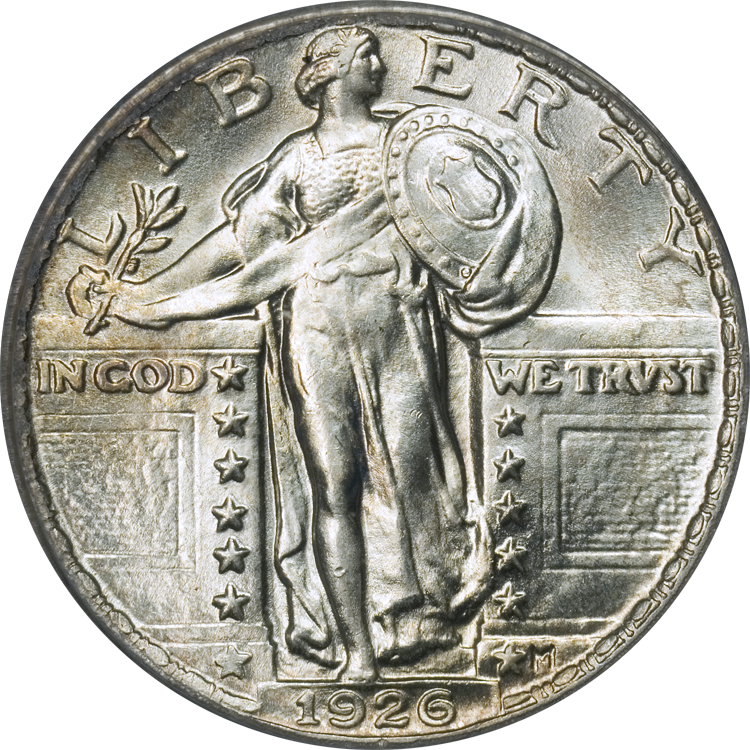
The Standing Liberty Quarter is a short, completable series — under two decades, three mints — and that makes it a favorite to build by date. But a handful of issues stand between a collector and a finished set.
The 1916. The whole first-year run was struck in the last two weeks of December 1916 — just 52,000 coins, the lowest mintage of any regular Standing Liberty Quarter and one of the great keys of 20th-century U.S. coinage. Most survivors are well-worn; high grades are genuinely rare, and even a heavily circulated 1916 carries a serious price.
The 1918/7-S overdate. During production at San Francisco, a die was struck with both a 1917 and a 1918 date hub, leaving a faint 7 buried under the 8. It's one of the most famous overdates in the series and one of its most valuable coins in any grade. (It has no separate mintage — it's a variety hiding within the regular 1918-S run.)
The 1921 and 1923-S. Both are scarce semi-keys. The 1921 (1,916,000 struck, Philadelphia only) and the 1923-S (1,360,000) command strong premiums even worn. The 1927-S (396,000) is scarce in high grade and notoriously hard to find sharply struck.
Which brings up the detail that defines the series for collectors: the Full Head, or "FH." Standing Liberty Quarters were often weakly struck, leaving Liberty's head flat and blurred. A coin earns the Full Head designation only when the head's fine detail is fully struck up — on Type 2 coins, that means a complete helmet outline, three visible leaves, and a clear ear hole. On some dates the FH is brutally scarce: only about 2% of certified 1926-D quarters qualify, and a Full Head example can be worth many times an ordinary one.
One last quirk explains why later dates are easier to find dated. The original design left the date raised on the surface, right where a thumb rubs — and by 1924 the Mint was getting back quarters worn completely smooth, dateless. In 1925 they recessed the date into the coin. Quarters from 1925 onward survive far more often with a readable date, which is exactly why early dates in collectible grades are scarcer and dearer than the numbers alone suggest.