Designer
James Earle Fraser
The frontier-raised sculptor who put an Indian on one side of the nickel and a buffalo on the other.
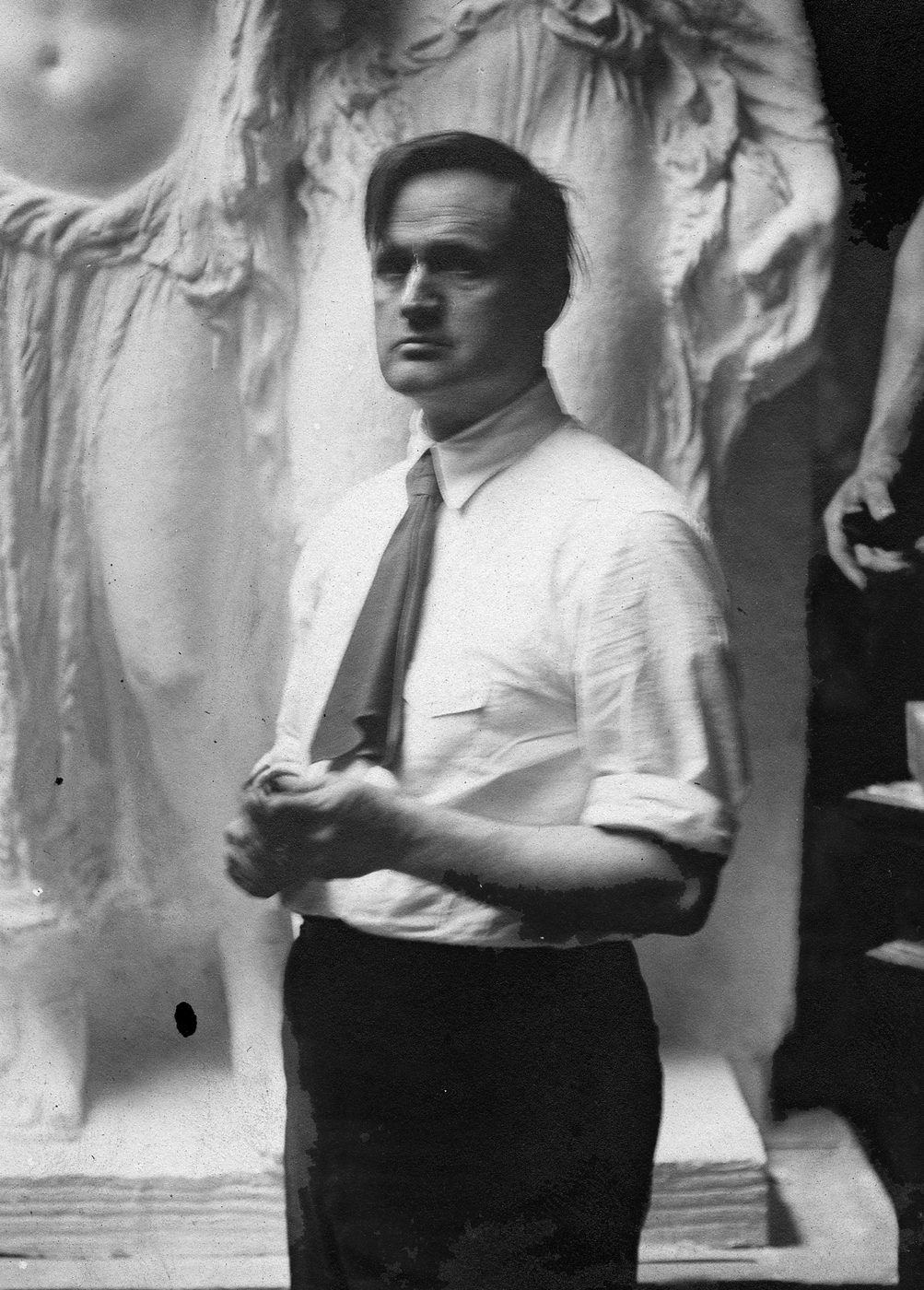
He grew up on the closing American frontier, watching the buffalo herds thin and the West he knew slip away. Then he spent the rest of his life trying to hold onto it in bronze and metal — and one of his designs is so loved the U.S. Mint brought it back, in gold, nearly a century later.
Who he was
James Earle Fraser was born in Winona, Minnesota, on November 4, 1876 — the year of the Battle of the Little Bighorn, the high-water mark of the Plains wars. That timing is almost too neat, but it shaped everything he made.
His father was a railroad engineer, and the work pulled the family west onto the Dakota plains while James was still a boy. He grew up where the frontier was actively closing — railroads pushing through, buffalo herds collapsing, and Native nations being forced onto reservations. He saw all of it happen. The grief of that vanishing world became the great subject of his life.
He started young. He was carving limestone he found near the family home as a child, and at fourteen he was already studying at the Art Institute of Chicago. From there he went to Paris — the École des Beaux-Arts and the Académie Julian — and fell into the orbit of Augustus Saint-Gaudens, the most celebrated American sculptor of the age. Fraser worked as his assistant for years. Saint-Gaudens was then remaking American coinage from the inside (his $20 gold piece is still considered the most beautiful coin the country ever struck), and that conviction — that a coin could be real art — rubbed off on the younger man.
By 1902 Fraser had his own studio in New York. He taught at the Art Students League, where he met a gifted student named Laura Gardin; they married in 1913 and became one of the rare husband-and-wife teams in American sculpture, both of them eventually designing U.S. coins. He served on the U.S. Commission of Fine Arts from 1920 to 1925, helping decide how the nation's monuments and money should look. He died in Westport, Connecticut, on October 11, 1953.
The craft — and the fight that defined his coin
Fraser's signature was emotional weight. His best work isn't pretty so much as heavy — a feeling of something ending. His most famous sculpture, End of the Trail, shows an exhausted Plains warrior slumped on an equally exhausted horse, lance dropped, head bowed against the wind. He had been working the image since he was a teenager; the monumental version stopped crowds at the 1915 Panama–Pacific International Exposition in San Francisco. It says, in one silhouette, what he felt about the West he'd watched disappear.
He carried that same instinct to the nickel. In 1911 the Treasury was looking for a new five-cent design, and Fraser pitched something no U.S. coin had ever done: a real Native American on one side and an American bison on the other. In a letter to the Mint that September he made the case plainly — the idea, he wrote, was "without doubt, purely American." He insisted the portrait be "a purely Indian type," not a European face dressed up in feathers. The obverse — the heads side — he built as a composite. Years later, in 1938, he named his sitters as Iron Tail, a Sioux; Big Tree, a Kiowa; and Two Moons, a Cheyenne. (He never claimed it was any single man's likeness; that's the point — it's a type, an idea of a people.)
The reverse — the tails side — is the bison that gives the coin its nickname. Collectors love to say it was modeled on a zoo buffalo named Black Diamond, and Fraser himself pointed to a New York zoo animal. The exact bison has been argued over for a century, and parts of the tale are likely embroidered — treat the specific name as a good story, not a settled fact.
Then came the fight. Charles Barber, the Mint's chief engraver, was a guardian of practicality and no fan of outside artists meddling with his coinage. He reworked Fraser's design for production — and the first version, the Type I, placed the buffalo on a raised mound with the words "FIVE CENTS" sitting high on that mound, right where coins wear first. The denomination was wearing away almost immediately. Within months the Mint cut the mound down to flat ground and pushed the lettering lower, into a protected recess. That's the Type II — and it's why 1913 nickels come in two flavors that collectors chase separately.
There was a second battle, too. The Hobbs Manufacturing Company made anti-slug devices for vending machines and insisted Fraser's relief would jam their gear; they demanded changes that would have gutted the design. Treasury Secretary Franklin MacVeagh refused. "If we should stop new coinage… for any commercial obstacles less than imperative," he wrote, "we should have to abandon a worthy coinage altogether." Production began on February 18, 1913. Fraser's coin survived its bureaucracy.
Career timeline
- 1876Born November 4 in Winona, Minnesota; childhood on the Dakota plains as his railroad-engineer father moved west.
- 1890Enters the Art Institute of Chicago at age 14.
- 1890sStudies in Paris (École des Beaux-Arts, Académie Julian); becomes an assistant to Augustus Saint-Gaudens.
- 1902Opens his own studio in New York; later teaches at the Art Students League.
- 1913Buffalo nickel enters production; marries fellow sculptor Laura Gardin.
- 1915Monumental 'End of the Trail' is the sensation of the Panama–Pacific International Exposition in San Francisco.
- 1920–1925Serves on the U.S. Commission of Fine Arts.
- 1935Completes 'The Authority of Law' and 'The Contemplation of Justice' flanking the U.S. Supreme Court building.
- 1953Dies October 11 in Westport, Connecticut.
- 2006Posthumous return: the U.S. Mint launches the American Gold Buffalo, adapting his 1913 design.
Key facts
- Born
- November 4, 1876 — Winona, Minnesota
- Died
- October 11, 1953 — Westport, Connecticut
- Nationality
- American
- Trained at
- Art Institute of Chicago; École des Beaux-Arts & Académie Julian, Paris
- Mentor
- Augustus Saint-Gaudens (worked as his assistant)
- Signature coin
- Buffalo nickel (Indian Head nickel), struck 1913–1938
- Coin revived as
- American Gold Buffalo bullion coin, first struck 2006
- Best-known sculpture
- End of the Trail (monumental version, 1915)
- Public service
- U.S. Commission of Fine Arts, 1920–1925
A note in his own words
The idea of the Indian and the buffalo on the same coin is, without doubt, purely American and seems to be singularly appropriate to have on one of our national coins.
— James Earle Fraser, in a September 1911 letter to the U.S. Mint, making the case for his Buffalo nickel design.
Questions people ask
Who designed the Buffalo nickel?
Sculptor James Earle Fraser. He proposed the Indian-and-bison design in 1911, and the coin was struck from 1913 to 1938. It's also called the Indian Head nickel.
Was the Indian on the nickel a real person?
Not one single person. Fraser built the portrait as a composite. In 1938 he named three of his sitters: Iron Tail, a Sioux; Big Tree, a Kiowa; and Two Moons, a Cheyenne. He wanted a 'type' that represented Native Americans broadly, not any one man's likeness.
What buffalo did Fraser use for the reverse?
The popular answer is a zoo bison named Black Diamond, and Fraser did point to a New York zoo animal. But the exact bison has been disputed for over a century and parts of the story are likely embroidered — enjoy it as legend rather than settled fact.
Why are there two kinds of 1913 Buffalo nickels?
The first design (Type I) put the bison on a raised mound, with the words 'FIVE CENTS' sitting on top of it — exactly where a coin wears first. The denomination wore away fast. So within months the Mint flattened the ground and dropped the lettering into a protected spot, creating the Type II. Both were made in 1913.
Is the American Gold Buffalo the same design?
Yes — it's a deliberate revival. When the U.S. Mint launched its first .9999 fine (24-karat) gold bullion coin in 2006, it adapted Fraser's 1913 nickel art, giving his design a second life nearly a century after he drew it.
What else did James Earle Fraser make?
His monumental sculpture End of the Trail (1915) is nearly as famous as the nickel. He also created the Authority of Law and Contemplation of Justice figures at the U.S. Supreme Court, statues of Alexander Hamilton and Albert Gallatin at the Treasury, and the Arts of Peace groups near the Arlington Memorial Bridge.