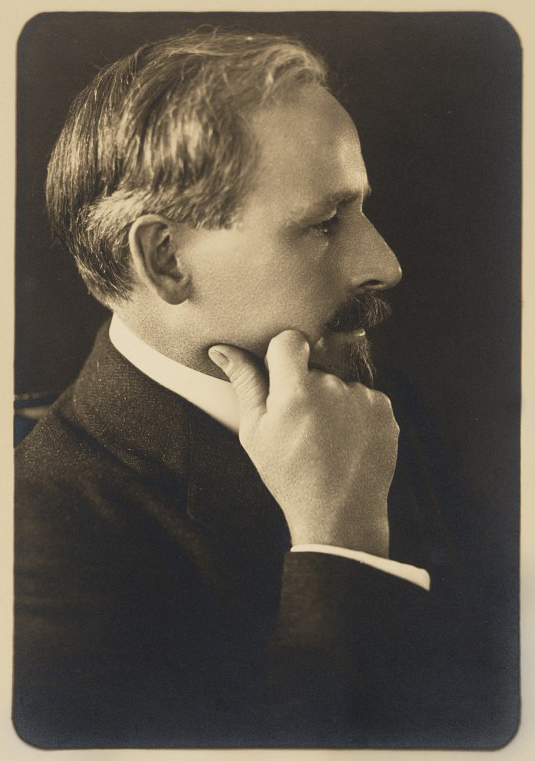
Designer

Adolph A. Weinman — the man who taught Liberty to walk

A boy who landed in New York at 14 grew up to design the two coins many collectors call the most beautiful America ever struck.

Adolph A. Weinman — the man who taught Liberty to walk
Carl Klim-Check; Smithsonian Institution, Archives of American Art 6574 · public domain · source

In 1916 the United States replaced three worn silver coins at once. Two of the new designs came from the same hand — a German immigrant named Adolph Weinman. One of them, his striding Liberty, was so loved that the Mint brought it back in 1986. It still walks across the front of the American Silver Eagle today.

The boy who arrived at fourteen

Adolph Alexander Weinman was born on December 11, 1870, in Durmersheim, a village near Karlsruhe in southwestern Germany. In 1885, at fourteen, he sailed to the United States with his mother. He arrived speaking little English and with no money behind him.

What he had was a gift for shaping things. As a teenager he apprenticed to Frederick Kaldenberg, a New York carver of ivory and meerschaum pipes — close, patient work that trained his hands. At night he took classes at the Cooper Union, the free art and engineering school in Manhattan, and later at the Art Students League.

Then came the doors that mattered. Weinman went to work in the studios of the leading American sculptors of the age — Charles Niehaus, Olin Warner, Daniel Chester French (who would later carve the seated Lincoln in the Lincoln Memorial), and, above all, Augustus Saint-Gaudens. Saint-Gaudens was the towering figure of American sculpture; his $20 gold "Double Eagle" of 1907 is still called the most beautiful coin the country ever made. Weinman learned the Beaux-Arts tradition — graceful, idealized, classically grounded figures — straight from the master.

In 1904 he opened his own studio in Forest Hills, New York. He was now a sculptor in his own right. The coins were still a dozen years away.

What made his work his own

Weinman thought like a monument-maker, not a coin engraver — and that is exactly why his coins look the way they do. He worked at large scale on buildings: in 1910 he carved the great stone eagles and the "Day and Night" figures for New York's original Pennsylvania Station, and in 1913 he crowned the Manhattan Municipal Building with Civic Fame, a 25-foot gilded figure that is still one of the tallest statues in Manhattan. He went on to make pediments — the triangular sculpted panels above a building's columns — for the National Archives and the Jefferson Memorial in Washington, and sculpture for the Supreme Court.

That habit of thinking big shows in his coins. He filled the small silver disc with motion and air, where earlier U.S. coins had sat stiff and frontal. His debt to Europe was open: the striding Liberty owes something to The Sower, the famous French coin figure by Oscar Roty. The art historian Cornelius Vermeule put it plainly — "The debt to [Oscar] Roty's Sower is obvious, but the Liberty Walking is an original creation, not a slavish copy."

Weinman also signed his work quietly. Look closely at his coins and you'll find a tiny monogram — a joined AW — tucked near the rim. That is the designer's mark, the way a painter signs a corner of the canvas.

1916: two coins from one hand

By 1916 a quirk of the law opened a door. A coin design could be changed without an act of Congress once it had been in use for 25 years — and the dime, quarter, and half dollar all dated to 1892. Mint Director Robert W. Woolley wanted them gone. He turned to the Commission of Fine Arts, the federal panel that advises on public art, and ran a competition. Three outside sculptors were invited: Weinman, Hermon MacNeil, and Albin Polasek. The Mint's own chief engraver, Charles E. Barber, submitted designs too — and they were rejected.

Weinman won two of the three. His dime and his half dollar were chosen; MacNeil took the quarter.

His dime is officially the Winged Liberty Head dime, though almost everyone calls it the "Mercury" dime — the public mistook the winged cap for the Roman messenger-god Mercury. They were wrong about the figure, and Weinman said so. In a 1916 letter he explained that the head was Liberty, and that "the wings crowning her cap are intended to symbolize liberty of thought." On the back he placed a fasces — a bound bundle of rods around an axe, an ancient emblem of strength through unity — wrapped with an olive branch for peace. The obverse, by the way, is the "heads" side of a coin; the reverse is "tails."

His half dollar is the Walking Liberty. Liberty strides toward a rising sun, wrapped in the American flag, an arm thrown forward, branches of laurel and oak in her other hand. On the reverse a bald eagle perches on a crag, wings half-open, a sapling of mountain pine at its feet. Vermeule called it "one of the greatest coins of the United States — if not of the world." Many collectors simply call it the most beautiful coin America ever circulated.

Beauty came at a cost. The half dollar's high relief — how far the design rises off the surface — fought the Mint's presses. Liberty's head and hand and the eagle's breast feathers were hard to strike up fully, and the design was reworked over the years to make it cooperate. That struggle is why fully struck, high-grade examples of certain dates are so prized today.

A face still walking among us

Both coins had long lives. The dime ran from 1916 to 1945; the half dollar from 1916 to 1947. They might have faded into history — except that in 1986, the U.S. Mint launched a new silver bullion coin, the American Silver Eagle, and reached back seventy years for its front. Weinman's striding Liberty was adapted for the obverse (the reverse, a heraldic eagle, was designed by Mint engraver John Mercanti). The Silver Eagle is now one of the most widely held silver coins on earth — which means Weinman's Liberty is, quietly, one of the most reproduced pieces of American sculpture ever made.

One detail captures the regard he earned. The American Numismatic Society's Saltus Medal honors lifetime achievement in the art of the medal. Weinman designed the medal itself — and then, in 1920, became its second recipient. He served as president of the National Sculpture Society and sat on the U.S. Commission of Fine Arts from 1929 to 1933, helping judge the very kind of public art he had spent his life making. Two of his sons followed him into sculpture; one, Howard, designed a U.S. commemorative half dollar of his own. Adolph Weinman died on August 8, 1952, in Port Chester, New York.

Career at a glance

  1. 1870Born in Durmersheim, near Karlsruhe, Germany, on December 11.
  2. 1885Emigrates to the United States at age 14 with his mother.
  3. c.1885Apprentices to ivory- and pipe-carver Frederick Kaldenberg; studies nights at Cooper Union and the Art Students League.
  4. 1890sWorks in the studios of Niehaus, Warner, Daniel Chester French, and Augustus Saint-Gaudens.
  5. 1904Opens his own studio in Forest Hills, New York.
  6. 1910Carves the eagles and 'Day and Night' figures for Pennsylvania Station, New York.
  7. 1913Completes 'Civic Fame' atop the Manhattan Municipal Building.
  8. 1916Wins the Mint competition; his Winged Liberty dime and Walking Liberty half dollar are adopted.
  9. 1920Receives the ANS Saltus Medal — which he had himself designed.
  10. 1929–1933Serves on the U.S. Commission of Fine Arts.
  11. 1952Dies in Port Chester, New York, on August 8.

Key facts

Born
December 11, 1870 — Durmersheim, near Karlsruhe, Germany
Died
August 8, 1952 — Port Chester, New York
Nationality
German-born American
Trained under
Augustus Saint-Gaudens and Daniel Chester French
Signature coins
Winged Liberty ('Mercury') dime (1916–1945); Walking Liberty half dollar (1916–1947)
Living legacy
Walking Liberty obverse revived on the American Silver Eagle (1986–present)
Designer's mark
Joined 'AW' monogram near the rim
Other major works
Pennsylvania Station eagles; 'Civic Fame'; National Archives & Jefferson Memorial pediments

What he said about the dime

The wings crowning her cap are intended to symbolize liberty of thought.

Adolph A. Weinman, explaining the Winged Liberty Head ("Mercury") dime in a 1916 letter — answering the public who assumed the winged figure was the god Mercury rather than Liberty herself.

Questions people ask

Who designed the Mercury dime?

Adolph A. Weinman, a German-born American sculptor who trained under Augustus Saint-Gaudens. He designed it in 1916. Its official name is the Winged Liberty Head dime — the 'Mercury' nickname came from people mistaking the winged cap for the Roman god Mercury. The figure is actually Liberty.

Did the same person design the Mercury dime and the Walking Liberty half dollar?

Yes. Weinman won the U.S. Mint's 1916 design competition for both coins at once. The dime ran from 1916 to 1945 and the half dollar from 1916 to 1947.

Why is Weinman's Liberty on the modern Silver Eagle?

When the Mint created the American Silver Eagle bullion coin in 1986, it adapted Weinman's 1916 Walking Liberty design for the obverse. It has appeared there ever since, making it one of the most reproduced coin designs in U.S. history.

Is it true a real woman modeled for the coins?

Collectors have long held that Elsie Kachel Stevens — wife of the poet Wallace Stevens, and once a tenant of Weinman's — sat for a 1913 bust that informed the designs. It's a much-repeated tradition and is widely believed, but Weinman never publicly confirmed the model's identity, so treat it as plausible lore rather than settled fact.

What is the 'AW' on the coin?

It's Weinman's monogram — his initials joined together, placed near the rim. It identifies him as the designer, the same way an artist signs a painting.

Sources