US coin · series

The Washington-Carver Half Dollar — the last of the classic commemoratives

Two Black American giants on a Cold War coin, designed by the first African American the U.S. Mint ever struck.

The Washington-Carver Half Dollar — the last of the classic commemoratives
United States Mint / Isaac Scott Hathaway (designer) · public domain · source

In 1951, the U.S. Mint did something it had never done: it struck a coin designed by a Black artist, honoring two Black Americans. Then it made far more than anyone would buy — and melted most of them. This is the coin that ended an era and almost vanished doing it.

The story behind the coin

By 1951, the great American commemorative coin program was dying of its own excess. In the 1930s, promoters had flooded collectors with dozens of "commemorative" half dollars honoring everything from local centennials to a roadside fort, often just to skim a profit on the surcharge. Congress and the Treasury had soured on the whole idea. The Washington-Carver half dollar was the last gasp — and it arrived wrapped in the politics of the Cold War.

The man behind it was S.J. Phillips, a former Tuskegee student who had already shepherded the Booker T. Washington Memorial half dollar (struck 1946–1951) through Congress. That earlier coin sold badly. Millions went unsold and were returned to the Mint. So Phillips came back with a new pitch: melt the leftover Washington coins and restrike them as a joint tribute to Booker T. Washington, the famed educator, and George Washington Carver, the agricultural scientist whose work with the peanut and soil made him one of the most celebrated Americans of his day.

The sales pitch had a hard edge of its time. The authorizing law — Public Law 82-151, passed September 21, 1951 — was promoted in part as a way to "oppose the spread of Communism" among African Americans, holding up two Black men who had risen through education and self-reliance as proof of what America offered. The reverse spells it out in a single word stamped across the map of the country: AMERICANISM.

The design

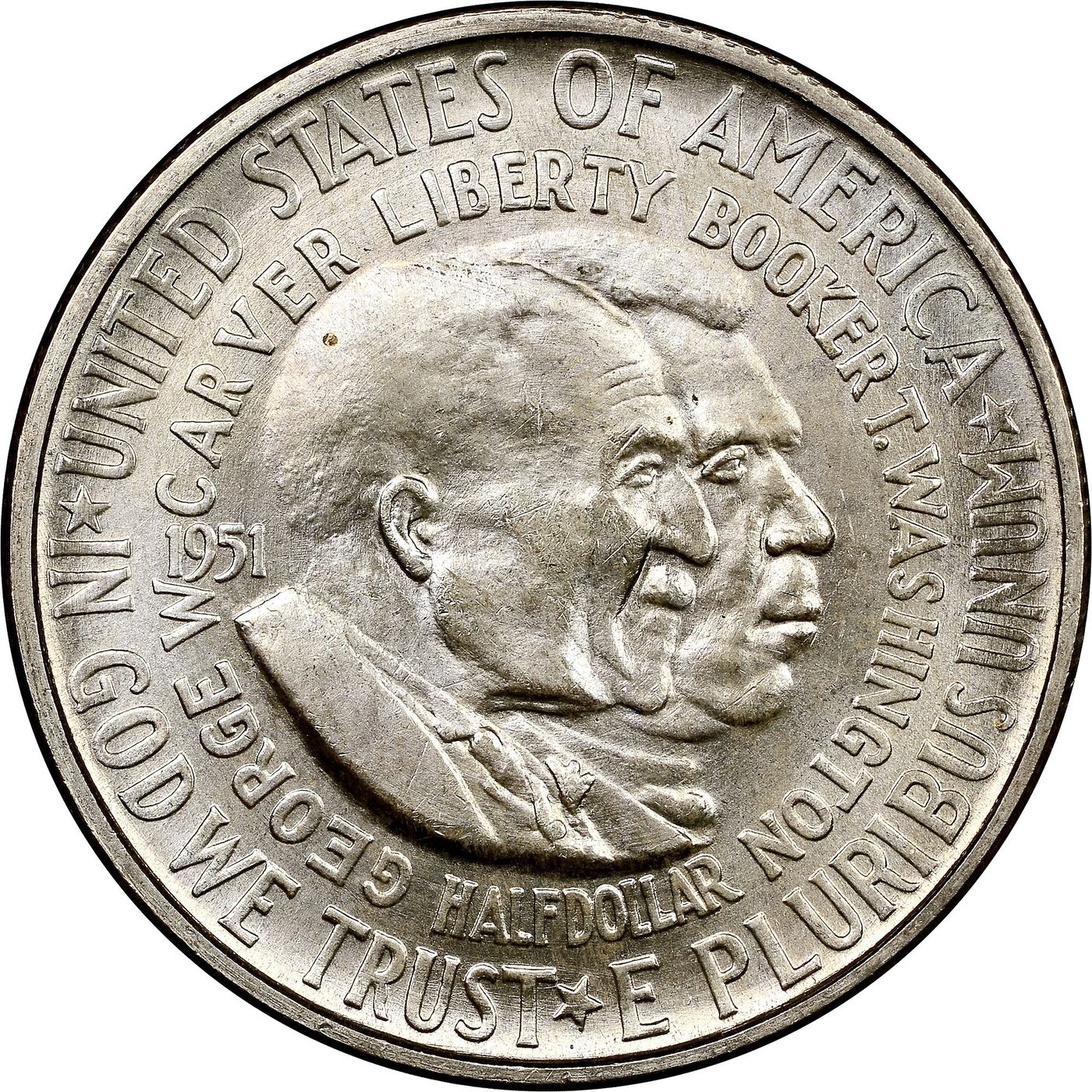
The obverse — the heads side — carries the conjoined profiles of Carver and Washington, both facing right, a quiet image of partnership across a generation. (Carver was, in fact, recruited to Tuskegee by Washington and taught there for decades.) The reverse is unusual: an outline map of the 48 states with "U.S.A." laid over it, ringed by the words FREEDOM AND OPPORTUNITY FOR ALL and AMERICANISM.

What makes this coin matter beyond its design is the hand that made it. Isaac Scott Hathaway, a sculptor and ceramicist who taught at Tuskegee, was the first African American artist whose work was struck by the United States Mint. He had designed the earlier Booker T. Washington coin too — winning the commission over an already-approved design by the established sculptor Charles Keck. For a Black artist to sign a federal coin in the era of segregation was, by itself, a landmark.

A commemorative like this was a special-issue coin sold above face value, with the premium meant to fund a cause — here, the George Washington Carver National Monument Foundation. It was legal tender, but it was built to be saved, not spent.

Key facts

Years struck
1951–1954
Mints
Philadelphia (no mark), Denver (D), San Francisco (S)
Designer
Isaac Scott Hathaway — first African American struck by the U.S. Mint
Authorizing act
Public Law 82-151, passed September 21, 1951
Composition
90% silver, 10% copper
Weight / diameter
12.5 g; 30.6 mm; reeded edge
Largest mintage
1952-P — roughly 2 million struck, by far the type's high point
Key dates
Low-mintage set issues — e.g. 1953-P and 1953-D, around 8,000 each
Honors
Booker T. Washington & George Washington Carver
Distinction
The last classic U.S. commemorative — none followed until 1982

Collecting it

Here is the paradox that drives the Washington-Carver market: huge numbers were made, almost nobody bought them, and so survivors are scarcer than the mintages suggest. Most years were sold only in three-coin sets — one each from Philadelphia, Denver, and San Francisco — which collectors resented. A few dates with bigger mintages (the 1951-P, the giant 1952-P, the 1953-S, the 1954-S) were sold as singles. The rest sat.

When the program collapsed at the end of 1954, the unsold hoards didn't disappear. Some went back to the Mint for melting. Others were dumped into circulation at face value or sold to speculators for pennies over. Then the silver melts of the late 1970s and early 1980s took a further heavy toll — well over a million Washington-Carver halves are believed to have gone to the pot for their metal.

For a collector today, two things matter. First, the key dates are the low-mintage set issues — the 1953-P and 1953-D, struck at roughly 8,000 each, sit at the scarce end. Second, condition is everything. Plenty survive in collectible mint state, but truly high grades are tough: these coins are notably hard to find in MS66 or finer (MS = "mint state," the uncirculated grades, where 70 is perfect). A common date in a top grade can outrun a key date in an ordinary one. The hunt here is less about the date than the strike and the surfaces.

Questions collectors ask

Why is the Washington-Carver called the last classic commemorative?

It was the final coin of the original U.S. commemorative era, which began in 1892. After the 1930s saw dozens of profit-driven issues, Congress and the Treasury turned against the whole program. The Washington-Carver, last struck in 1954, closed the book — no commemorative coin followed until 1982.

Who designed it, and why does that matter?

Isaac Scott Hathaway, a sculptor who taught at Tuskegee Institute. He was the first African American artist whose work was struck by the United States Mint. He designed both the Booker T. Washington half dollar and this Carver-Washington coin — a genuine landmark in an era of segregation.

What's the key date in the series?

The low-mintage set issues are the scarce ones — the 1953-P and 1953-D were each struck at roughly 8,000 coins. But because so many examples were melted, even higher-mintage dates can be hard to find in top grades.

Why were so many melted?

The coins sold poorly, so large quantities went unsold. Some were returned to the Mint and melted; others were spent at face value. Then the silver booms of the late 1970s and early 1980s sent over a million more to the melting pot for their bullion value.

Is this the same as the Booker T. Washington half dollar?

They're a pair, not the same coin. The Booker T. Washington Memorial half dollar (1946–1951) came first, designed by the same artist. When it sold poorly, the leftover coins were melted and restruck as the joint Carver-Washington issue (1951–1954).

Sources